Here’s where things stand at the end of this week.
Releases At Gov. John Bel Edwards’ daily press conference on Tuesday, Department of Corrections Secretary James LeBlanc announced that he has plans to release what will amount to about 1,100 people. That’s not even 2% of the total number of people incarcerated in Louisiana, not including those in ICE facilities or on probation or parole! Not only that, but the plan only applies to those who: are doing time for a nonviolent offense, are within six months of their release date, and already have a residence plan for their release. Even worse, the review board–which includes no formerly incarcerated people–didn’t begin until today, will only look at 40 cases at a time, and will require 5 of 6 board members to vote in favor of release. This is a negligible plan that isn’t informed by medical or public health experts, and doesn’t actually create any true social distancing within facilities. Can you please call Gov. Edwards right now at 225-342-0991 and tell him we demand that more people, especially our elderly and immunocompromised loved ones, come home?! Then can you repeat this call every day, and encourage others to do the same?
PLEASE SHARE THESE ACTION IMAGES AS FAR AND WIDE AS POSSIBLE.
On Saturday, Patrick Jones died of the coronavirus while inside FCI Oakdale Prison in Allen Parish. Seven others from Oakdale are currently hospitalized because the pandemic has been spreading among the 990 men held at this facility. Positive cases are also confirmed at Angola, as well as in jails in Jefferson, Orleans, and Ascension Parishes. The spread among facilities is quickly catching up to–and will eventually surpass–the rate among the broad public. In NYC, for example, the infection rate in jails is already EIGHT TIMES that of outside the jail.
For the past three weeks we’ve been calling on decisionmakers at every level to immediately release as many people from these facilities as possible so that not only do they not endure the same fate as Patrick did, but they don’t put thousands of others in harm’s way, too, by spreading the virus.
The answer we keep hearing? “We’re working on it.”
That’s vague. It’s irresponsible. It’s not something that consoles our families who are worried sick about their loved ones on the inside.
Gov. Edwards must take swift action before he has blood on his hands.
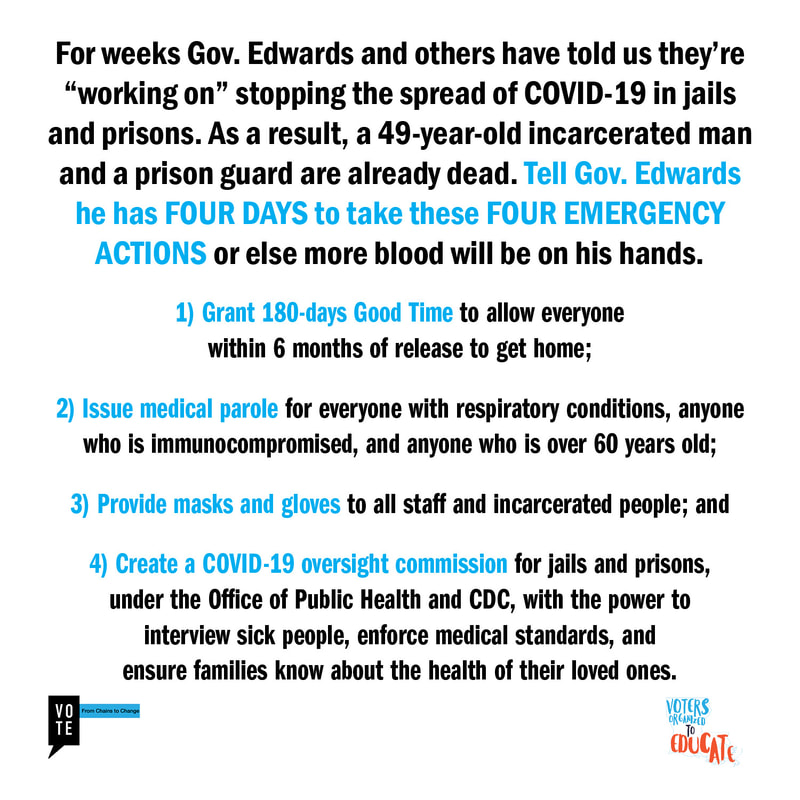
We DEMAND that IN THE NEXT FOUR DAYS, he does the followingFOUR EMERGENCY ACTIONS:
1) Grant 180-days Good Time to allow everyone within 6 months of going home to get home;
2) Issue medical parole for everyone with respiratory conditions, anyone who is immunocompromised, and anyone over 60 years old;
4) Create a jail and prison COVID-19 oversight commission under the Office of Public Health and CDC, with the power to interview sick people, enforce basic medical standards, and ensure families have a right to know about the health of their loved ones.
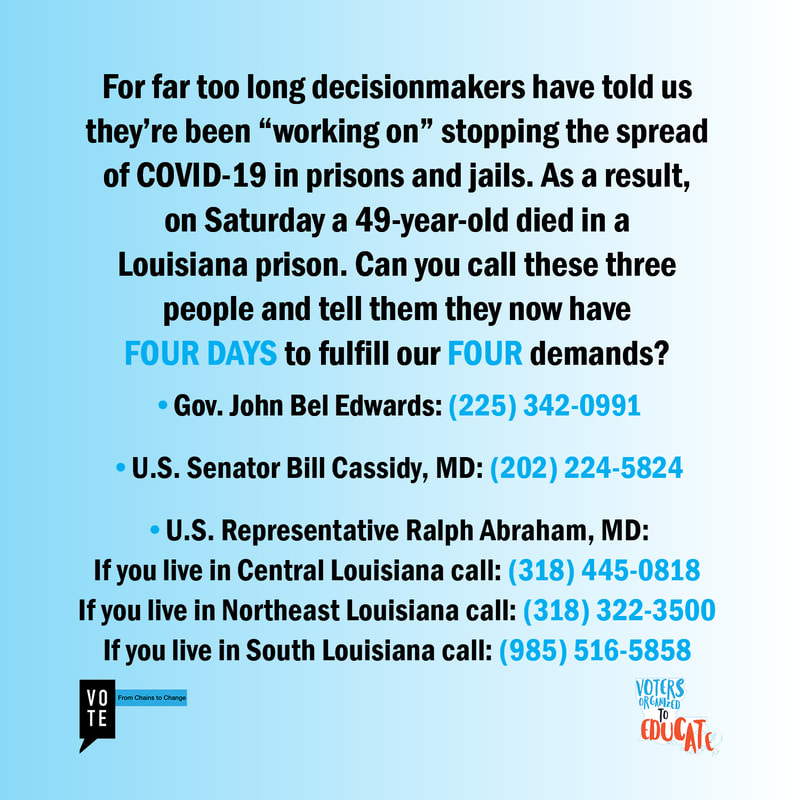
Can you help us make these demands by calling these three people today?
Gov. John Bel Edwards: 225-342-0991
U.S. Senator Bill Cassidy, MD: 202-224-5824
U.S. Representative Ralph Abraham, MD: if you live in Central Louisiana call 318-445-0818 if you live in Northeast Louisiana call 318-322-3500 if you live in South Louisiana call 985-516-5858
Read the full demands letter that we sent to the Governor here.
Thank you for taking action. We are sending you and your loved ones love, persistence and hope in these times.
I can still remember when I first saw you– a seemingly random night that brought a seemingly random discovery, was really Providence.
Wading into the depths of time to merge our storied paths. A small step back into history and there you were, sitting atop the town.
Gracious. Humble. Secret.
I immediately knew I had uncovered something special something secret some part of me.
You draw me closer to you. At first approach, I can feel you embrace me.
Warm. Inviting. Honest.
One deep look into you and you begin to whisper your secrets.
Though time has faded and chipped away You still gleam with beauty and elegance, Poised there over the city.
I see you grin as you take in all her stories and witness all her changes. Yet you remain unchanged, A timeless beauty.
Gilded. Golden. Graying. Gracious.
That place in my heart that I share with no one. My own private room of silence, solitude, and security.
I gaze up at you in our secret embrace and I am lost.
I do not know the year. I do not know the day. I do not know the hour. I only know here. I only know now.
You hear my fears and see my tears. When I am away from you, my heart sojourns back to you.
A stolen piece of history Spirited into my world With no judgment, no angst, no noise Only Grace.
Angelo D. Golatt is currently incarcerated at David Wade Correctional Center.
If you or someone you know is a currently or formerly incarcerated person with creative content to offer, please submit your materials to admin@vote-nola.org and we’ll be in touch! We’ll share the content on social media and always give credit to the artist(s) involved. Any type of submission–whether stories, poems, illustrations, music, videos or something else–are welcome!
First and foremost, we are here for you. These are turbulent times, and we want to remind you that we love you, we are with you, and we will get through this together. Here are a few updates on where things stand with our incarcerated loved ones and with for members at home.
Our incarcerated loved ones Most important, now is the time to bring as many of our loved ones in jails and prisons home.When the virus hits facilities, it will spread like wildfire among 2.3 million people. A federal lockdown that further punishes and tears families apart is not the solution. Rather, we demand that our elderly, anyone with existing health conditions, those doing time for nonviolent offenses, anyone in jail on technical violations or misdemeanors, and anyone in jail awaiting trial go NOW! We also demand that routine police stops, warrants, and any unnecessary arrests cease immediately.
This legislative session we’re introducing our most ambitious line up of bills yet. In order to win them, we need to show up at the Capitol as one strong and unified voice. That means we need more people with direct experiences of incarceration to speak up and speak out about the injustices they have faced. How? Check out these tips for successful advocacy, which work whether we’re sitting in one-on-one meetings with our elected officials, testifying in front of legislative committees, or making a speech in front of an audience on the Capitol steps.
1. Be prepared and brief. We can expect all types of questions about our bills from both our supporters and the opposition. On top of that, we usually only have a few minutes of a legislator’s time to gain their support. We need to know what we’re going to say and be brief with it! Instead of writing out a full script (which can sound too practiced or, worse, fake) we like to make a list of two or three main points to really hit home, sandwiched by a short introduction and conclusion. Legislators hear so many people speak about bills every day, so use a strong opening statement to really grab their attention. For example, the Justice and Accountability Center of Louisiana is lobbying for bill HB 344, which would ban prisons from putting pregnant women and people with mental illness in solitary confinement. In practicing her testimony for HB 344, which would ban the use of solitary confinement for pregnant women and people with mental illness, Shametria Gonzales opened with, “Ending solitary confinement isn’t only a moral issue, it’s a bipartisan issue.” This hard-hitting and concise phrase sets the tone for a powerful testimony.
2. Be honest. Our credibility is central to our relationships at the Capitol, so being honest in our conversations and testimonies is a must. There will be times when legislators ask tough questions about the facts of a bill. There’s no need to make something up or exaggerate anything. When we don’t know the answer, the best response we can offer is, “I’m not sure, I’ll find out and get back to you quickly.” Of course, our lived experiences are also our truth, and legislators who have never been incarcerated themselves need to hear them. As long as we stick to what we know, we will be successful.
3. Be respectful. Speaking of relationships: keep it real, but be respectful. This helps us form new alliances and maintain the old. Even though there are many legislators who might not understand or respect our movement, we never know who’s watching. For example, during committee hearings, it can be tempting to get up to the podium and clap back at a representative or senator who’s not on our side. But if we attack one legislator, we can lose the important votes of their friends that we need to get our bill passed. Phrases like “great question, let me explain” and “I can see where you’re coming from, but” go a long way towards making legislators feel heard, while not compromising our truth or integrity. Challenge the idea, not the person communicating it. Finding a shared value goes a long way, too.
4. Be yourself. The best thing we can do is to bring our whole selves with us to the Capitol. The building’s halls and chambers are filled with lobbyists who may be great at rattling off facts and figures, but they don’t know much about our lived experiences, if anything. As a community, that’s our greatest asset. “[VOTE] is bringing the directly impacted people,” says Rep. Ted James, the new Chairman of the Justice Committee. “Our personal stories are what move people and the needle.” This work can be tiring and make us want to not share what we know, but just remember that we all have each other’s backs. When we go to the Capitol as a Blue Wave, it’s not just to fight injustice, but to lean on each other in the process, too.
Ready to get engaged? Got all of the above down pat? Find a bill (or two or five) that you have experience with and get in touch about testifying. A few bill examples from the 2020 Session include:
HB 380 will ensure that someone who is offered a plea deal will be told all of the consequences they’ll face by agreeing to it. If you’ve ever taken a plea bargain and were not fully told ahead of time about how it would affect your ability to find a job, housing or go to school, this bill is for you.
HB 339 will give all incarcerated people, including lifers, a chance to go before the parole board and be considered for release. If you know someone doing life, or were once doing life yourself but got out on a new law, we need to hear from you!
The Fair Chance in Hiring Bill will reduce the number of barriers employers are allowed to set up against people with convictions. Right now, many job applications from people with convictions are tossed out as soon as the employer finds out about it. If this bill passes, employers will only be allowed to reject the application if the conviction is related to the job. “This bill would make it possible for people like me to get more than a minimum-wage job,” says Kisha Edwards, of The First 72+. If you’re in the same boat as Kisha, please consider testifying on this bill!
If you have experience with any of the issues we’re tackling this session, your story can help us win. Drop us a note at admin@vote-nola.org and we’ll get you prepared to testify when the time comes!
They say reading is fundamental, well what the hell is writing–essential? In school I didn’t know an adverb from an adjective. I knew a sentence had to have a subject and a predicate because Dr. Dre gave that to me in old school hip hop. But I could never get my subject and verb to agree–actually, I still have trouble making them not argue.
You may have seen a gangsta turn rapper, rapper turn movie star, but you never seen a thug turn writer, and thug does not mean brutal ruffian or assassin regardless of what Webster says. Thug means The Highest Under God.
To say that my inspiration to write came from my great love to tell a story is the farthest from the truth. Instead, I was in the hobby shop learning how to make clocks and jewelry boxes. I was getting good, and I was ready to start sending them home to get sold. My college friend had an account on Ebay and sold one of my clocks. This was how I was going to make the money, I thought. I needed to hire a lawyer and get home.
One day I was called to the Warden’s office. They told me to pack my stuff. I asked “where am I going?” They told me I was going to the dungeon. I’m like, “for what?” All they said was: “you know.” Completely baffled, I packed my stuff, went to the blocks, and sat there not knowing why I got locked up.
Two weeks later, I got called to an office. An investigator came to talk with me. He had a report in his hand, which he started to read. It said: “Prime Time told me to go to the McDonald’s in St. Francisville. His cousin was there and he gave me some weed and money. I was bringing Prime Time the weed.”
The report had a lot of Prime Time this and Prime Time that. When I heard this I was able to identify the young police officer who had given this statement. I figured he was under pressure at work so he was just giving them something. He had told them the play, but he didn’t want to tell on the actual player(s), so he used a nickname, and it just so happened to be my nickname. The officer probably thought the people reading the report would never find the person it was about, but that’s not how it works in prison. Even if they don’t know they’ll make it look like they know to avoid the appearance of stupidity. I knew who they were talking about, but that wasn’t my business to tell.
I told the investigator that I didn’t know what he was talking about, and if I did, I wouldn’t tell him nothing. The man gave me an angry look but quickly recovered. He said he respected that, me being a convict and all. I wasn’t a convict, though. I had just got to prison. I had been there for maybe six to seven months and was still wet behind the ears. If I were a convict, I would have known the next move.
When I went to court, they read the report. They had replaced every mention of Prime Time with Eyba Brown. I put in a motion to review the original report, but the motion was denied, and I was on my way to extended lock down [solitary confinement].
When I was in my cell I told myself that I couldn’t make money with my hands, so I had to make it with my mind. How was I going to do that? I sat in the dungeon for more than 60 days. But if you are in the dungeon for more than 45 days, they have to re-route you to a lesser custody status than you were sentenced to. That’s how I ended up in the working cell block, Camp C. I could have gotten out to play football, but I didn’t want to get stuck in the outer camp, so I made my move to get back to the main prison. As I said, I had only been locked up for a couple of months, so I didn’t know what I was doing. I ended up going to extended lock down for real this time. People stay there for years. You do nothing but sit in a cell for 23 hours. You get only an hour out of the cell each day.
In Camp C one of my friends was about to go to the main population to play ball for Camp C. Before he left, we walked the yard and strategized. He told me about a commercial idea he had that sounded like a short movie. As I sat in my cell on extended lock down I kept thinking about that commercial, and figured I could come up with a commercial, too. I started thinking about all the really good commercials I could remember and writing down my own ideas.
Eventually I was sent back to the main prison, C Block. There I met this dude who had a cousin who was studying film at USC. This dude would send his cousin movie scripts. He let me read one: “How to be a Player.” I remembered this movie, so as I’m reading the script I can see the movie in my head. I started writing scripts, too.
Math had always been my favorite subject because it has structure to it. Writing didn’t. Or at least I thought it didn’t. But I soon found out writing had a formula, too, and formulas are things I understand. My friend from LSU brought me some books on how to be a screenwriter. I wrote four movies and 10 commercials. I learned about the Writer’s Guild, got a list of agencies, and contacted my cousin in Atlanta because Atlanta had a great number of agencies. Only four of them, however, would take unsolicited manuscripts.
I gave my cousin the scripts for the movie Blast4Me and three commercials: Tag, Runaway, and First Kiss. He told me the commercials were Super Bowl-type commercials, and I gave him the addresses to the agencies. He sent the commercials to the agencies. Of the four agencies, two asked him to come in for an interview. But it was spring break and he went to Daytona Beach instead.
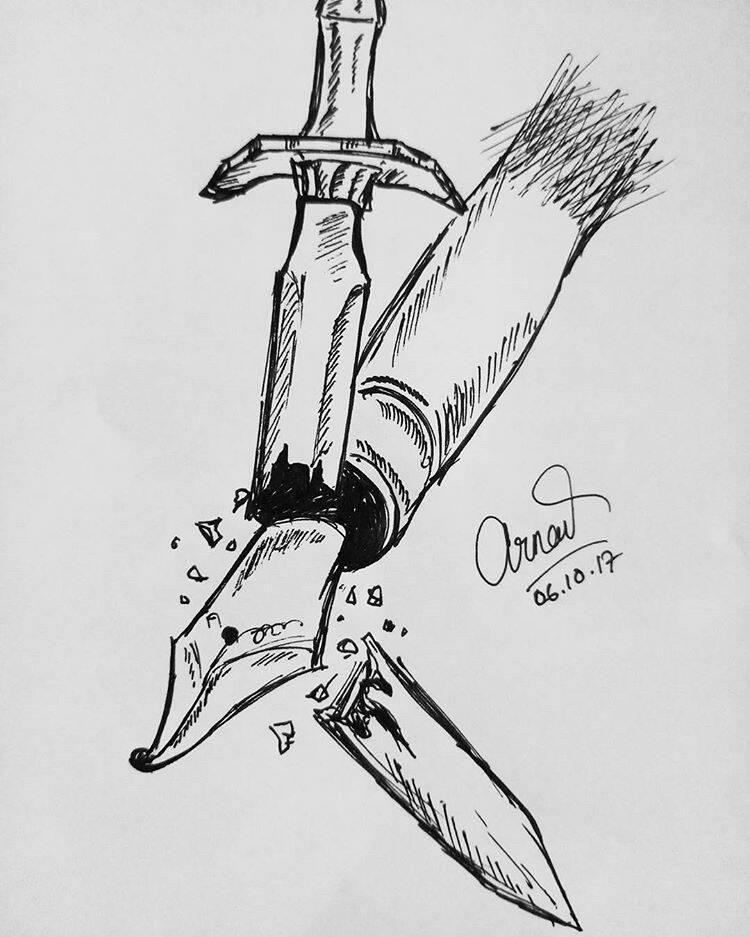
Of course the pen is mightier than the sword, unless you’re in a knife fight in which case you’d better have a Rambo knife. The pen is a mighty weapon, however, if you know how to use it. In prison you need an army, family or friend support to help your words get heard. And if you’re saying something, how mighty is your pen?
Eyba Brown is currently incarcerated at Raymond Laborde Correctional Center.
If you or someone you know is a currently or formerly incarcerated person with creative content to offer, please submit your materials to admin@vote-nola.org and we’ll be in touch! We’ll share the content on social media, always give credit to the artist(s) involved, and cover the costs of submission. Any type of submission–whether stories, poems, illustrations, music, videos or something else–are welcome!
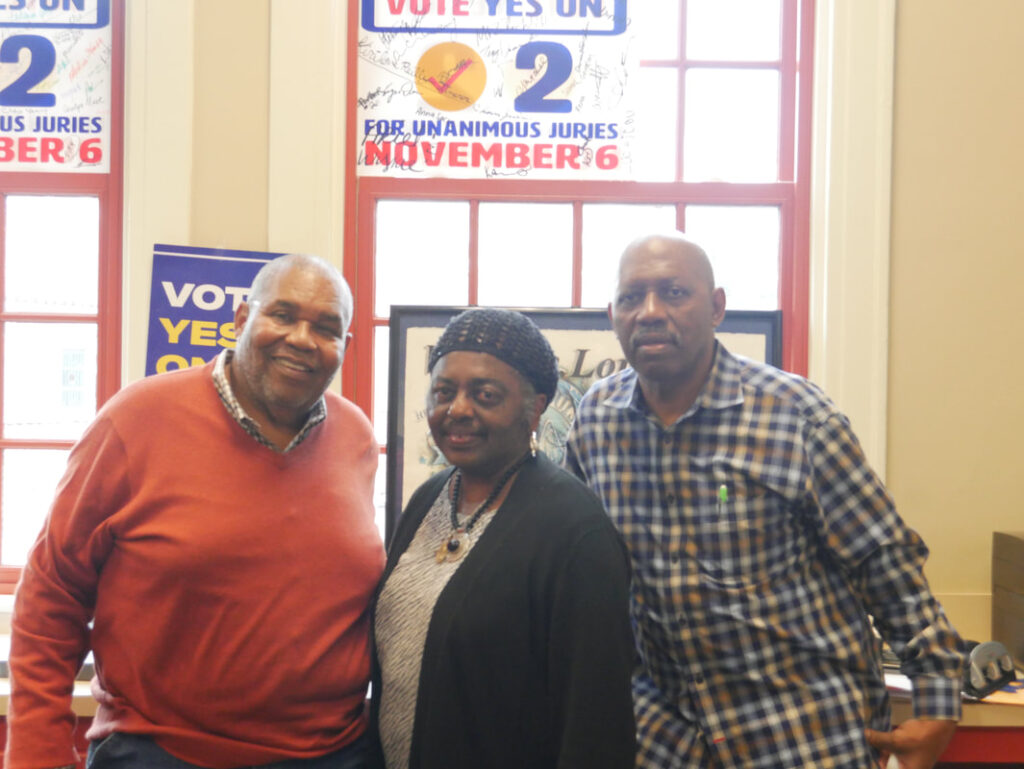
In fall 2018, former State Representative Naomi Farve visited Voters Organized to Educate Policy Director Checo Yancy (left) and our Founder and Executive Director Norris Henderson (right). In 1985, she was the first state legislator to sponsor a bill drafted by people serving life at Angola.
In the mid 1980s, our Founder and Executive Director was part of the Lifers Club at Angola State Penitentiary–a group of men who were told they’d never have a chance to come home. Refusing to accept this fate, they started to do research. Together the Lifers wrote to other people doing life in 10 Southern states, asking about their sentencing laws and reform. To the club’s surprise, they got responses indicating that so many states were fighting for the same reforms as our leader and his friends. They used the letters to draft a legislative bill that aimed to reduce the sentences of people serving life without the possibility of parole (LWOP). Hungry for change, they were disappointed to learn that they needed a legislator to sponsor and file the bill for them. So they wrote to Louisiana state lawmakers, but this time they didn’t get many letters back. Shortly thereafter, Henderson was sharing about feeling dismayed at the Lifers’ monthly meeting, which certain people on the outside were allowed to attend. When he had finished speaking, a woman sitting in the front row stood up. “My name is Naomi White Warren,” she said. “I’m a newly-elected state representative from New Orleans, and I’ll take your bill on for you.” The Lifers’ stories, voices, and perseverance inspired Rep. Warren (now Farve) to join their fight for freedom. “The excitement in the prison was off the chain,” says Henderson. Unfortunately, as that year’s legislative session went on, it was clear that the bill wouldn’t pass. Yet the bill was still a huge success, not only because it finally passed many years later, but because it was the first time in VOTE’s history that our people–the ones closest to the problem–organized to the point of changing the entire trajectory of their lives. Today we carry on this legacy by fighting for more bills and more reform at the Capitol. Every year, our collective voice gets stronger. Here’s what we’re fighting for this year, and how you can join us.
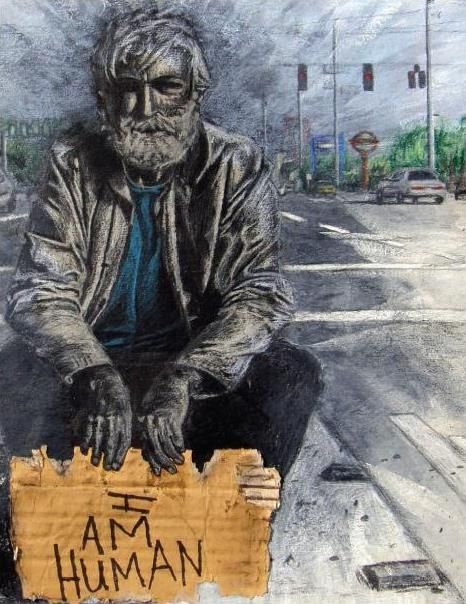
What do you know about four brick walls, and 15-minute collect phone calls?
What do you know about 20-foot-high wire fences?
What do you know about getting screamed at and told what to do, by an ‘authority’ figure who couldn’t walk a day in your shoes?
What do you know about having nothing to call your own? What do you know about having a four-foot cell with a pisser in it, and nothing to call home?
What do you know about having everything stripped from your life, and praying you don’t get stabbed when you try to sleep at night?
Before you pass judgement and say I chose my own path, let me take a second and give you some insight into my past.
What do you know about growing up below the poverty line? What do you know about your mother being gone for days, and you don’t have no idea where she went? What do you know about freezing in the winter because they’ve turned off the power? What do you know about going next door to the neighbor’s house just to get something to eat? What do you know about getting kicked out when you’re 16 years old? What do you know about being forced to sleep in the back of a van, or on the streets, because you have nowhere else to go?
So, before you pass judgement about a man you’ve never seen, Ask yourself:
What do you REALLY know about ME?
Aaron G. Kitzler is currently incarcerated at Angola State Penitentiary.
If you or someone you know is a currently or formerly incarcerated person with creative content to offer, please submit your materials to admin@vote-nola.org and we’ll be in touch! We’ll share the content on social media and always give credit to the artist(s) involved. Any type of submission–whether stories, poems, illustrations, music, videos or something else–are welcome!
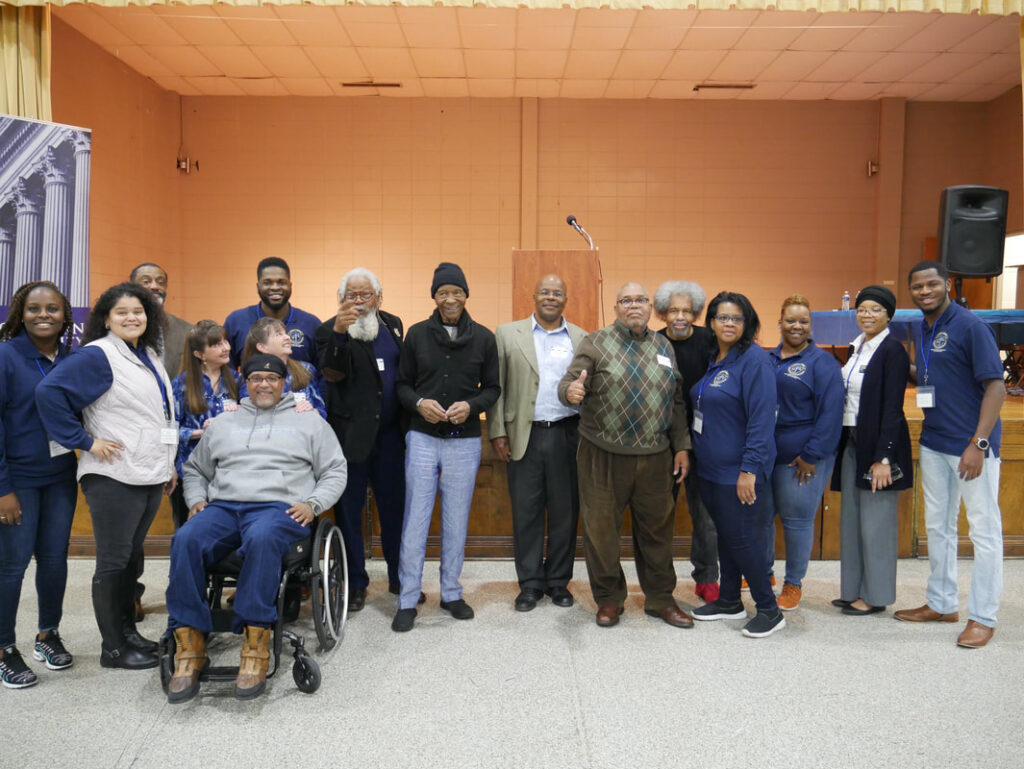
Louisiana Stop Solitary Coalition leader Albert Woodfox (fifth from right), Voters Organized to Educate Policy Director Checo Yancy (sixth from right), and Light of Justice Project Director Calvin Duncan (seventh from right) were among the many advocates at the summit.
Last Friday VOTE gathered alongside other justice reform advocates the inaugural Underground Railroad to Justice Summit hosted by Southern University Law Center. The day’s sessions spanned from current policy strategies to attracting media attention, but the resounding message from the summit was unified: our movement is strong, and it must keep growing in order to keep winning.
More than 25 Louisiana justice organizations came to the summit, proving the unstoppable power of our movement. Together we reiterated the importance of holding every part of the system that has locked us up and locked us out accountable.
Spending all my time, I’m looking for that perfection; I dare not stop for anything less…
Spending all my time, traveling the world for reflection; I dare not pause for anything else…
I’m looking for that perfect book, the one with the perfect rhyme; I’m looking for that perfect look, the complete and the sublime…
Spending all my time, I’m looking for the perfect smile; the one to fill my heart…
Spending all my time, looking for beauty worthwhile, a face defined as art…
I’m looking for that perfect song, the one with the perfect tune; I’ve been looking for you all along, the perfect woman to swoon…
I’ve spent all my time, all my time, looking blue, But I still have a lot more left, to spend with silly little you…
Won’t you spend yours as well searching? Let’s get to know each other; let’s ride across the universe, from one star to another…
Let’s spend all our time together as much as we can. Even as sunshine falls and stars appear, we shall dance, we shall dance…Searching
Jeremy Smith is currently incarcerated at Louisiana State Penitentiary (Angola).
If you or someone you know is a currently or formerly incarcerated person with creative content to offer, please submit your materials to admin@vote-nola.org and we’ll be in touch! We’ll share the content on social media and always give credit to the artist(s) involved. Any type of submission–whether stories, poems, illustrations, music, videos or something else–are welcome!