Even The Accused Have Voting Rights

Jan 13th 2026| New Orleans Times-Picayune, Editorial Board Opinion

“Some violations of civil rights occur not by design but by situations unforeseen by the law’s designers. When this happens, the correct response is to fix the law without fuss.

That’s what Louisiana lawmakers should do in the case of people who are in jail, but not yet tried for alleged crimes, who are not allowed to vote. Unless and until they are convicted, their right to vote and their practical ability to do so must not be infringed.

Even if only a tiny subset of the population is denied its legal right to vote, provision must be made to preserve that right.

A group called Voice of the Experienced filed suit Dec. 12 in the state’s 19th Judicial District Court about this problem. State laws intended to guard against voter fraud require voters who register online or by mail to cast their ballots in person if they’ve never voted before. Exceptions are made for the disabled and military personnel deployed away from home, among others.

Whether such a restriction is wise or necessary is subject to debate, but a one-time in-person rule is no more unusual than a requirement for someone to show up in person for a first driver’s license. The civil rights problem arises only in the law’s application to those in jail awaiting trial.

Because they are in jail, it is the state itself that is keeping them from showing up in person to vote. They are literally not free to comply with his particular voting law. Yet, at the same time, the combination of the 13th, 14th and 15th amendments to the U.S. Constitution makes it incontrovertible that, as unconnected citizens, they have absolute rights to vote.

Especially in a state that features jurisdictions with among the longest pre-trial incarcerations in the country – at some risk, by the way, of violating the Sixth Amendment’s right to a speedy trial – the problem of unconvicted inmates being unable to vote is very real. For example, the suit filed last month names Rachael Day, who has been awaiting trial for more than six years for alleged involvement in an armed robbery that turned deadly.

If Day did commit the crime, she deserves the punishment she would receive. But she should not lose her rights for a single week, much less for six years, without having her day in court.

To fix the problem would be easy. All lawmakers must do is add “unconnected people awaiting trial” to the list of exceptions (disabled, military) to the law requiring first-time voters to appear in person. After all, because they are in the state’s custody, the state already can verify their identities, which makes the possibility of voter fraud entirely moot.

It’s a simple problem with a simple fix, and lawmakers need to start fixing it on the very first day of the next session.”

Originally Published in print on January 13, 2026 in the New Orleans Times Picayune Opinion section as the Letter From The Editor (https://www.nola.com/opinions/our_views/editorial-even-the-accused-have-voting-rights/article_81a87b30-3b1a-4567-87f5-f90f853c1962.html)

What a Difference an Open-Minded Employer Can Make!  

By VOTE Members Julia Cass & Danena Williams

When Danena Williams came out of prison in March 2023 after serving 16 years of a 20-year sentence, she wanted to prove to herself, her friends, her family and the world that she was going to get it right. “I was young, 20, when I went to prison. I came home nowhere near that naïve girl I was then. I came home as an adult with education and ready to live life and achieve things and make up for the time that was lost.”  

Danena Williams pictured in the Diamond House with
Norris Henderson (Executive Director) and Ivy Mathis (Reentry Specialist)

She was fortunate to get a place in VOTE’s transitional living facility for women- Diamond House – where she got support services and was able to live without paying rent for six months.

“It’s once you start job searching and apartment hunting that you run into roadblocks,“ she said. “Everybody wants to know: Are you a convicted felon? People don’t want to give you a chance because of your past. You want to start over and do right and be a productive citizen but you run into all these no, no, nos. It’s very discouraging.” 

Danena ran into these roadblocks when she looked for housing. She said she viewed a number of different properties, met with the people renting them and “everything was a lovely experience.” She felt she was on the brink of being accepted several times but after her background check came in, she would get an email: We can’t rent to you. Finally, one landlord gave her a chance and, she said, she never missed a check or was late on the rent.

She did not hit a roadblock when she sought a job. She decided to apply at the IHOP on Carrollton Avenue, not far from Diamond House. While she was in prison, she took a number of courses and in one, she was certified in Serve Safe, a food safety course. She met with the general manager and said she had Serve Safe certification. “I was almost hired on the spot.” She started out as a server. After about a month, she was promoted to food chief and then assistant manager. When the manager left for another IHOP location, she became the manager. She has been manager there now for more than a year and has since hired six other formerly incarcerated women. 

Danena Williams, I-HOP manager pictured with Stacy, a Diamond House alum also employed at I-HOP.

“We hired her as a server and she exceeded that role,” said Dhiya Esmail, the manager who hired Danena. He is part of the family that owns several IHOP franchises in the area. “She had the qualities of a leader. For example, I said we wanted the (condiment) caddy set up in a certain way and she focused on not just her tables but the whole restaurant. She is a genuine leader. This was not something we told her to do. This was what she came in the door doing.” He said franchisees can set their own employment policies, and his family does not refuse jobs for any category of people. “We always like to give people an opportunity to better themselves.”  

Danena believes more employers should give formerly incarcerated people a chance in part for their own, business reasons. “That person you won’t consider could be one of the best employees you ever had – always on time, always dependable, whatever task you give them, they do 100 percent – then you miss out because you judged off the past.” 

Society benefits too when people coming out of prison don’t have the odds stacked against them from the start. “Most people don’t leave prison thinking, ‘I’m going to commit a crime.’ The circumstances can dictate what comes next. I don’t think people realize how much messages impact people. But it’s a bad message that when get out, you’re not going to be able to get a job because you’re a convicted felon.” Employment is also necessary to obtain housing. Even if landlords didn’t reject Danena because of her record, they would not have considered renting to her if she had no income. 

In the two years since she was released from prison, Danena has become a manager.  She earns extra money with Door Dash – “When I’m not here, I’m Door Dashing” – and now owns a home in New Orleans East. She said her parents, who live in Texas, are, “As proud of her as parents could be. My mom was very disappointed when I was incarcerated. They had great hopes because I was in college. For me, being home and being 100 percent out of trouble and getting everything established and achieving what I have achieved, it’s about making them proud.” Even though Danena cannot really make up for lost time, she said, she has been able to “come home and show, not just say, but show that I can still make something of my life.”

Danena proudly stands in front of her first home.
(Photo Credit – Catholic Charities Archdiocese of New Orleans)

Voter Fatigue? That’s the Point.

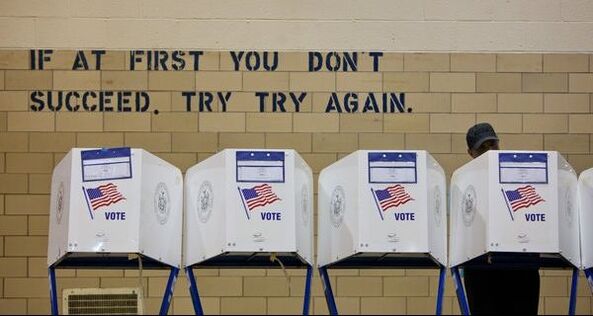
Voting booths lined up in front of a school gym wall stenciled “If at first you don’t succeed, try try again.” Photo: Todd Heisler/New York Times.

This year, Louisiana’s runoff election is December 5.

These “second round” elections are often for positions that directly affect our communities — jobs like city council, district attorney, and school board officials. Because of their local impact, they’re just as important as national elections. It’s also hard to win one of these races outright. 

Elections in Louisiana can only be won by “majority,” which means that a candidate has to get at least 50% plus one vote to win. In a race where there are more than two candidates, that’s nearly impossible — and that’s how we get runoffs

Runoff elections are part of the system of disenfranchisement built against Black voters during the Jim Crow era. The idea was if people had to go vote a second time for important races like governors, mayors, judges, it would “diminish the influence of Black politicians who could more easily win in a multi-candidate race with a plurality of the vote,” (source: Chicago Tribune.) In doing so, they would “preserve white political power in the majority-white state.” 

Continue reading Voter Fatigue? That’s the Point.

No One Man Should Have All That Power

February 2000, a fight breaks out in a hole-in-the-wall club in Slidell, Louisiana. It was an open mic night hosted by New Orleans rapper Mac “The Camouflage Assassin” Phipps, showcasing a crew of up-and-coming Black artists in front of a large and rowdy crowd. First came the sound of a smashing bottle, then a gunshot, and then a young man lay dying on the floor. Although a slew of eyewitnesses would come forward to police and identify another man as the one who pulled the trigger, St. Tammany’s infamous district attorney Walter Reed would convict Mac for the crime. 

Today, Mac is still imprisoned at Elayn Hunt Correctional Center. 

Illustration of Mac Phipps. Dale Edwin Murray/NPR.
Continue reading No One Man Should Have All That Power

5 Ways to Stop Voter Suppression This Election

VOTE Staffer Ariel Jeanjacques and other VOTE members rallying to spread the word about Act 636.

1. Vote early 
Voter turnout this election season has already broken record numbers. Thanks to the hard work of advocates, both early voting and vote-by-mail were expanded so that the polls would be less crowded on election day. Avoid long lines and other potential election-day nightmares by casting your ballot by mail or in-person before Nov. 3! 

If you are voting by mail, we strongly suggest that you request your ballot and send it back as soon as you can, keeping in mind that Oct. 30 is the official deadline. 

In-person early voting is from Oct. 16-27, except Sundays, from 8am-7pm. 
Your early voting location is different from your election-day location, so you can check your early voting polling place here.

Continue reading 5 Ways to Stop Voter Suppression This Election