
In Conversation: The School-to-Prison Pipeline “It Affects Everybody”

Featuring Amelia Herrera, Organizer, Voice of the Experienced (VOTE), and Dr. Matthew Green, Associate Professor of Education, UL Lafayette

Amelia Herrera: I’m Amelia Herrera, an organizer with VOTE — Voice of the Experienced — in Baton Rouge. I’m also an advocate and a mother. I’ve been doing criminal justice reform work and following the criminal legal system in Louisiana for about seven years now.

Dr. Matthew Green: My name is Dr. Matthew Green. I’m a VOTE member and an associate professor of education. I’m also the interim department head of the curriculum and instruction department at UL Lafayette. I’ve been working with VOTE for about five years. Part of my research and teaching is around the school-to-prison pipeline — how school suspensions and education systems push students out of educational opportunity and into the criminal legal system.


How are you both coming into this conversation today?

Dr. Green: I’m tired but energized. Anytime I come to work with a community like VOTE, it re-energizes me. Even though times are tough, I’m feeling inspired.

Amelia: I can say the same. I’m inspired and energized — especially around this subject. Though many of us know it exists, it’s not a well-discussed topic. So I’m glad we’re lifting it up.


Why did you each want to be part of this conversation?

Amelia: I grew up in New Orleans, graduated high school, and went off to Xavier before eventually moving to California. When I came back home and had kids of my own, I took a look at our school system and was alarmed. There was a stark difference from what I was accustomed to raising my kids elsewhere. I kept thinking — why isn’t anyone paying attention to this?

Dr. Green: For me, it was moving to Louisiana and seeing the carceral nature of how this state approaches almost everything. People often think schools and prisons are the antithesis of each other — but Louisiana is the only state I’ve ever lived in, taught in, or done work in where there’s a person at schools with the job title of disciplinarian. Everywhere else, discipline is one part of a role. In Louisiana, there’s a person devoted specifically to punishment. That stark contrast from how other places approach schools is really how I came to this work.


How would you define the school-to-prison pipeline?

Amelia: I’d identify it as a systemic process — a way of pushing marginalized communities, specifically Black and brown youth, into the incarceration system. It’s a pipeline. All the pieces are systematically put together so that incarceration becomes the most accessible path — sometimes the only visible way out — for many in our communities. Intentional, systemic, and closed-box syndrome.

Dr. Green: I explain it as the policies and processes that push students out of educational opportunity and into the criminal legal system — things that favor incarceration over education. And I use that phrase deliberately: favor incarceration over education. If you look at the funding in Louisiana, there’s far more money per capita going to our carceral systems than to our education systems. When you give more money to something, you’re showing that you favor it over something else.


What do you want people to know about this topic that they might not know?

Dr. Green: The thing I want people to understand is that it affects everybody. It affects your child’s school. It affects kids and adults across the full age spectrum. When we talk about the school-to-prison pipeline, we’re not just talking about teenagers. We’re talking about kindergartners who are arrested at school, punished, denied educational opportunity. We’re talking about adults who were pushed into the criminal legal system years ago. And we often associate this issue with schools in dangerous neighborhoods or certain parts of town — but the way it operates, it affects every kid in every community, because every student is under the same umbrella. The same systems that either provide educational opportunity or push people out of it work across Louisiana and across the nation. It is not one school, one community, one isolated instance.

Amelia: What I want people to know is: what are the identifiers? What should we look for? Coming from a Black mother — it starts as young as third grade. A lot of people in our community don’t know that. Everyone looks at the middle school and high school years as the primary danger zone, but the pipeline goes all the way back. The marks teachers put on your child’s record in pre-K, kindergarten, first and second grade — those are determining their future. You can be involved. You can ask for your child’s records. You can show up and ask questions. Just because someone is a teacher or administrator doesn’t mean they have your child’s best interest at heart. I want people to identify this big, ugly system that is locking our kids up.

Dr. Green: I want to add — it sounds simple, but: kids don’t suspend themselves. That requires a teacher, an administrator, a decision by an educator. One of VOTE’s most important principles is that those closest to the problem are closest to the solution. Once teachers start identifying that they are in control of many of these outcomes, we can begin working with parents, students, and communities toward real solutions.

Amelia: And we also have to look at what teachers are bringing into the space — predisposing biases, assumptions about how a child looks or how they show up. For a Black child, the default response is often to punish rather than support or encourage. Teachers aren’t always culturally cognizant of what each student from a different neighborhood or household is carrying when they walk through that door. And they’re going to demonize these kids without even knowing what they’re dealing with.

Dr. Green: And teachers aren’t always coming from the communities that their students come from. They don’t always understand the history and context of that community.


What are some common myths about the school-to-prison pipeline?

Dr. Green: The myth I always focus on is that the punishment fits the infraction. There’s a well-known study out of Tulane — done about six years ago — that looked at school suspensions across Louisiana and examined the disproportionality. It found what is found nationwide: three groups are suspended more than any other. Not that they commit more infractions — they are suspended more. Those groups are Black and brown students, students in special education, and students in poverty. What was most striking: a Black student and a white student can get into the exact same fight with each other, and on average across Louisiana, the Black student is suspended one day longer. Most suspensions in this state are for nonviolent offenses. Not contraband, not weapons, not fighting — but subjective things: disrespecting a teacher, questioning authority, insubordination. Things that require a teacher’s judgment. And even when the infraction is clear-cut, we see disproportionate suspensions along racial lines.

Amelia: I always bring it back to community. Take two kids — James and Tommy. James is a Black child from a two-parent home. Tommy comes from an abusive household. They’re in the same classroom with the same teacher. Tommy is carrying trauma that James isn’t carrying. If James doesn’t act out and Tommy does, why isn’t there support for Tommy? Because no one knows — or cares — what Tommy is going home to. So teachers start marking him as disobedient, unable to grasp the material. The records pile up. The child gets discouraged and stops wanting to go to school. Then you have truancy. And there are officers in the schools now. That is a direct pathway to the incarceration system.

Dr. Green: That’s a perfect description of how small infractions become systematized — repeated over time, put on records, escalating punishments, until kids don’t want to go to school. Or they get kicked out. Why would you go to school if it’s a hostile place toward you?

Amelia: I met a parent whose son was on the spectrum. She didn’t have the tools or resources to support him properly, so she hoped the teachers would catch it. The teacher didn’t — she ridiculed him in front of the class. So he wrote a note to the teacher, something he’d seen on television. The teacher took it to the school resource officer. Instead of recognizing a child crying out for help, it was treated as a criminal matter. That child now has to report to the juvenile detention center. He has a full record. Because of one outcry that no one knew how to answer.

Dr. Green: This is why I always teach that all behavior is communication. The behavior of kids who sit still and silent, the behavior of rambunctious youth — it’s all communicating met and unmet needs. The school-to-prison pipeline is what happens when the response to those unmet needs is punishment: demerits, paperwork trails, infractions, suspensions. All negative consequences rather than care.


What does summer mean for youth in Louisiana, in the context of all this?

Dr. Green: Before we get to summer, I want to name something. VOTE member Ronald Marshall championed a bill a couple of years ago about mental health screenings for anyone entering incarceration. For many people, that is the first mental health screening they have ever had. When we talk about under-resourced schools, when we talk about Amelia’s story of that child — if going to prison is the first time someone receives a screening for trauma or mental health needs, it is way too late to change the course of that person’s life.

Amelia: What summer looks like to me — I’m going from this conversation to a budget hearing where they’re giving more money to the Baton Rouge Police Department. Our communities are already being over-policed. Juveniles roughly ages 8 to 16 have nothing to do. No parks to go to. No mentorship programs. Where are the Boys and Girls Clubs? So these neighborhoods are over-policed, officers already arriving with assumptions about who these kids are. Meanwhile, the pull of the street is real — especially for a child whose parent is too busy surviving to be home, who has no clean park, no structured activity, nothing to do but sit on the porch. A police officer sees that and calls it a threat. Not knowing that if you gave that child a basketball, a safe park, a resource — the outcome could be completely different. It’s intentional. I see it as intentional. There are police cars parked throughout certain neighborhoods, and when I cross to the other side of town, they’re nowhere to be found.

Dr. Green: From an educator’s perspective, if people could compare what summer looks like for different children across Louisiana, it would be staggering. Some children have summers full of enriching experiences: academic programs, summer camps, structured and unstructured play, great parks, tons of opportunity. Others have the complete opposite. And that is a strategic, purposeful decision. Louisiana loves to talk about community — but where we draw the lines of community matters. Because if we’re truly a community, we should be taking care of every child in this state. Which parks get funded. Which sports leagues. Which neighborhoods. The decision to defund programs, remove parks, eliminate spaces where people can gather — and then at the same time complain about young people being on their phones — you took away all the other spaces. And when you layer surveillance systems and police monitoring only in certain neighborhoods on top of that, you’re going to arrest more people in the places police are. This is a layered system that starts with decisions that don’t seem to be about schools or prisons at all — and yet they determine children’s lives and opportunities.


What solutions do you see? What are you working toward?

Amelia: I’m going to go back to community. There’s an intersectionality here that we can’t ignore. In EBR Parish, roughly 38% of Black and brown children in impoverished communities — about 72% of them are being pushed down the pipeline. That’s alarming. So what happens on the back end? Fully incarcerated people coming home — they are mentors. They can go in and talk to at-risk youth and say, this is not what you want. The parent is too busy surviving. The teacher has already given up. Someone has to care. Pull on your community. Pull on the ones who’ve seen it, done it, been there. Because the people governing are not prioritizing this — they’re closing schools and building prisons. We have to demand that money come back to the community. Educate impacted communities to know: you don’t have to accept this. You can go to your child’s school and ask questions. You can advocate for your child. Who said you had to listen to what that resource officer said? That is your child.

Dr. Green: From a school perspective — the easiest, most concrete solution is: stop suspending students. There are alternatives. Even one suspension increases the likelihood of a child interacting with the criminal legal system by 50%. Avoiding that first suspension is critical. But the bigger battle, and for me the most viable long-term solution, is changing the mindset that children deserve to be punished. It is pervasive. One of the first classes I taught in Louisiana, students asked me: “Dr. Green, if you don’t punish a kid, how will they learn?” That was eye-opening. There is a deep-seated notion that punishment is right, deserved, and produces positive outcomes. That same mindset drives the adult incarceration system too. But in schools, with children, it is toxic — it hampers educational opportunity and life opportunity. When you break it down and ask someone: do you really think a five-year-old deserves to be kicked out of school? It sounds ridiculous. But that is what is happening. To kindergartners, to third graders. The things we do to high school students — who we too often see as adults rather than children — we also do to the youngest kids in our schools.


Any final takeaways?

Amelia: I want to say — we need bridges between community members and experts like Dr. Green. This issue is so prevalent, but it isn’t discussed. If you don’t know what to say or how to go about it, go to the experts. Let them show you the way. Something needs to be done, and something can be done.

Dr. Green: To anyone listening — the first step is holding up a mirror, for yourself and in your conversations with others: What are you willing to accept, and what are you not? The reason we have a school-to-prison pipeline is because as a society, we have accepted far too many children being suspended, punished, pushed out. We accept it because we think they deserve it. That is a harsh and damning critique of our society. And my last thought: if we are willing to do it to children, we are definitely willing to do it to adults — and worse.
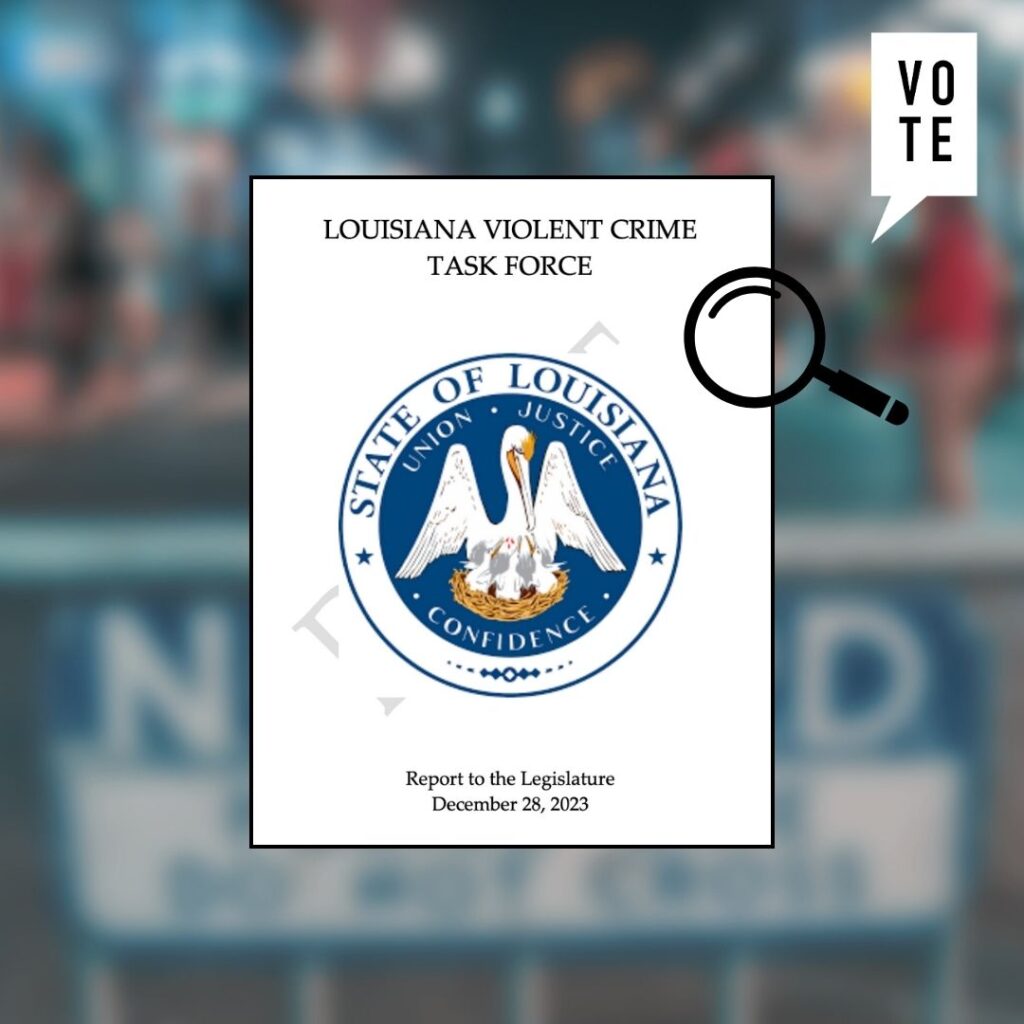

VOTE Responds to LA Violent Crime Task Force Report

Dear Members of the Violent Crime Task Force (VCTF), 

Thank you for posting the Draft Report under HR 168. After thoroughly reviewing the report and examining the data in the public folder, please find the comments from Voice of the Experienced (VOTE) below, addressing specific sections of the Draft Report: 

Addressing Violent Crime 

The purpose of the HR 168 task force is “to study and evaluate recent legislative reforms to the Louisiana criminal justice system and the effects of such reforms on public safety and crime in Louisiana,” and make legislative recommendations for “criminal justice reform that reduces crime and recidivism in Louisiana while improving public safety and strengthening our communities.” However, the task force falls short by focusing on only a few reforms, neglecting hundreds of others, and potentially misinterpreting data. This narrow focus, combined with the conflation of data sets, leads to questionable and dangerous conclusions about the relationship between sentencing reforms and new crime. 

Importantly, the VCTF crunches two data sets together, incarceration and crime, and implies a causality that has not been proven. The task force erroneously correlates the rise in crime with an increase in parole, implying causality without evidence. First, you would need to show that there are more people on parole (there are not) and second you would need to show that these people on parole are at the heart of a spike (you have not). In fact, members of the VCTF have claimed that there are not enough parole violations. 

There are two types of reasons someone on parole can be returned to jail or prison, for a “New Crime” or for a “Technical Violation.” The first one will get their parole revoked along with an additional new sentence. The second, a technical violation, is when there is no new crime, but they violated the terms of their parole- often related to living conditions, jobs, travel, or a failed drug screen. Technical violations do not drive up crime rates. Sometimes such people will have parole revoked and sometimes they will get “sanctions” of several days in jail. 

The VCTF also fails to distinguish between “all crime” and “violent crime.” It is well established that people who have four or more felony convictions are nearly always those people who struggle with mental health and/or addiction. Often, such people will have no victim in their cases other than themselves, and potentially low-level property offenses. It appears that the VCTF’s goal is to lock away the problem and not seek to address it. It would be negligent and backwards if Louisiana’s best solution to mental health and addiction issues is incarceration in the form of psych prisons and addiction prisons. 

The VCTF possesses more data than a “hunch,” as to the relationship between sentencing reforms and new crime. There have been no changes in the law that prevent a prosecutor from charging someone with a violent crime, regardless of whether they were 12 years old or convicted five times before. 

The task force suggests punitive measures without addressing root causes, such as mental health, addiction, poverty and lack of tools for conflict resolution. Instead of proposing solutions, it leans towards incarcerating individuals without considering alternative interventions. The need for programs that mediate disputes, provide outlets for children’s anger, and offer support to struggling families is crucial. 

To tackle violent crime effectively, the legislature should focus on addressing the underlying factors that contribute to criminal behavior. This involves creating decent job opportunities, affordable living conditions, and accessible mental health resources. The desperation of poverty creates a confined list of poor choices. When someone’s parent(s) are incarcerated, or struggling with poverty, mental health, or addiction: those children get a daily education in a harsh world. There is a reason that most of the violence is perpetrated by young people whose minds are not fully developed, and who have a limited view of the possibilities. They act impulsively and are often put in dilemmas far beyond their years to navigate. 

If the legislature is serious about preventing violent crime, it is critical Louisiana political leadership call upon people with firsthand experience in violence and its consequences. Impacted people are not just credible messengers to reach young people acting out of hopelessness and anger, Louisiana needs their insights as to how we can address the critical factors that can save lives. Humans are not robots to program or dogs to whip into submission. We are complex emotional creatures, and we will all sink or swim together. 

Addressing specific parts of the Draft Report: 

  1. Has violent crime gone up, or has the Legislature simply labeled more crimes as “violent?” 

First, it should be noted that crime is down from last year, across Louisiana and across the nation. For example, New Orleans has seen such dramatic decreases in violent crime between 2022 and 2023:     

  • Homicides decreased by 27% 
  • Carjackings dropped by 43% 
  • Armed robberies were down by 35% 
  • Nonfatal shootings decreased by 23% 

All of these improvements occurred while the New Orleans Police Department has been experiencing an unprecedented staffing shortage. This suggests there is less connection between law enforcement and violence as some would believe. And although some equate the crime spike coincided with the COVID-19 epidemic to “less policing” or “delayed trials,” the more thoughtful connection is regarding employment, housing stability, recreational activities, school closures, and more. 

Statistically speaking, violent crime data will inherently change if we redefine “violent crime.” Many citizens would likely be surprised to learn that Louisiana classifies 60 offenses as “violent crime.”  These offenses include high profile and extreme scenarios like murder, rape, and robbery, but also lesser offenses such as 2nd degree battery, violating a protective order, and possession of a firearm (in certain circumstances). Re-classifying crimes into the “violent” category of R.S. 14.2 does not make crime go up or down but does create apples-to-oranges comparisons over time. If there were 40 crimes, for example, in 2004, then a twenty-year comparison would be adding 20 new offenses to the data set. 

According to the 2022 JRI Report: 

  • The largest increase in Types of Crimes is “Possession of Firearm by Felon” – from 1,028 (2016) to 2,009 (2021).  Because this is categorized as a “violent crime” under Louisiana R.S. 14.2(57), it creates a significant uptick in “violent crime” whether a person was harmed by the firearm or not. As a staunch 2nd Amendment rights state, it is unclear what impact that culture has on gun ownership. 
  • By contrast, the next largest (and one of few) increases by crime type was Possession of Schedule II Drug, from 926 to 1,427, respectively. Roughly half the increase of the possession of a firearm. 
  • 1700 people were sentenced to probation for “violent crimes.” This indicates prosecutors and judges agreed that the offense, although classified as “violent,” was not so egregious as to warrant imprisonment (although surely many served multiple months in pretrial detention before their probation sentence). 
  1. Several Draft Report claims do not seem supported by the data 

The report reads: 

  1. “Length of time served by an inmate is actually less than 15% of their actual sentences.”  

According to the DPSC Table 1.f “Time Served,” and Table 1.e “Sentence Length,” we get a snapshot of incarcerated people, but not the percentage of their overall sentence served upon release. If the VCTF can point to a specific data point revealing this 15% number, please do. 

Among those incarcerated: 

  • 60.4% served 0-5 years  
  • 14.1% are 6-10 years 
  • 25% served over 10 years 

This leads us to another peculiar statement in the Report: 

  1. “Moreover, the data shows that less than 5% of Louisiana’s prison population is serving more than thirty years.”  

How is this remotely true, when the data clearly shows 11.3%?  [See Table 1e]  

  • 6.6% are serving 0-2 years 
  • 7% serving 3-4 years 
  • 29.7% 5-10 years 
  • 19.8% 11-20 years 
  • 25.3% 21-30 years 
  • 7.7% 31-50 
  • 3.6% 51+ 

The statement is especially misleading when an additional 25% are sentenced between 21-30 years. Thus, well over a third are sentenced to longer than a generation.  

Continuing the odd choice of data: 

  1. “[T]he average time served by a violent offender is less than six years.” 

This should be changed to, “among those released on a violent crime, they served an average of 64.3 months on a sentence averaging 122.9 months (about 10 years).” The sentence may need an * as the data in the 2022 JRI Report (p. 46, Table 15) may be omitting Life Sentences and discretionary parole altogether. This is nowhere near the 15% figure noted above. 

Additionally, only 17% of people released from prison are for violent offenses.  

The average time served before discretionary parole on violent offenses is 261.3 months, or nearly 22 years. This is only a few dozen people. Perhaps the VCTF can calculate the time served prior to death within the data. 

III. Recidivism data matters- and Report claims need support 

A. “55% recidivism for Habitual Offender class after 5 years.” 

This statement deserves context. 

As the table below [compiled from various data tables DPSC provides] indicates, all recidivism has gone down over the past decade, with some sub-populations dropping more than others. While 4th offenses is at 55%, 3rd offenses are only at 24%. It is also unclear by the DPSC data how many people fit this most extreme data point. And as noted above, people in this class are typically saddled with an addiction or mental health situation that requires treatment to overcome. 

People who have served over 7 years in prison have less than 3% recidivism, with those who spent over a decade at less than 1%.  Considering the average release time on a violent offense is over 5 years, there is certainly a significant overlap here. This erodes the notion that “violent recidivism” is a driver of incarceration growth or spikes in crime. 

People released after violent offenses have lower recidivism (37%) than those released on nonviolent offenses (40%), on a consistent basis over the years.  

The recidivism rooted in education completion has had the most drastic impact (from 44% down to 29%), likely attributable to both the quality of education available and the expansion of opportunities over the years (such as licensing reform and Ban the Box policies), including policy reforms attributable to a bipartisan Louisiana Legislature. 

The parole board has 22% recidivism amongst a tiny sample, while the massive number of people completing Probation or Parole (20,188) have just 12% recidivism. 

The gap between getting out of jail vs. prison is growing, with people having more success leaving the latter. This likely stems from the programming, education, and recreational activities in prison. 

Population Subset  2012 Releases 5th yr Returns 2017 Releases 5th Year Returns 
Total Releases (baseline) 14,487 43.6% 14,460 40.3% 
GoodTime Parole (auto) 11,808 45.1% 12,620 41.5% 
NonViolent Offenses 11,943 44.4% 11.833 40.9% 
Education completion 1,345 44.7% 974 29% 
Released Local Jail 8,441 46.2% 9,566 43.3% 
Released State prison 3,080 43.4% 2,197 35.3% 
Completed P&P 19,017 15% 20,188 12.9% 
Work Release 2742 37.7% 2,849 36.4% 
Parole Board 825 38.5% 288 22.2% 
Violent offenses 2,551 40% 2,627 37.6% 
Under 1 yr served    51.6% 
1-3 yrs    32.4% 
3-7 yrs    11.7% 
7-10 yrs    2.7% 
Over 10 yrs    Under 1% 
Jefferson P.    31.7% 
Orleans P.    33.7% 
EBR    36% 
Caddo    45.7% 
Livingston    46.2% 
1st Offense    4.7% 
2nd Offense    16.1% 
3rd Offense    24% 
4th Offense   55.2% 

Livingston (20.8%) and Ouachita (22.8%) Parishes have nearly double the Statewide 1st year recidivism (13.8%), which is 5% in Orleans and 8.8% in Jefferson, suggesting that access to resources plays a major role in stability. Among the DPSC listed parishes: Bossier, Lafourche, Ouachita, Rapides, Terrebonne, Caddo, and Livingston all have over 41% recidivism after 5 years. 

According to the Draft Report:  

B. “LDAA shared that 55% of 1,948 people who benefitted from early release under JRI were arrested”  

Louisiana District Attorneys Association (LDAA) data set was not provided, or not posted to the Task Force folders. 

Arrests are not convictions, nor are they P&P violations (although they could be), as people carry the presumption of innocence. It is troubling that government lawyers would provide such data when they could easily provide conviction or revocation data instead, as DPSC has done. 

2017 release data (above) shows 14,460 people; meaning that 12,512 people were released without the benefit of JRI. Thus, 86% of the people released did not get the benefits of JRI reforms. And those who got the “benefits” mostly were released a matter of weeks or months earlier than otherwise. There is ZERO spike in 2017 recidivism data, and this is part of a consistent trend over the previous decade. 

Similarly, where is the LDAA data that indicates:  

C. “1/3 of those [1,948 JRI impacted] released had been arrested for violent crimes and sex offenses.”  

Is the point of this to mean they were originally in prison for violent or sex crimes, and JRI reforms allowed them to be released weeks or months sooner? Or is VCTF/LDAA stating that over 600 of this specific cohort has been re-arrested for one of the 60 violent crimes or a sex offense? It is unclear, but again: arrests are a poor form of data when believing in the legal system that relies on either a guilty plea or a trial conviction. This data is not in the folder. 

  1. “JRI reforms, which made it much more difficult to revoke an offender’s probation of parole sentence for violations of their supervision, led to an approximately 50% reduction in probation revocations between 2016 and 2020.” 

What specifically made it “more difficult?”  

Fewer revocations may also mean fewer violations of supervision. Would the Task Force be satisfied if revocations were trending upward, thereby implying supervision does not work? 

According to the 2022 JRI Report: Probation revocations for New Criminal Activity have steadily declined from 1,133 (2016) to 836 (2021). Other revocations have similarly declined (GTPS, Parole, Technical Violations). (p.12 Fig. 4) 

The average sentence length for new felony admissions (for those on supervision) is 64.5 months (about 5 and a half years). This implies that many must be sentences under 5 years, including many nonviolent crimes. 

The shortest stint are technical probation violations (no new crime committed)- averaging 49.3 months in 2021. Thus, a technical probation violation and a new felony admission are (on average) only 15 months apart. GTPS revocations are 85.4 (2016) and 58.5 months (20, respectively, in 2021. (Fig. 12) 

Habitual Offender sentences decreased, but the length stayed relatively stable. In 2016, 466 sentences averaged 124.8 months. A decline in usage at first saw a spike in sentencing, then 2021 dropped to 89 sentences averaging 119.4 months. 

Juvenile Crime 

Regarding juvenile violent crime, it is impossible to assess any changes without breaking out crimes committed by age group. From 2016 to 2023, the number of juveniles adjudicated of a violent offense increased from 1,408 to 2,199. Were those seven hundred 17-year-olds? 

Did 17-year-olds commit MORE crimes after being moved into the juvenile system? The same? Fewer? Of course, all the numbers went up. First, Louisiana moved the most criminally active of all age groups under 18 into the juvenile system. Second, Louisiana made no changes in the number of judges, lawyers, and carceral facilities despite years of phasing in the “Raise the Age” legislation. 

Conclusion 

Based on the data provided, the past decade has seen a reduction in both crime and punishment. We should not legislate based on salacious stories and extreme examples. We must work to create more opportunities for people to become better people and then accept them back into our community when that happens. It is the only way to reverse cycles of trauma, poverty, and violence. 

Sincerely,  

Bruce Reilly 

Deputy Director 

Voice of the Experienced 

New Hope for Hundreds of Incarcerated People in Louisiana: LA v. Harris Ruling Summary

Louisiana’s Supreme Court building. Photo by WAFB9 news.

In 2008, a judge sentenced Derek Harris to 15 years for selling a $30 bag of cannabis. Sound extreme? If Harris hadn’t had a record, he surely would not have gotten 15 years for this small-time drug sale. But those 15 years were not enough. The district attorney in Harris’ case took it a step further and filed to have him classified under the habitual offender statute. With one court filing, Harris’ past convictions, which he already paid the price for, were used against him yet again to sentence him to life without parole (LWOP). Harris, like so many others labeled by the (in)justice system as Habitual Offenders, was sentenced to death by prison. Harris started the arduous appeals process, desperately pleading that some judge, at some level, recognized that dying in prison was too extreme. He hoped they would agree that only a bad lawyer could have let this happen. Thankfully, even between uninspired lawyers and bureaucratic red tape, Derek’s latest lawyers (the only good ones) convinced the Louisiana Supreme Court (LASC) to overturn their previous decision. With their ruling out last week, on his sixth stage in his process, he won the opportunity for his case to be reviewed.

The ultra-punitive nature of prosecutors and judges is only one part of the courtroom equation that explains why Louisiana leads the nation in mass incarceration. Other parts include (a) defense counsel, and (b) restrictive appellate rules that can block even the most unconstitutional actions from being reviewed.

The LASC ruling declared that appellate judges CAN review errors during sentencing, including ineffective assistance of counsel. This is a major victory in creating fair appellate rules–but how many people will be able to benefit? It will take a few more cases to test the boundaries of this ruling, but our calculation is that those who tried to get their sentences reviewed (including when judges wrongfully thought the application of a Habitual Offender sentence was mandatory) but were categorically barred from raising the issues, will have a new window for appealing their case. For those people denied under Meline v. Louisiana (1996), they may have a year to build and file their case. While ultimately this is TBD, impacted people should seek legal advice.

Keep reading for a deeper dive into the legal analysis of this case. 

Continue reading New Hope for Hundreds of Incarcerated People in Louisiana: LA v. Harris Ruling Summary