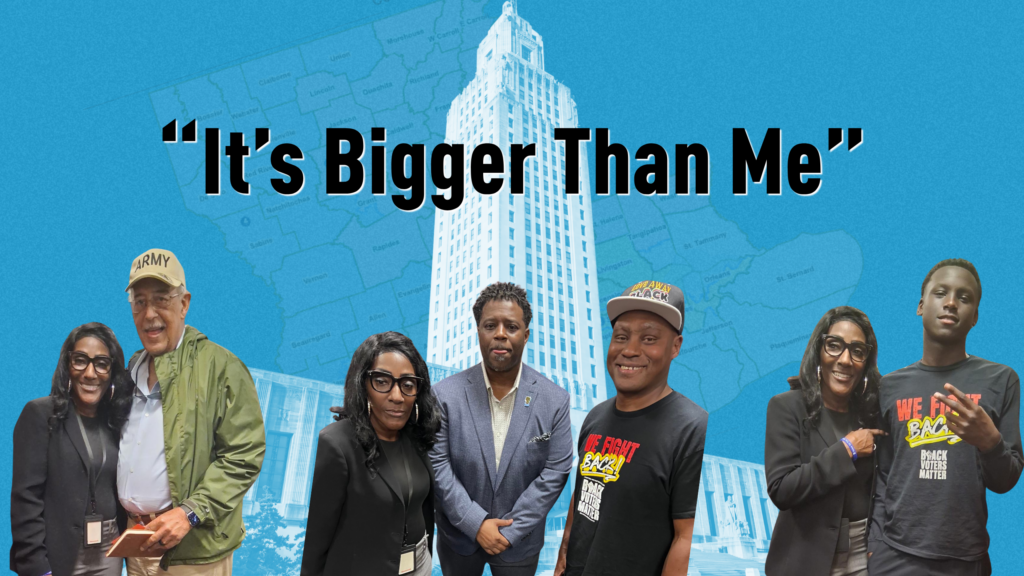
There’s a feeling you get the moment you walk into the Louisiana State Capitol.
It starts before you even reach the committee room.
You walk in, you get checked in, you nod at the familiar faces at the front desk—but once you get past all that, something shifts. The air gets heavy. The building itself feels like it’s telling you: you don’t belong here.
And if you listen too closely, your mind starts to echo it.
What you have to say doesn’t matter.
They’re not going to listen.
You should just leave.
But my feet keep moving anyway.
Up those hard stairs.
Down those long halls.
Into rooms where decisions are made about people’s lives—about my community, about families I know, about the people still locked behind walls and fighting systems that weren’t made to protect them.
Systems that were never broken—systems that were built to break people.
Every time I walk into a committee to testify, my body goes into fight or flight.
My hands tremble.
My chest tightens.
Everything in me says: turn around, walk out, run.
But there’s something stronger than fear.
It’s the commitment I made to the people I serve.
It’s the faces of the families who are waiting for someone to speak up.
It’s the voice of a loved one who can’t stand there themselves.
And I know—if I don’t speak—I’m letting them down.
And that feeling? That’s heavier than fear.
So I stay.
Even when I feel like I don’t belong.
Even when I look into the faces of people who refuse to see me.
Even when I hear laughter, side comments, or watch them scroll their phones like the stories being told in that room aren’t about real human lives.
There are moments I sit there and ask myself:
Why am I doing this?
Why do I keep putting myself through this?
They don’t care.
But then something in me answers back.
What if one person does?
What if one voice reaches someone sitting behind that desk?
What if one story shifts something—even just a little?
What if the record matters, even when the room doesn’t respond?
Because putting it on record matters.
Saying their names matters.
Telling the truth out loud—where they cannot erase it—matters.
So I make myself steady.
I stand at that table.
I become someone stronger than I feel.
Impenetrable, even when I’m shaking inside.
And I speak.
No matter how uncomfortable it is.
No matter how much my body wants to shut down.
No matter how much doubt creeps in.
I speak because I have to.
This isn’t something I do once.
It’s something I do every time.
Every bill.
Every hearing.
Every return to that building that makes me feel small the moment I step inside.
And still—I go back.
Because this fight doesn’t end when I leave the Capitol.
It follows me home.
From the moment my feet hit the floor in the morning
to the moment I lay down at night—
I’m fighting.
For people who look like me.
For families who are trying to survive systems stacked against them.
For the ones still inside, still waiting, still hoping someone out here hasn’t forgotten.
And I’ll be honest:
I’m tired.
I hate that this is the fight we have to fight.
But I’m more afraid of something else.
I’m afraid of what happens if we stop.
Because if we lose hope—
if we stop showing up—
if we decide it’s not worth it—
then we lose everything.
So I keep going back.
Not because it’s easy.
Not because I feel welcome.
Not because I believe those rooms always care.
But because somebody has to stand there.
Because our stories deserve to be heard—even when they try not to hear them.
Because silence would cost too much.
And because somewhere, in the smallest, slimmest chance—
it might make a difference.
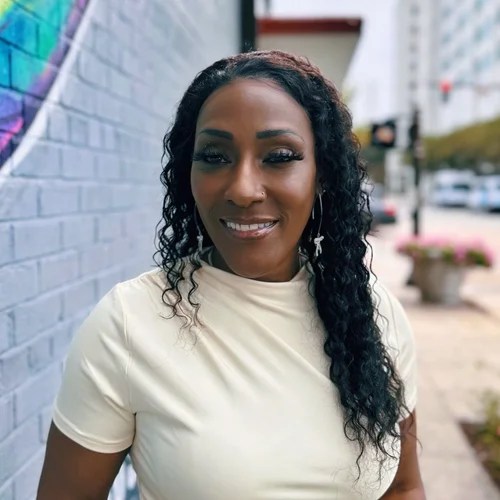
Amelia is a dedicated organizer for Voice of the Experienced in Baton Rouge. She is committed to fighting against overly punitive criminal procedures that disproportionately affect Black communities and champions climate justice. She focuses on critical issues such as housing, mental health, employment, and education, while actively advocating for policy changes that support our most vulnerable populations.
The Regular 2025 Louisiana Legislative Session (April 14 – June 12) showcased once again the state’s obsession with punishment over people. The budget ballooned for carceral expansion, while support systems for our youth, elders, and communities remain underfunded or attacked outright. But amid it all, VOTE’s Policy team and partners showed up:
We testified. We called out hypocrisy. We helped defeat harmful bills. We pushed forward the truth.
(iStock)
Most of laws passed from the last session went into effect on August 1st. Here’s a breakdown of what went down and what it means for our communities:
Where the Money Goes: Punishment Over People
The state passed HB 1/ Act 1, Louisiana’s operating expenses budget bill for Fiscal Year 2025-2026. This year’s budget was more than a financial document – it was a statement of right-wing values. What this new budget says, loudly and clearly, is that Louisiana still sees incarceration as a tool for big business to make and a means to control and marginalize Louisiana citizens. And with it came millions more for the carceral system:
$444M for State Police (-$25M) ↓ (after mushrooming last year)
$39M local police supplemental pay
$197M Office of Juvenile Justice
$129M for Department of Corrections (DOC) Administration ($8M)↑
$104M for Probation & Parole ($2M)↑—partially funded by the $13M they squeeze out of citizens on supervision by charging fees
$48M Public Defenders Office (constitutionally required indigent defense)
$41M to District Attorneys Association
$37M child welfare services
Facilities
$64M to jail deputies’ pay
$87M Hunt (-$18M)↓
$66M Dixon (-$3M)↓
$46M Laborde ($2M)↑
$41M Wade (no change)
$39M Rayburn (-$16M)↓
$36M Allen (no change)
$35M Louisiana Correctional Institute for Women (LCIW) ($1M)↑
$500K Winn (30 people incarcerated at the state level), being rented to LaSalle Corrections, which rakes in millions from ICE to detain over 1,500 people. Filling this prison with people who aren’t from Louisiana leaves the state scrambling to pay sheriffs to house more people in local jails—effectively subsidizing jail guard jobs under the guise of public safety.
Under HB 2/ Act 2, the “capital outlay” bill, which funds future infrastructure projects, the Legislature approved $257,000,000 for the following regressive projects:
$64M for Lafayette Parish to build a new jail
$58M for juvenile prison expansion
$36M for state prison expansion
$33M to the Orleans Communications District (911, 311)
$27M State Police facility in St. Tammany
$26M in Angola State Penitentiary maintenance and upgrades
Courtesy of HB 93 / Act 240, voters in the “Acadiana Regional Juvenile Justice District” should expect a 1% tax (sales, services, rent) on their ballot to fund a new prison. These parishes are Acadia, Allen, Evangeline, Iberia, Jefferson Davis, St. Landry, St. Martin, St. Mary and Vermillion.
Louisiana doesn’t have the money to fund politicians’ obsession with prison expansion—and voters likely wouldn’t approve it anyway if ever put to the ballot. But don’t be surprised if Louisiana politicians try to funnel federal dollars through Homeland Security to keep it going (i.e. Florida got $500m to build an ICE detention facility). The real issue isn’t just profiting from cruelty—it’s that our state treats prisons like a rural jobs program while lining the pockets of big business contractors and architects who benefit from massive prison infrastructure projects.
Prior to the recent redistricting and the rise of a punitive supermajority, Louisiana’s Legislature had been on a promising path toward reducing overincarceration through the bipartisan Justice Reinvestment Initiative (JRI)—a 2017 reform package aimed at lowering the prison population, saving taxpayer money, and reinvesting those savings into community-based services and supports for victims. The initiative led to a significant drop in incarceration and helped reduce Louisiana’s long-standing status as the most incarcerated state in the nation. This recent reversal is especially devastating—not only because it undoes years of hard-fought progress, but because it signals a willful return to failed policies that harm families, waste public dollars, and deepen racial injustice.
So, brace yourself: they’re not done. Lawmakers will keep criminalizing everyday life, stacking on longer sentences, and pouring money into bigger prisons—doubling, even tripling incarceration costs—until all that’s left in Louisiana are cages, guards, and the people they’ve locked away.
Wins Far & Few Between (Not Including Defeated Bills!)
There weren’t many clear wins this session but a few positive bills did pass:
HB 405 / Act 498 – Requires election law changes to be made public. Mandates that the Secretary of State publicly share all changes in election law – boosting transparency in voting regulation. Hopefully we can use this to go backwards, and the state can finally clearly explain who can vote with a criminal conviction, and how they get registered. We’ve been doing that work for them over the past six years.
SR 154 – Creates atask force to study ways to increase voter participation and ensure more people are engaged in the political process.
SB 182 / Act 440 – Maintains access to Medicaid during a declared state of emergency. The federal government is poised to throw millions of people into health care related debt, poverty, and despair.
HB 100 / Act 140 – Prohibits bail bond agents from using cell phone tracking devices.
HB 384 / Act 497–Reduced the expulsion period for students from 2 years to 1. If the offense is cannabis, suspension only happens after a second violation. We know criminalizing kids doesn’t help them—and this is a step in the right direction.
HB 457 / Act 278 – Requires access to educational and religious materials in solitary confinement unless proven to be a “security risk.”
HB 584 /Act 209 – Establishes “Back on Track” Youth Pilot Program, a youth-centered alternative to incarceration.
Ultimately Vetoed
SB 87 – Ensures those who post cash bonds receive warrant notifications. Although SB 87 did pass through the Legislature, it was vetoed by Governor Jeff Landry with the below message. His prejudicial belief that only a family should post bond for someone accused of a crime ensures that people in poverty stay in jail, and only the wealthy gain their full constitutional rights.
VETO MESSAGE FROM GOVERNOR LANDRY: “It is no secret that George Soros, Kamala Harris, and the rest of the radical left has declared war on the concept of pre-trial bail advocating instead for letting criminals back out onto our streets and in our communities to commit further crimes with no oversight or accountability. One of the most popular tools in their arsenal is the use of “bail funds”, funded and supported by George Soros and similar radicals, that put up cash money deposits for bail for criminals they’ve often never met and with whom they have no connection. [Read more]”
Jim Crow Juries: We Still Refuse to Right the Wrong, But We’ll Study It
SB 218 – which would’ve allowed new trials (or new plea agreements) for people convicted by unconstitutional non-unanimous juries —failed on the Senate Floor after making it out of committee for the first time ever. Only 9 senators voted yes.
But not all hope is lost. A study commission, SR 183 is now tasked with studying and identifying how many people are still behind bars because of Jim Crow-era split jury verdicts. Impacted individuals can submit their case to the commission, which will meet starting in October 2025. Recommendations are to be developed by 2026.
Meanwhile, HR 243 calls on the Legislative Fiscal Office for a study on how much it would cost to grant those people new trials. We’ll be making sure they also study the moral and financial cost of doing nothing—from growing medical bills for aging people in prison, to Louisiana’s reputation as a national embarrassment.
After 5 years of failing to bestow justice upon these unjust convictions, it is past time to Let the People Decide. Lawmakers must push forth a ballot initiative for a statewide constitutional amendment decided by all, rather than 100 politicians. If nothing changes, we are spending close to a billion public dollars for 800 people to eventually die in prison. These people deserved a fair trial, and that will never go away.
Direct Blows: Bills That Passed, Unfortunately.
HB 675: Attacks on Post-Conviction Relief
Post-conviction relief (PCR) was aggressively under attack this session with multiple bills proposed. One of the most damaging bills of the session—HB 675 /Act 393 —became law. This dangerous new law makes it harder to challenge wrongful convictions, especially for those who plead guilty—even if new evidence proves innocence. This affects every person convicted and serving prison time – and specifically – the 55 people on Louisiana’s death row as well as the nearly 5,000 people serving life sentences. This represents a cornerstone of Gov. Landry’s campaign promise to resume executions in Louisiana after more than a decade-long pause.
Here’s what it does:
Bans people who pled guilty from later claiming they’re innocent—even if new evidence proves it (pro-tip: file claims anyway; get denied in state court and then take to federal court). FYI: this ban includes coerced pleas, where people are being threatened or deceived.
Forces people to give up attorney-client privilege if they claim ineffective assistance of counsel—allowing the state to cross-examine their lawyer (no problem) and demand disclosure of all private conversations (problem).
Doubles the state’s response time to post-conviction petitions from 30 to 60 days. Despite the claims that incarcerated people are “dragging out” their demand to be heard in court… it is usually the opposite.
Sets strict deadlines: if you filed a placeholder (“shell”) petition by July 1, 2025, you must complete it by July 1, 2026. Petitions filed before July 1, 2023, must be resolved by July 1, 2026, unless the court gives a rare extension. These timelines will likely overload the courts.
Dismisses petitions as “abandoned” after two years of inactivity. Typically, any inactivity is related to incarcerated people desperately seeking lawyers willing to take their (often complicated) case pro bono.
Eliminates the “interests of justice” exception—an important federal protection for rare, meritorious claims. The U.S. Supreme Court has always given space to extreme circumstances that should override a procedural bar, such as paperwork not being filed on time. This is a key exception for people who are filing things from inside a prison cell, through the mail, with no computer or phone access to the court or opposing counsel.
Denies bail to people who win a new trial after overturning a conviction.
Grants the attorney general the authority to file procedural objections to prisoners’ claims and to move to dismiss cases. This is aligned with the Baton Rouge state government seeking to take over the authority of locally elected district attorneys.
HB 675 is a slap in the face to anyone who’s ever tried to seek justice through Louisiana’s courts. If you or someone you know is impacted, act quickly, meet deadlines, and consider taking your case to federal court.
If you were wondering why Governor Landry was trying to pass a constitutional amendment for the creation of new “specialty courts” outside of long-established jurisdictions: A court that can dismiss all post-conviction petitions would ensure nobody ever is exonerated through the state courts, thus delaying any release for years, if not decades.
Bleeding a Stone
HB 199 / Act 253 doubles down on extracting money from the poorest people (“in forma pauperis”) in the system. It requires incarcerated people to submit six months of financial records just to request a waiver for civil court filing fees. Even with only a few dollars in their account, the prison must now take 20% of their income every month until the fee is paid in full. If someone has been released, they’re still on the hook—expected to report their assets and start paying once they have more than $10. Poverty, under this law, isn’t a circumstance—it’s a lifetime payment plan. Now, those claims won’t even move forward until every cent is paid.
This matters because civil lawsuits are often the only tool incarcerated people have to challenge dangerous conditions or misconduct and hold the system accountable. We are all too familiar with litigation around medical care, unsafe heat, solitary confinement, mental health care, rats, lead, asbestos, and forced labor in unsafe conditions. Someone could be working in a prison field for years just to earn the right to file a pro se lawsuit about why working conditions in the field are unsafe.
Policing Pregnancy: Civil Bounties and Criminal Traps
HB 575 / Act 383, Louisiana’s “Justice for Victims of Abortion Drug Dealers Act,” was one of the most chilling bills proposed during the 2025 session. Previously, a person receiving an abortion could sue the provider for any wrongful injuries suffered, similar to medical malpractice, and the financial compensation would be reduced if the patient signed a consent waiver. This bill was originally an incredibly vague law designed for men, and parents of the pregnant woman, to sue over abortions that allegedly already occurred, where he was allegedly the biological father. Public pressure dialed that way back.
What’s new? HB 575 now allows a lawsuit simply for having the abortion itself (and not rooted in wrongful injuries suffered by the pregnant woman) by expanding who can be sued. Specifically, it now includes anyone who facilitated the use of an abortion-inducing drug, whether they prescribed, sold, or distributed it. The new law also eliminated the reduction of any award based on consent. Most importantly, it creates a $100k minimum award for damages, that could be a financial incentive for every woman who knowingly and consensually had an abortion with no health complications whatsoever. The law applies retroactively and regardless of whether an abortion actually occurred.
The law targets anyone who distributes “abortion-inducing drugs,” but exempts health care providers and pharmacists who are licensed in Louisiana. It is intended to target those who facilitate banned medications like misoprostol (legal in other states), which is used to treat miscarriages, postpartum hemorrhage, and ulcers. HB 575 is part of a broader pattern: using civil courts to criminalize care, punish compassion, and expand the reach of surveillance and control. This isn’t about protecting life—it’s about outlawing solidarity.
HB 425 / Act 275 (Rep. Josh Carlson, R) expands the criminal definition of “coerced abortion” to include vague new definitions under the extortion statute: “a threat intended to compel a pregnant woman to have an abortion.” Even when no abortion happened, someone can be charged with “coerced abortion.” This is yet another example of the systematic control Louisiana is moving towards. The government majority’s desire to force births, by any means necessary, may only get more dystopian as time goes on.
A Blueprint for Immigration Surveillance, Not Safety
Louisiana didn’t just pass immigration bills in 2025—it built a surveillance regime. As ICE raids ramp up and Trump demands “3,000 arrests per day,” many of those detained end up here—where the federal government pays sheriffs around $100 a day to cage people. This is our economy of choice now: one that depends on locking people up. However, the truth is just a small but powerful group of people are reaping the benefits of creating this Big Government Immigration Program.
This package of laws does nothing to address Louisiana’s real issues. It doesn’t feed families, improve schools, or stabilize housing. What it does is weaponize basic services, chill access to care, divide communities, and turn the state into a foot soldier for federal immigration enforcement with no regard for civil rights, due process or common decency. It’s not immigration policy—it’s a playbook for fear.
SB 100 / Act 419 now requires state agencies to collect and report the immigration status of anyone receiving public services—whether that’s health care, housing, food, or education. Pitched as a measure to “coordinate” resources, its true function is to intimidate. For many immigrants, documented or not, seeking help now carries the risk of being flagged, tracked, or reported. Compassion becomes a liability. And anyone who believes their own services won’t be interrupted because they are not an immigrant: the state agency will need everyone to prove their citizenship and/or immigration status for them to uncover the small number of people they are looking for. Similar to drug testing regimes, the inquiry will end up costing far more than the savings.
SB 15 / Act 399goes a step further: it criminalizes obstruction of ICE agents, with fines and/or a sentence up to a year for any act intended to “hinder, delay, prevent, or otherwise interfere with or thwart” ICE, even if that means choosing not to comply with a detainer request. That’s not about safety—it’s about forced complicity. It deputizes the entire state to act as ICE’s backup, under threat of jail time. And it exposes a deeper truth: Louisiana politicians love federal power when it comes to locking people up—but not when it comes to protecting our environment, enforcing civil rights, or ensuring fair elections.
HB 307 / Act 351mandates immigration status checks for anyone applying for public assistance and requires that non-citizens be reported to ICE. It also orders annual audits calculating how much aid was given to “illegal aliens” and “unaccompanied minors.”
HB 554 / Act 292brands IDs issued to non-citizens with a special code and formal notice about voting restrictions—ensuring that even lawful presence comes with a mark of exclusion.
And HB 303 /Act 264 creates a special law enforcement unit, the Fugitive Apprehension Unit, within the Attorney General’s office to partner with ICE and U.S. Marshals in hunting down “fugitives.”
HB 436 / Act 17prevents an undocumented person from collecting damages in an auto accident, putting people outside the coverage of our laws, part of an intention to make the state entirely unlivable for some people under the mistaken impression our state will be better for it.
The War on (Natural) Drugs Marches On
The War on Drugs continues—this time targeting leaves and mushrooms. With the passage of SB 154 / Act 41 kratom—a plant-based substance long used to manage pain, PTSD, anxiety, and opioid withdrawal—is now banned statewide. Despite hours of testimony from health professionals and users advocating for regulation over prohibition, the legislature chose to criminalize it outright, backed by law enforcement and pharmaceutical interests. As of August 1, 2025, possession of kratom becomes a felony in Louisiana.
For years, kratom was sold openly and served as a lifeline for thousands of Louisianans, especially those without insurance or access to traditional care.
Meanwhile, HB 176 / Act 154 criminalizes derivatives of amanita mushrooms and phenibut—natural substances used for centuries—based on little more than anecdote and fear. There was no input from the Department of Health. No scientific studies. Just a Grant Parish sheriff claiming kids are “overdosing on candy” near checkout lines.
This is how drug policy gets made in Louisiana: the Executive Branch—charged with enforcing laws—instead acts as lead lobbyist, while the Criminal Justice Committee, chaired by Rep. Debbie Villio (who officially works for the Fraternal Order of Police), does the legislating. No health experts. No science. Just sheriffs and DAs pushing prohibition through law enforcement channels. So much for separation of powers.
This isn’t about safety. It’s about control. And the hypocrisy is glaring. In the same session, lawmakers advanced SB 19 / Act 464 to make ivermectin—a livestock dewormer turned folk remedy—available over the counter, waving the “individual freedom” flag. But when it came to amanita and kratom, that flag disappeared. A plant became a threat.
VOTE’s testimony reminded legislators: no one is asking why people turn to these substances. There’s no data. No proof of widespread harm. Just another swipe at individual freedom under the banner of “public safety.”
HB 12 / Act 233makes it a crime to sell or purchase consumable hemp products—like drinks or gummies—for anyone under 21. But rather than offering clarity, the law piles onto the chaos already surrounding Louisiana’s hemp industry, where mixed messages and scattershot bills are pushing tax-paying, job-creating businesses toward collapse.
Meanwhile, HB 36 /Act 345 offers a rare bit of sanity: shielding businesses from lawsuits if their hemp products are approved by the health department and sold through proper permitting channels. But even that comes wrapped in contradiction—the same statute calls these regulated products “illegal controlled substances,” putting hemp in the same category as street drugs, while alcohol and nicotine—far more deadly—remain exempt.
But Wait There’s More: Criminal Legal Bills
HB 5 / Act 230created a redundant “no parole” sentence for soliciting minors—even though that’s already illegal, and people convicted of this crime already are not parole eligible.
HB 14 / Act 343 adds “cruelty to the elderly or people with infirmities” as the 16th legal justification for the death penalty in Louisiana—when intent to inflict great bodily harm is found. If no intent is proven, it mandates life without parole. This law is most likely to impact caregivers, including staff at assisted living facilities where neglect and mistreatment are notorious. Previously, the maximum penalty for cruelty without death was 10 years; for manslaughter (when there’s no intent to kill), it was 30 years. Now, caregivers could face life in prison or death for the same situations.
HB 214 / Act 70 intensifies last year’s Crime Session goal of putting people in prison for lesser crimes and holding them for longer sentences. The key provision is that if someone commits another felony, the judge loses discretion to violate their probation. Now a violation is mandatory, no matter how petty the felony.
HB 208 /Act 158 changes yet another part of the law where parole is denied. It is mind-boggling as to how many statutes exist to deny people parole, good time, or probation violations. So many, the Governor, District Attorneys Association, our legislators (and their lawyers) need multiple bites at the apple to get them all. Meanwhile, they are ratcheting up the concept of “one bite at the apple” on appeals, and the slightest mistake can doom your plea of innocence.
Ironically, HB 171 / Act 248 removed the max salary cap for parole board members and makes their pay subject to annual legislative budget requests—despite parole being all but eliminated the year before. With fewer people eligible and longer wait times after denials, the board is doing less work than ever—and legislators are rewarding them. Parole has become so narrow, it’s like trying to ride a horse through the eye of a needle, yet some politicians still want it gone entirely (a violation of Constitution’s ban on ex post facto punishment or changing the rules after someone’s already been sentenced).
SB 39 / Act 317 buries claims of false imprisonment under procedural roadblocks and shields sheriffs and the DOC from civil liability when an incarcerated person is held past their legal release date. Under this new law (effective 8/1/25), anyone wrongfully imprisoned must first go through the administrative remedy process (ARP)—often a lengthy, uphill bureaucratic battle—and win before suing. Lawsuits filed before that are dismissed outright; ones filed too late are dumped with prejudice.
HB 64 / Act 237 gives the Attorney General sweeping power to take over any litigation filed against any local “political subdivision” (police department, city council, sheriff, school board, etc.) and blocks a local government defendant from entering into a consent decree without the approval of both the Attorney General and Governor. This is aimed at federal civil rights allegations and will generate another layer of lawyers’ fees paid by us.
HB 206which passed, but was VETOED BY GOVERNOR.This bill, directed at parish registrars and the Secretary of State, would have required legislative approval for any settlement agreements that arise in litigation. The Governor vetoed it because Act 237 already gives him control over these lawsuits and more. Thus, he has final say over redistricting, which is currently in the courts.
A Constitutional Amendment for Vote in November
HB 63 / Act 219–Do you support an amendment to change the mandatory retirement age for judges from seventy to seventy-five, provided that a judge may continue to serve to complete a term of office?
While it may seem innocuous, the structural issues it hides are serious. Voters rarely have full insight into a judge’s mental sharpness, stamina, or health. Lawyers—those best positioned to know and the only ones eligible to run themselves—won’t speak out, since their careers depend on staying in a judge’s good graces. That’s why judges are almost never challenged and only leave when a seat is open. The best elder judges can still serve as ad hoc judges or return to private practice. This amendment isn’t about public interest—it’s about a few individuals who want to stay on the bench.
When it comes time to vote on this: keep in mind the apparent malfeasance of New Orleans Chief Judge Derbigny, who suddenly quit this month. He had a massive backlog of cases for years, leading to the jail overflowing with people, and yet no lawyer would run against him in an election.
What We Dodged: Harmful Bills or Elements That Didn’t Make It
Not every attack on our people made it through. Here’s what didn’t pass—thanks to organizing, testimony, and pressure:
SB 74 Aimed to send 15-year-olds to adult court, yet again trying to dismantle the juvenile justice system and fast-track youth into the adult system. The bill was thankfully killed in committee—but it wasn’t the first attempt, and likely won’t be the last. This push mirrors shady Amendment 3, which Louisiana voters overwhelmingly rejected on the March 29 ballot. Despite that clear message, lawmakers continue to push their own punitive, unpopular agendas instead of listening to the will of the people.
HB 193Would have made it significantly harder for incarcerated people to challenge their incarceration or conditions of confinement. The bill proposed stricter rules for filing lawsuits—allowing the state to throw out cases over minor technicalities. If someone didn’t follow the prison grievance process exactly on time, their case would be dismissed with prejudice—meaning permanently. Even if a lawsuit was filed while someone was still waiting on the prison’s internal response, it would be automatically tossed. This bill would have gutted incarcerated people’s access to the courts and made it easier to ignore serious claims of abuse, neglect, and unsafe conditions.
HB 673 Would have repealed Louisiana’s wrongful conviction compensation statute entirely, stripping the state of any obligation to compensate those it wrongfully imprisoned. Even under the current law—where relief is limited and the bar for exoneration remains high—Louisiana has seen numerous qualifying cases. According to the National Registry of Exonerations, Orleans Parish leads the nation in per capita exonerations with 23 cases, while Jefferson Parish ranks eighth with 12. Rather than confronting this crisis of injustice, HB 673 is a harsh example of prioritizing punishment over people, offering no accountability for the system and no support for its victims.
HB 76 Sought to criminalize exposure to sexually transmitted diseases (STDs), with felony charges and lifetime electronic monitoring for intentional exposure to incurable STDs, and misdemeanors for curable ones. In reality, it would have pushed people further from care—discouraging testing, treatment, and disclosure.
HB 685 Anti-DEI (Diversity, Equity and Inclusion) programs across state government and barred race-or gender-based curricula at public colleges. Louisiana’s elected leadership struggles with addressing the past, including non-unanimous juries, voting rights, Cancer Alley, chain gangs, the Civil War, and slavery. Anyone having such a hard time accepting facts that have already gone by will sadly find it difficult to tangle with the present and plan the future.
HB 262, HB 619,SB 196 Anti-homelessness bills, including a homelessness court program, did not pass. Whether they call it “public camping” or “loitering” or some new term yet to be developed: it is unfortunate that our massive crises in housing and health care are constantly invoking courts, police, and jails to intervene.
HB 400 Regressive health care bill that would have required parental consent for most medical care was killed.
Passed but Neutralized
HB 310 / Act 352 was amended to remove the “any person” must file electronically in criminal court; it now only applies to “attorneys,” meaning pro se petitioners can still mail in their filings.
The Road Ahead
While the Capitol remains hostile, the people remain organized. As we head toward the 2026 session and the 2025 elections, our message is clear:
Louisiana doesn’t need more prisons. We need housing, jobs, care, and accountability.
To those inside and their loved ones outside—keep fighting, keep organizing, and keep holding power to account.
Bruce Reilly Testifies Against Criminalizing Peaceful Protest
In the first 90 days of Louisiana’s legislative proceedings, a curious tone has emerged, marked by a series of bills and acts that demand scrutiny and reflection. From contentious changes in gun laws to sweeping reforms in criminal justice and education, the legislative agenda reflects a hyper-focus on certain issues while neglecting others of equal importance. The prioritization of punitive measures over rehabilitation in criminal justice reform and the erosion of civil liberties in the name of public safety raise concerns about the state’s moral compass and commitment to justice.
Let’s delve into the key highlights and implications of these legislative actions.
Gun Legislation: The legislative session kicked off with a series of bills aimed at reshaping gun laws in Louisiana. Measures such as ACT 1, which permits concealed carry without permits or training, and SB 233, which mandates businesses to allow law enforcement to carry concealed firearms, reflect a concerted effort to expand gun rights. Additionally, SB 214 would allow concealed guns in restaurants that serve alcohol. The implications for public safety and individual liberties warrant careful consideration about collective security.
Criminal Justice Reforms: The legislative agenda also includes significant reforms in the realm of criminal justice. Acts such as ACT 13, which prosecutes all 17-year-olds as adults for all crimes, and ACT 8, which increases standard probation lengths and eliminates administrative sanctions for probation violations, signal a shift towards punitive measures over rehabilitation and second chances. The elimination of parole and Good Time, as well as the expansion of justifiable homicide laws, reflect a tougher stance on crime and punishment.
Social and Civil Liberties: Legislative action has been targeting marginalized groups, such as transgender individuals (HB 608), sexual orientation discussions in schools (HB 122), and reproductive rights (HB 156). Bills like HB 122, which bars teachers from discussing sexual orientation, and HB 156, which forces teenage girls who are raped to carry their pregnancies to term, raise concerns about equality and individual autonomy. Additionally, restrictions on public records requests (SB 423) and limitations on peaceful protest (HB 127, HB 205) undermine transparency and freedom of expression.
Economic and Social Welfare: The legislative agenda also addresses economic and social welfare issues, with bills impacting marginalized communities and social safety nets. Measures such as HB 303, which cuts SNAP benefits if a child is adjudicated for a crime, and HB 481, which cuts federal TANF benefits for those failing a drug test, raise questions about the state’s commitment to supporting vulnerable populations. The prioritization of corporate interests over public welfare, as seen in decisions regarding insurance regulations and federal funding for children’s food programs, raises questions about political priorities.
Education: Bills like HB 71 and HB 745, mandating the posting of the Ten Commandments in schools and expanding voucher funding for private/religious/charter schools, highlight a push towards ideological agendas in education. The implications of these measures on the separation of church and state and the quality of public education merit further examination.
It seems they are hyper-focused on people such as:
The neo-Nazi who intentionally drove into a protest, injuring many and killing another in Charlottesville;
The police officer who kneeled on a man’s neck for 9 minutes in Minneapolis;
The out-of-town teenager who shot and killed two protestors in Kenosha;
The protestors who marched through the neighborhoods of Baton Rouge after the police killed an unarmed vendor;
The self-appointed neighborhood security who killed Black teenagers in Florida and Georgia;
Teachers who shed light on any uncomfortable aspects of history;
Other people’s sexual identities;
Journalists who seek public documents regarding government actions;
People below the poverty line seeking federal support;
The culpability of gun owners.
In light of these legislative developments, it’s crucial for Louisiana residents to engage critically with their elected representatives and advocate for policies that reflect their values and interests. By staying informed and actively participating in civic discourse, citizens can shape the future of Louisiana and hold their leaders accountable to the principles of democracy and justice.
As Louisiana gets ready for another hurricane season, with Hurricane Ida (2021) insurance claims still in dispute, political leaders have decided that throwing ourselves at the mercy of a deregulated insurance industry is the way to save our homes. For a state that is so dependent on tourism dollars in the liberal and diverse city of New Orleans, where drinking is legal in the streets and live music can be heard on nearly every corner… it is wise for the passengers on this ship to question which direction the captain is taking us.
Check out the full list of proposed bills below:
Allow everyone over age 18 to carry a concealed weapon, with no permit, registration, nor training; ACT 1
Force all businesses to allow law enforcement (active or retired) to bring a concealed gun inside the premises; SB 233
Allow concealed guns in restaurants that serve alcohol; SB 214
Prevent civil liability of anyone who is injured or killed by people with concealed weapons; ACT 2
Reinforce State’s burden in proving someone did not act in self-defense; HB 819
Create a “justifiable homicide” where a driver runs over a pedestrian, protestor, or anyone in a roadway who made the driver afraid (and requiring no actual contact nor weapon); HB 355 (DEFERRED)
Prevent civil liability where a fearful driver runs down a pedestrian, protestor, or anyone in a roadway; HB 383
Create a crime of conspiring or planning to block a roadway; HB 127
Expand racketeering laws to include protest planning; HB 205
Create a crime of protesting in a way that a resident’s peace is disturbed; HB 737
Criminalizes getting within 25-feet of a police officer; HB 173
Limit public records requests to resident citizens of Louisiana; SB 423
Require photo-ID for anyone requesting public records; SB 502
Exclude the Governor’s schedule from public records; SB 482
Publicly post the arrest of everyone 17 and over, including their mugshots; ACT 15
Prosecute all 17-year-olds in the adult system for all crimes; ACT 13
Drug test everyone who is arrested; ACT 4
Increase standard probation lengths from 3 years to 5 years; ACT 8
Eliminate administrative sanctions (and short jail stints) for petty violations of probation; ACT 8
Allow full revocation of probation (and sentence someone to 5 years prison) for an arrest, without needing a conviction; ACT 8
Amend the state constitution to allow an elimination of the juvenile criminal courts; HB 203
Allow children to be imprisoned in adult facilities; HB 210
Have the Governor appoint the Public Defender; ACT 22
Create a commission to procure funding for juvenile prison construction; SB 431
Allow for, and subsidize, hiring of police officers and sheriff’s deputies; Exec. Order
Create a division of state police in New Orleans; Act 20
Create and fund Attorney General’s shadow prosecution office in New Orleans; Exec. Order, HB 1
Violate U.S. Supreme Court rulings, including Trump v. Missouri (2024), that prohibits states from putting qualification restrictions on candidates for federal office; HB 664
Violate the Louisiana Constitution Art. 1, Sec. 10.1 by adding additional restrictions on running for school board; HB 188
Create a gender-specific surgical punishment for men convicted of sex offenses; HB 166
Twenty-five year mandatory minimum for “detectable amount” of colorful fentanyl; ACT 19
Ten-year mandatory minimum for detectable amount of fentanyl that looks like a generic pill; HB 720
Eliminate parole; ACT 6
Eliminate Good Time; ACT 7
Criminalizes giving anything of value to panhandlers; HB 97
Creates $500m private/religious/charter school voucher funding; HB 745
Mandate the Ten Commandments be posted in every school; HB 71
Forego federal dollars for children’s food programs; Exec. Order
Automatically cut SNAP benefits if a child is adjudicated for a crime; HB 303
Allow up to 10 years in prison for a false statement in applying for workers comp. benefits; HB 247
Cutting federal TANF benefits of anyone failing a drug test; HB 481
End mandatory meal breaks for child laborers who work over 5 hours; HB 156
Force transgender people to use bathrooms, or live in quarters, that do not reflect their appearance, in schools, jails, shelters, and prisons; HB 608
Bar teachers from discussing sexual orientation; HB 122
Force teenage girls who are raped to birth their child; HB 156
Create an interstate compact on immigration enforcement, and violate U.S. Supreme Court rulings, including Arizona v. United States (2010), that preempt the state from regulating immigration; SB 388
Fund a deployment of Louisiana National Guard to Texas; Act 20
Call for two-week Constitutional Convention (this June) among the 144 Legislators and Governor’s appointees to be submitted to voters this October; HB 800
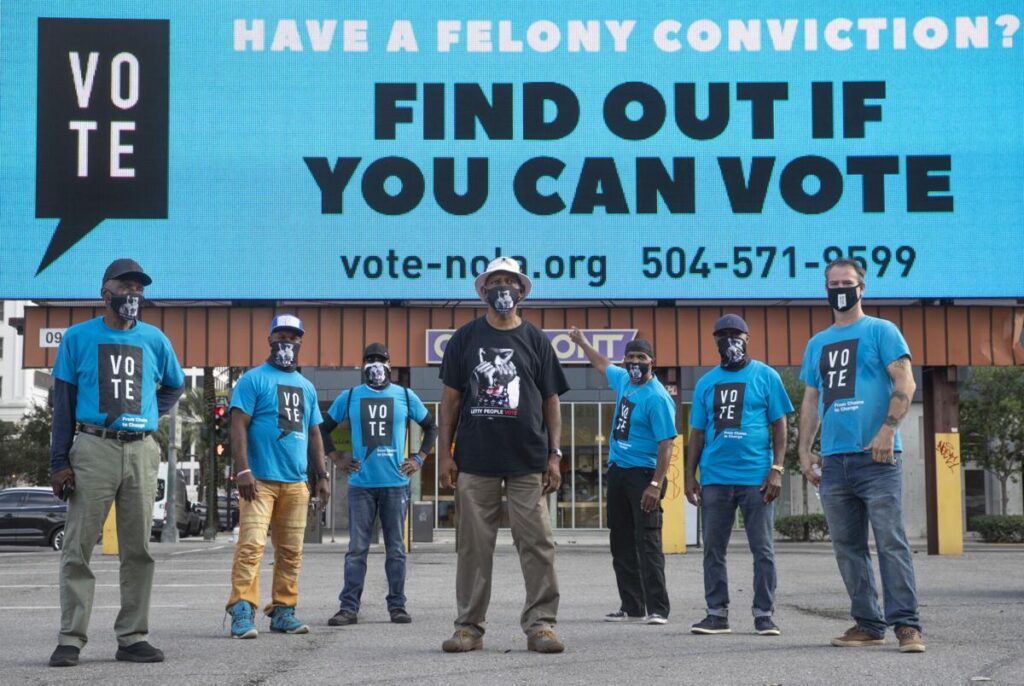
VOTE members and staff, including Executive Director Norris Henderson and Deputy Director Bruce Reilly, stand in front of one of VOTE’s voting rights billboard in New Orleans.
This year’s election season was as important as it was long. It felt both like a marathon and a sprint. November 3 brought significant victories both locally and nationwide, but for us in Louisiana, it didn’t end there. Many parishes also had a runoff election on December 5. Our VOTE family of organizers, canvassers, members, and partners kept energy high, and the results showed just how much our state was ready for change. Once we reached the finish line, our hard work paid off. Justice reform was on the ballot and justice reform WON.
This election season, two of our biggest wins were the people power we built and the progressive candidates we elected. Even through the physical separation of social distancing, our VOTE team was showing up. On Oct. 24, as part of the national “Justice Votes” day, VOTE rallied across the state to celebrate the formerly incarcerated communities’ right to vote. In Shreveport, Baton Rouge, and New Orleans, we rallied, listened to speakers, and hit the polls as a family, showing what a true movement looks like.
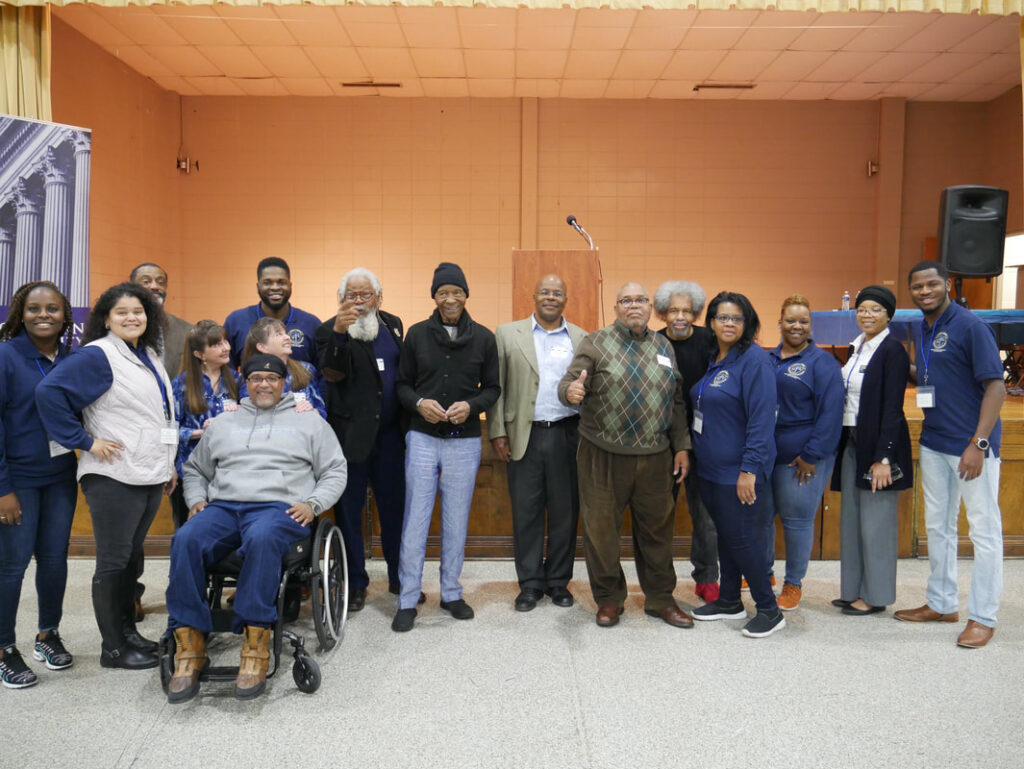
Louisiana Stop Solitary Coalition leader Albert Woodfox (fifth from right), Voters Organized to Educate Policy Director Checo Yancy (sixth from right), and Light of Justice Project Director Calvin Duncan (seventh from right) were among the many advocates at the summit.
Last Friday VOTE gathered alongside other justice reform advocates the inaugural Underground Railroad to Justice Summit hosted by Southern University Law Center. The day’s sessions spanned from current policy strategies to attracting media attention, but the resounding message from the summit was unified: our movement is strong, and it must keep growing in order to keep winning.
More than 25 Louisiana justice organizations came to the summit, proving the unstoppable power of our movement. Together we reiterated the importance of holding every part of the system that has locked us up and locked us out accountable.
Today is the first day of the year 2020. Last year–2019–marked 400 years since the arrival of the first slave ship to what we now know as the Americas. With the new year comes new beginnings, but as the old African symbol of the Sankofa bird reminds us, we can’t see where we’re going if we don’t know where we’ve been.
Mass incarceration is a direct result of the transatlantic slave trade. Because the festering wounds from this collective trauma went unhealed, over the past 400 years we’ve seen the progression from slavery, to Jim Crow, to a public health crisis so severe that it affects one in every two American families.