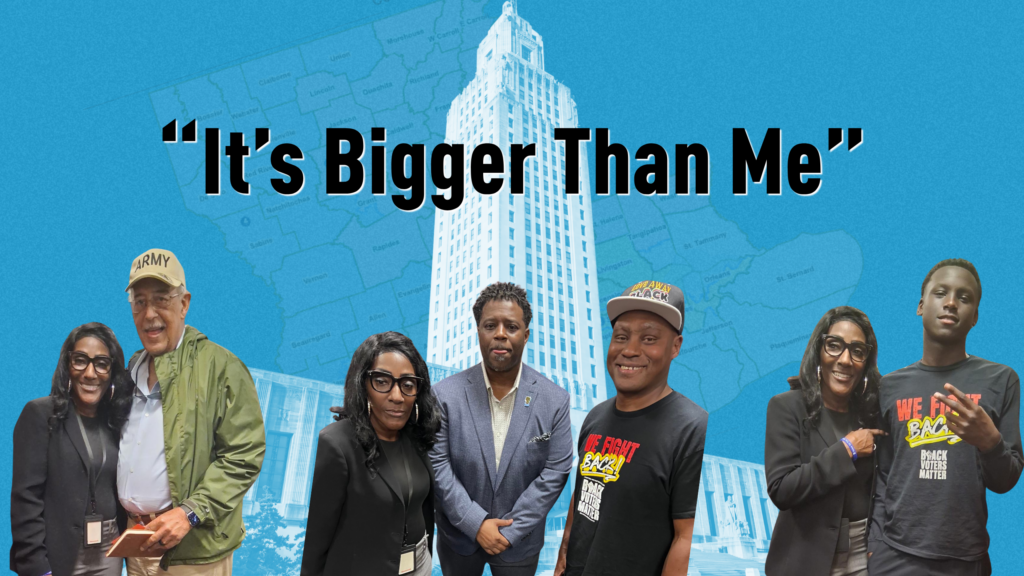
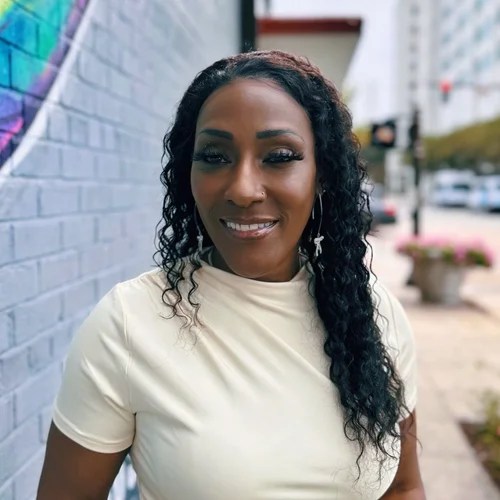
Featuring Amelia Herrera, Organizer, Voice of the Experienced (VOTE), and Dr. Matthew Green, Associate Professor of Education, UL Lafayette
Amelia Herrera: I’m Amelia Herrera, an organizer with VOTE — Voice of the Experienced — in Baton Rouge. I’m also an advocate and a mother. I’ve been doing criminal justice reform work and following the criminal legal system in Louisiana for about seven years now.
Dr. Matthew Green: My name is Dr. Matthew Green. I’m a VOTE member and an associate professor of education. I’m also the interim department head of the curriculum and instruction department at UL Lafayette. I’ve been working with VOTE for about five years. Part of my research and teaching is around the school-to-prison pipeline — how school suspensions and education systems push students out of educational opportunity and into the criminal legal system.
How are you both coming into this conversation today?
Dr. Green: I’m tired but energized. Anytime I come to work with a community like VOTE, it re-energizes me. Even though times are tough, I’m feeling inspired.
Amelia: I can say the same. I’m inspired and energized — especially around this subject. Though many of us know it exists, it’s not a well-discussed topic. So I’m glad we’re lifting it up.
Why did you each want to be part of this conversation?
Amelia: I grew up in New Orleans, graduated high school, and went off to Xavier before eventually moving to California. When I came back home and had kids of my own, I took a look at our school system and was alarmed. There was a stark difference from what I was accustomed to raising my kids elsewhere. I kept thinking — why isn’t anyone paying attention to this?
Dr. Green: For me, it was moving to Louisiana and seeing the carceral nature of how this state approaches almost everything. People often think schools and prisons are the antithesis of each other — but Louisiana is the only state I’ve ever lived in, taught in, or done work in where there’s a person at schools with the job title of disciplinarian. Everywhere else, discipline is one part of a role. In Louisiana, there’s a person devoted specifically to punishment. That stark contrast from how other places approach schools is really how I came to this work.
How would you define the school-to-prison pipeline?
Amelia: I’d identify it as a systemic process — a way of pushing marginalized communities, specifically Black and brown youth, into the incarceration system. It’s a pipeline. All the pieces are systematically put together so that incarceration becomes the most accessible path — sometimes the only visible way out — for many in our communities. Intentional, systemic, and closed-box syndrome.
Dr. Green: I explain it as the policies and processes that push students out of educational opportunity and into the criminal legal system — things that favor incarceration over education. And I use that phrase deliberately: favor incarceration over education. If you look at the funding in Louisiana, there’s far more money per capita going to our carceral systems than to our education systems. When you give more money to something, you’re showing that you favor it over something else.
What do you want people to know about this topic that they might not know?
Dr. Green: The thing I want people to understand is that it affects everybody. It affects your child’s school. It affects kids and adults across the full age spectrum. When we talk about the school-to-prison pipeline, we’re not just talking about teenagers. We’re talking about kindergartners who are arrested at school, punished, denied educational opportunity. We’re talking about adults who were pushed into the criminal legal system years ago. And we often associate this issue with schools in dangerous neighborhoods or certain parts of town — but the way it operates, it affects every kid in every community, because every student is under the same umbrella. The same systems that either provide educational opportunity or push people out of it work across Louisiana and across the nation. It is not one school, one community, one isolated instance.
Amelia: What I want people to know is: what are the identifiers? What should we look for? Coming from a Black mother — it starts as young as third grade. A lot of people in our community don’t know that. Everyone looks at the middle school and high school years as the primary danger zone, but the pipeline goes all the way back. The marks teachers put on your child’s record in pre-K, kindergarten, first and second grade — those are determining their future. You can be involved. You can ask for your child’s records. You can show up and ask questions. Just because someone is a teacher or administrator doesn’t mean they have your child’s best interest at heart. I want people to identify this big, ugly system that is locking our kids up.
Dr. Green: I want to add — it sounds simple, but: kids don’t suspend themselves. That requires a teacher, an administrator, a decision by an educator. One of VOTE’s most important principles is that those closest to the problem are closest to the solution. Once teachers start identifying that they are in control of many of these outcomes, we can begin working with parents, students, and communities toward real solutions.
Amelia: And we also have to look at what teachers are bringing into the space — predisposing biases, assumptions about how a child looks or how they show up. For a Black child, the default response is often to punish rather than support or encourage. Teachers aren’t always culturally cognizant of what each student from a different neighborhood or household is carrying when they walk through that door. And they’re going to demonize these kids without even knowing what they’re dealing with.
Dr. Green: And teachers aren’t always coming from the communities that their students come from. They don’t always understand the history and context of that community.
What are some common myths about the school-to-prison pipeline?
Dr. Green: The myth I always focus on is that the punishment fits the infraction. There’s a well-known study out of Tulane — done about six years ago — that looked at school suspensions across Louisiana and examined the disproportionality. It found what is found nationwide: three groups are suspended more than any other. Not that they commit more infractions — they are suspended more. Those groups are Black and brown students, students in special education, and students in poverty. What was most striking: a Black student and a white student can get into the exact same fight with each other, and on average across Louisiana, the Black student is suspended one day longer. Most suspensions in this state are for nonviolent offenses. Not contraband, not weapons, not fighting — but subjective things: disrespecting a teacher, questioning authority, insubordination. Things that require a teacher’s judgment. And even when the infraction is clear-cut, we see disproportionate suspensions along racial lines.
Amelia: I always bring it back to community. Take two kids — James and Tommy. James is a Black child from a two-parent home. Tommy comes from an abusive household. They’re in the same classroom with the same teacher. Tommy is carrying trauma that James isn’t carrying. If James doesn’t act out and Tommy does, why isn’t there support for Tommy? Because no one knows — or cares — what Tommy is going home to. So teachers start marking him as disobedient, unable to grasp the material. The records pile up. The child gets discouraged and stops wanting to go to school. Then you have truancy. And there are officers in the schools now. That is a direct pathway to the incarceration system.
Dr. Green: That’s a perfect description of how small infractions become systematized — repeated over time, put on records, escalating punishments, until kids don’t want to go to school. Or they get kicked out. Why would you go to school if it’s a hostile place toward you?
Amelia: I met a parent whose son was on the spectrum. She didn’t have the tools or resources to support him properly, so she hoped the teachers would catch it. The teacher didn’t — she ridiculed him in front of the class. So he wrote a note to the teacher, something he’d seen on television. The teacher took it to the school resource officer. Instead of recognizing a child crying out for help, it was treated as a criminal matter. That child now has to report to the juvenile detention center. He has a full record. Because of one outcry that no one knew how to answer.
Dr. Green: This is why I always teach that all behavior is communication. The behavior of kids who sit still and silent, the behavior of rambunctious youth — it’s all communicating met and unmet needs. The school-to-prison pipeline is what happens when the response to those unmet needs is punishment: demerits, paperwork trails, infractions, suspensions. All negative consequences rather than care.
What does summer mean for youth in Louisiana, in the context of all this?
Dr. Green: Before we get to summer, I want to name something. VOTE member Ronald Marshall championed a bill a couple of years ago about mental health screenings for anyone entering incarceration. For many people, that is the first mental health screening they have ever had. When we talk about under-resourced schools, when we talk about Amelia’s story of that child — if going to prison is the first time someone receives a screening for trauma or mental health needs, it is way too late to change the course of that person’s life.
Amelia: What summer looks like to me — I’m going from this conversation to a budget hearing where they’re giving more money to the Baton Rouge Police Department. Our communities are already being over-policed. Juveniles roughly ages 8 to 16 have nothing to do. No parks to go to. No mentorship programs. Where are the Boys and Girls Clubs? So these neighborhoods are over-policed, officers already arriving with assumptions about who these kids are. Meanwhile, the pull of the street is real — especially for a child whose parent is too busy surviving to be home, who has no clean park, no structured activity, nothing to do but sit on the porch. A police officer sees that and calls it a threat. Not knowing that if you gave that child a basketball, a safe park, a resource — the outcome could be completely different. It’s intentional. I see it as intentional. There are police cars parked throughout certain neighborhoods, and when I cross to the other side of town, they’re nowhere to be found.
Dr. Green: From an educator’s perspective, if people could compare what summer looks like for different children across Louisiana, it would be staggering. Some children have summers full of enriching experiences: academic programs, summer camps, structured and unstructured play, great parks, tons of opportunity. Others have the complete opposite. And that is a strategic, purposeful decision. Louisiana loves to talk about community — but where we draw the lines of community matters. Because if we’re truly a community, we should be taking care of every child in this state. Which parks get funded. Which sports leagues. Which neighborhoods. The decision to defund programs, remove parks, eliminate spaces where people can gather — and then at the same time complain about young people being on their phones — you took away all the other spaces. And when you layer surveillance systems and police monitoring only in certain neighborhoods on top of that, you’re going to arrest more people in the places police are. This is a layered system that starts with decisions that don’t seem to be about schools or prisons at all — and yet they determine children’s lives and opportunities.
What solutions do you see? What are you working toward?
Amelia: I’m going to go back to community. There’s an intersectionality here that we can’t ignore. In EBR Parish, roughly 38% of Black and brown children in impoverished communities — about 72% of them are being pushed down the pipeline. That’s alarming. So what happens on the back end? Fully incarcerated people coming home — they are mentors. They can go in and talk to at-risk youth and say, this is not what you want. The parent is too busy surviving. The teacher has already given up. Someone has to care. Pull on your community. Pull on the ones who’ve seen it, done it, been there. Because the people governing are not prioritizing this — they’re closing schools and building prisons. We have to demand that money come back to the community. Educate impacted communities to know: you don’t have to accept this. You can go to your child’s school and ask questions. You can advocate for your child. Who said you had to listen to what that resource officer said? That is your child.
Dr. Green: From a school perspective — the easiest, most concrete solution is: stop suspending students. There are alternatives. Even one suspension increases the likelihood of a child interacting with the criminal legal system by 50%. Avoiding that first suspension is critical. But the bigger battle, and for me the most viable long-term solution, is changing the mindset that children deserve to be punished. It is pervasive. One of the first classes I taught in Louisiana, students asked me: “Dr. Green, if you don’t punish a kid, how will they learn?” That was eye-opening. There is a deep-seated notion that punishment is right, deserved, and produces positive outcomes. That same mindset drives the adult incarceration system too. But in schools, with children, it is toxic — it hampers educational opportunity and life opportunity. When you break it down and ask someone: do you really think a five-year-old deserves to be kicked out of school? It sounds ridiculous. But that is what is happening. To kindergartners, to third graders. The things we do to high school students — who we too often see as adults rather than children — we also do to the youngest kids in our schools.
Any final takeaways?
Amelia: I want to say — we need bridges between community members and experts like Dr. Green. This issue is so prevalent, but it isn’t discussed. If you don’t know what to say or how to go about it, go to the experts. Let them show you the way. Something needs to be done, and something can be done.
Dr. Green: To anyone listening — the first step is holding up a mirror, for yourself and in your conversations with others: What are you willing to accept, and what are you not? The reason we have a school-to-prison pipeline is because as a society, we have accepted far too many children being suspended, punished, pushed out. We accept it because we think they deserve it. That is a harsh and damning critique of our society. And my last thought: if we are willing to do it to children, we are definitely willing to do it to adults — and worse.
There’s a feeling you get the moment you walk into the Louisiana State Capitol.
It starts before you even reach the committee room.
You walk in, you get checked in, you nod at the familiar faces at the front desk—but once you get past all that, something shifts. The air gets heavy. The building itself feels like it’s telling you: you don’t belong here.
And if you listen too closely, your mind starts to echo it.
What you have to say doesn’t matter.
They’re not going to listen.
You should just leave.
But my feet keep moving anyway.
Up those hard stairs.
Down those long halls.
Into rooms where decisions are made about people’s lives—about my community, about families I know, about the people still locked behind walls and fighting systems that weren’t made to protect them.
Systems that were never broken—systems that were built to break people.
Every time I walk into a committee to testify, my body goes into fight or flight.
My hands tremble.
My chest tightens.
Everything in me says: turn around, walk out, run.
But there’s something stronger than fear.
It’s the commitment I made to the people I serve.
It’s the faces of the families who are waiting for someone to speak up.
It’s the voice of a loved one who can’t stand there themselves.
And I know—if I don’t speak—I’m letting them down.
And that feeling? That’s heavier than fear.
So I stay.
Even when I feel like I don’t belong.
Even when I look into the faces of people who refuse to see me.
Even when I hear laughter, side comments, or watch them scroll their phones like the stories being told in that room aren’t about real human lives.
There are moments I sit there and ask myself:
Why am I doing this?
Why do I keep putting myself through this?
They don’t care.
But then something in me answers back.
What if one person does?
What if one voice reaches someone sitting behind that desk?
What if one story shifts something—even just a little?
What if the record matters, even when the room doesn’t respond?
Because putting it on record matters.
Saying their names matters.
Telling the truth out loud—where they cannot erase it—matters.
So I make myself steady.
I stand at that table.
I become someone stronger than I feel.
Impenetrable, even when I’m shaking inside.
And I speak.
No matter how uncomfortable it is.
No matter how much my body wants to shut down.
No matter how much doubt creeps in.
I speak because I have to.
This isn’t something I do once.
It’s something I do every time.
Every bill.
Every hearing.
Every return to that building that makes me feel small the moment I step inside.
And still—I go back.
Because this fight doesn’t end when I leave the Capitol.
It follows me home.
From the moment my feet hit the floor in the morning
to the moment I lay down at night—
I’m fighting.
For people who look like me.
For families who are trying to survive systems stacked against them.
For the ones still inside, still waiting, still hoping someone out here hasn’t forgotten.
And I’ll be honest:
I’m tired.
I hate that this is the fight we have to fight.
But I’m more afraid of something else.
I’m afraid of what happens if we stop.
Because if we lose hope—
if we stop showing up—
if we decide it’s not worth it—
then we lose everything.
So I keep going back.
Not because it’s easy.
Not because I feel welcome.
Not because I believe those rooms always care.
But because somebody has to stand there.
Because our stories deserve to be heard—even when they try not to hear them.
Because silence would cost too much.
And because somewhere, in the smallest, slimmest chance—
it might make a difference.
Amelia is a dedicated organizer for Voice of the Experienced in Baton Rouge. She is committed to fighting against overly punitive criminal procedures that disproportionately affect Black communities and champions climate justice. She focuses on critical issues such as housing, mental health, employment, and education, while actively advocating for policy changes that support our most vulnerable populations.
The Regular 2025 Louisiana Legislative Session (April 14 – June 12) showcased once again the state’s obsession with punishment over people. The budget ballooned for carceral expansion, while support systems for our youth, elders, and communities remain underfunded or attacked outright. But amid it all, VOTE’s Policy team and partners showed up:
We testified. We called out hypocrisy. We helped defeat harmful bills. We pushed forward the truth.
(iStock)
Most of laws passed from the last session went into effect on August 1st. Here’s a breakdown of what went down and what it means for our communities:
Where the Money Goes: Punishment Over People
The state passed HB 1/ Act 1, Louisiana’s operating expenses budget bill for Fiscal Year 2025-2026. This year’s budget was more than a financial document – it was a statement of right-wing values. What this new budget says, loudly and clearly, is that Louisiana still sees incarceration as a tool for big business to make and a means to control and marginalize Louisiana citizens. And with it came millions more for the carceral system:
$444M for State Police (-$25M) ↓ (after mushrooming last year)
$39M local police supplemental pay
$197M Office of Juvenile Justice
$129M for Department of Corrections (DOC) Administration ($8M)↑
$104M for Probation & Parole ($2M)↑—partially funded by the $13M they squeeze out of citizens on supervision by charging fees
$48M Public Defenders Office (constitutionally required indigent defense)
$41M to District Attorneys Association
$37M child welfare services
Facilities
$64M to jail deputies’ pay
$87M Hunt (-$18M)↓
$66M Dixon (-$3M)↓
$46M Laborde ($2M)↑
$41M Wade (no change)
$39M Rayburn (-$16M)↓
$36M Allen (no change)
$35M Louisiana Correctional Institute for Women (LCIW) ($1M)↑
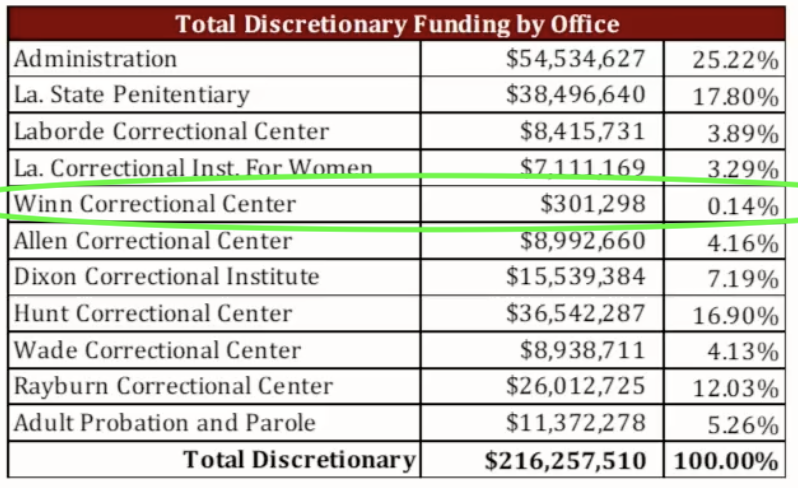
$500K Winn (30 people incarcerated at the state level), being rented to LaSalle Corrections, which rakes in millions from ICE to detain over 1,500 people. Filling this prison with people who aren’t from Louisiana leaves the state scrambling to pay sheriffs to house more people in local jails—effectively subsidizing jail guard jobs under the guise of public safety.
Under HB 2/ Act 2, the “capital outlay” bill, which funds future infrastructure projects, the Legislature approved $257,000,000 for the following regressive projects:
$64M for Lafayette Parish to build a new jail
$58M for juvenile prison expansion
$36M for state prison expansion
$33M to the Orleans Communications District (911, 311)
$27M State Police facility in St. Tammany
$26M in Angola State Penitentiary maintenance and upgrades
Courtesy of HB 93 / Act 240, voters in the “Acadiana Regional Juvenile Justice District” should expect a 1% tax (sales, services, rent) on their ballot to fund a new prison. These parishes are Acadia, Allen, Evangeline, Iberia, Jefferson Davis, St. Landry, St. Martin, St. Mary and Vermillion.
Louisiana doesn’t have the money to fund politicians’ obsession with prison expansion—and voters likely wouldn’t approve it anyway if ever put to the ballot. But don’t be surprised if Louisiana politicians try to funnel federal dollars through Homeland Security to keep it going (i.e. Florida got $500m to build an ICE detention facility). The real issue isn’t just profiting from cruelty—it’s that our state treats prisons like a rural jobs program while lining the pockets of big business contractors and architects who benefit from massive prison infrastructure projects.
Prior to the recent redistricting and the rise of a punitive supermajority, Louisiana’s Legislature had been on a promising path toward reducing overincarceration through the bipartisan Justice Reinvestment Initiative (JRI)—a 2017 reform package aimed at lowering the prison population, saving taxpayer money, and reinvesting those savings into community-based services and supports for victims. The initiative led to a significant drop in incarceration and helped reduce Louisiana’s long-standing status as the most incarcerated state in the nation. This recent reversal is especially devastating—not only because it undoes years of hard-fought progress, but because it signals a willful return to failed policies that harm families, waste public dollars, and deepen racial injustice.
So, brace yourself: they’re not done. Lawmakers will keep criminalizing everyday life, stacking on longer sentences, and pouring money into bigger prisons—doubling, even tripling incarceration costs—until all that’s left in Louisiana are cages, guards, and the people they’ve locked away.
Wins Far & Few Between (Not Including Defeated Bills!)
There weren’t many clear wins this session but a few positive bills did pass:
HB 405 / Act 498 – Requires election law changes to be made public. Mandates that the Secretary of State publicly share all changes in election law – boosting transparency in voting regulation. Hopefully we can use this to go backwards, and the state can finally clearly explain who can vote with a criminal conviction, and how they get registered. We’ve been doing that work for them over the past six years.
SR 154 – Creates atask force to study ways to increase voter participation and ensure more people are engaged in the political process.
SB 182 / Act 440 – Maintains access to Medicaid during a declared state of emergency. The federal government is poised to throw millions of people into health care related debt, poverty, and despair.
HB 100 / Act 140 – Prohibits bail bond agents from using cell phone tracking devices.
HB 384 / Act 497–Reduced the expulsion period for students from 2 years to 1. If the offense is cannabis, suspension only happens after a second violation. We know criminalizing kids doesn’t help them—and this is a step in the right direction.
HB 457 / Act 278 – Requires access to educational and religious materials in solitary confinement unless proven to be a “security risk.”
HB 584 /Act 209 – Establishes “Back on Track” Youth Pilot Program, a youth-centered alternative to incarceration.
Ultimately Vetoed
SB 87 – Ensures those who post cash bonds receive warrant notifications. Although SB 87 did pass through the Legislature, it was vetoed by Governor Jeff Landry with the below message. His prejudicial belief that only a family should post bond for someone accused of a crime ensures that people in poverty stay in jail, and only the wealthy gain their full constitutional rights.
VETO MESSAGE FROM GOVERNOR LANDRY: “It is no secret that George Soros, Kamala Harris, and the rest of the radical left has declared war on the concept of pre-trial bail advocating instead for letting criminals back out onto our streets and in our communities to commit further crimes with no oversight or accountability. One of the most popular tools in their arsenal is the use of “bail funds”, funded and supported by George Soros and similar radicals, that put up cash money deposits for bail for criminals they’ve often never met and with whom they have no connection. [Read more]”
Jim Crow Juries: We Still Refuse to Right the Wrong, But We’ll Study It
SB 218 – which would’ve allowed new trials (or new plea agreements) for people convicted by unconstitutional non-unanimous juries —failed on the Senate Floor after making it out of committee for the first time ever. Only 9 senators voted yes.
But not all hope is lost. A study commission, SR 183 is now tasked with studying and identifying how many people are still behind bars because of Jim Crow-era split jury verdicts. Impacted individuals can submit their case to the commission, which will meet starting in October 2025. Recommendations are to be developed by 2026.
Meanwhile, HR 243 calls on the Legislative Fiscal Office for a study on how much it would cost to grant those people new trials. We’ll be making sure they also study the moral and financial cost of doing nothing—from growing medical bills for aging people in prison, to Louisiana’s reputation as a national embarrassment.
After 5 years of failing to bestow justice upon these unjust convictions, it is past time to Let the People Decide. Lawmakers must push forth a ballot initiative for a statewide constitutional amendment decided by all, rather than 100 politicians. If nothing changes, we are spending close to a billion public dollars for 800 people to eventually die in prison. These people deserved a fair trial, and that will never go away.
Direct Blows: Bills That Passed, Unfortunately.
HB 675: Attacks on Post-Conviction Relief
Post-conviction relief (PCR) was aggressively under attack this session with multiple bills proposed. One of the most damaging bills of the session—HB 675 /Act 393 —became law. This dangerous new law makes it harder to challenge wrongful convictions, especially for those who plead guilty—even if new evidence proves innocence. This affects every person convicted and serving prison time – and specifically – the 55 people on Louisiana’s death row as well as the nearly 5,000 people serving life sentences. This represents a cornerstone of Gov. Landry’s campaign promise to resume executions in Louisiana after more than a decade-long pause.
Here’s what it does:
Bans people who pled guilty from later claiming they’re innocent—even if new evidence proves it (pro-tip: file claims anyway; get denied in state court and then take to federal court). FYI: this ban includes coerced pleas, where people are being threatened or deceived.
Forces people to give up attorney-client privilege if they claim ineffective assistance of counsel—allowing the state to cross-examine their lawyer (no problem) and demand disclosure of all private conversations (problem).
Doubles the state’s response time to post-conviction petitions from 30 to 60 days. Despite the claims that incarcerated people are “dragging out” their demand to be heard in court… it is usually the opposite.
Sets strict deadlines: if you filed a placeholder (“shell”) petition by July 1, 2025, you must complete it by July 1, 2026. Petitions filed before July 1, 2023, must be resolved by July 1, 2026, unless the court gives a rare extension. These timelines will likely overload the courts.
Dismisses petitions as “abandoned” after two years of inactivity. Typically, any inactivity is related to incarcerated people desperately seeking lawyers willing to take their (often complicated) case pro bono.
Eliminates the “interests of justice” exception—an important federal protection for rare, meritorious claims. The U.S. Supreme Court has always given space to extreme circumstances that should override a procedural bar, such as paperwork not being filed on time. This is a key exception for people who are filing things from inside a prison cell, through the mail, with no computer or phone access to the court or opposing counsel.
Denies bail to people who win a new trial after overturning a conviction.
Grants the attorney general the authority to file procedural objections to prisoners’ claims and to move to dismiss cases. This is aligned with the Baton Rouge state government seeking to take over the authority of locally elected district attorneys.
HB 675 is a slap in the face to anyone who’s ever tried to seek justice through Louisiana’s courts. If you or someone you know is impacted, act quickly, meet deadlines, and consider taking your case to federal court.
If you were wondering why Governor Landry was trying to pass a constitutional amendment for the creation of new “specialty courts” outside of long-established jurisdictions: A court that can dismiss all post-conviction petitions would ensure nobody ever is exonerated through the state courts, thus delaying any release for years, if not decades.
Bleeding a Stone
HB 199 / Act 253 doubles down on extracting money from the poorest people (“in forma pauperis”) in the system. It requires incarcerated people to submit six months of financial records just to request a waiver for civil court filing fees. Even with only a few dollars in their account, the prison must now take 20% of their income every month until the fee is paid in full. If someone has been released, they’re still on the hook—expected to report their assets and start paying once they have more than $10. Poverty, under this law, isn’t a circumstance—it’s a lifetime payment plan. Now, those claims won’t even move forward until every cent is paid.
This matters because civil lawsuits are often the only tool incarcerated people have to challenge dangerous conditions or misconduct and hold the system accountable. We are all too familiar with litigation around medical care, unsafe heat, solitary confinement, mental health care, rats, lead, asbestos, and forced labor in unsafe conditions. Someone could be working in a prison field for years just to earn the right to file a pro se lawsuit about why working conditions in the field are unsafe.
Policing Pregnancy: Civil Bounties and Criminal Traps
HB 575 / Act 383, Louisiana’s “Justice for Victims of Abortion Drug Dealers Act,” was one of the most chilling bills proposed during the 2025 session. Previously, a person receiving an abortion could sue the provider for any wrongful injuries suffered, similar to medical malpractice, and the financial compensation would be reduced if the patient signed a consent waiver. This bill was originally an incredibly vague law designed for men, and parents of the pregnant woman, to sue over abortions that allegedly already occurred, where he was allegedly the biological father. Public pressure dialed that way back.
What’s new? HB 575 now allows a lawsuit simply for having the abortion itself (and not rooted in wrongful injuries suffered by the pregnant woman) by expanding who can be sued. Specifically, it now includes anyone who facilitated the use of an abortion-inducing drug, whether they prescribed, sold, or distributed it. The new law also eliminated the reduction of any award based on consent. Most importantly, it creates a $100k minimum award for damages, that could be a financial incentive for every woman who knowingly and consensually had an abortion with no health complications whatsoever. The law applies retroactively and regardless of whether an abortion actually occurred.
The law targets anyone who distributes “abortion-inducing drugs,” but exempts health care providers and pharmacists who are licensed in Louisiana. It is intended to target those who facilitate banned medications like misoprostol (legal in other states), which is used to treat miscarriages, postpartum hemorrhage, and ulcers. HB 575 is part of a broader pattern: using civil courts to criminalize care, punish compassion, and expand the reach of surveillance and control. This isn’t about protecting life—it’s about outlawing solidarity.
HB 425 / Act 275 (Rep. Josh Carlson, R) expands the criminal definition of “coerced abortion” to include vague new definitions under the extortion statute: “a threat intended to compel a pregnant woman to have an abortion.” Even when no abortion happened, someone can be charged with “coerced abortion.” This is yet another example of the systematic control Louisiana is moving towards. The government majority’s desire to force births, by any means necessary, may only get more dystopian as time goes on.
A Blueprint for Immigration Surveillance, Not Safety
Louisiana didn’t just pass immigration bills in 2025—it built a surveillance regime. As ICE raids ramp up and Trump demands “3,000 arrests per day,” many of those detained end up here—where the federal government pays sheriffs around $100 a day to cage people. This is our economy of choice now: one that depends on locking people up. However, the truth is just a small but powerful group of people are reaping the benefits of creating this Big Government Immigration Program.
This package of laws does nothing to address Louisiana’s real issues. It doesn’t feed families, improve schools, or stabilize housing. What it does is weaponize basic services, chill access to care, divide communities, and turn the state into a foot soldier for federal immigration enforcement with no regard for civil rights, due process or common decency. It’s not immigration policy—it’s a playbook for fear.
SB 100 / Act 419 now requires state agencies to collect and report the immigration status of anyone receiving public services—whether that’s health care, housing, food, or education. Pitched as a measure to “coordinate” resources, its true function is to intimidate. For many immigrants, documented or not, seeking help now carries the risk of being flagged, tracked, or reported. Compassion becomes a liability. And anyone who believes their own services won’t be interrupted because they are not an immigrant: the state agency will need everyone to prove their citizenship and/or immigration status for them to uncover the small number of people they are looking for. Similar to drug testing regimes, the inquiry will end up costing far more than the savings.
SB 15 / Act 399goes a step further: it criminalizes obstruction of ICE agents, with fines and/or a sentence up to a year for any act intended to “hinder, delay, prevent, or otherwise interfere with or thwart” ICE, even if that means choosing not to comply with a detainer request. That’s not about safety—it’s about forced complicity. It deputizes the entire state to act as ICE’s backup, under threat of jail time. And it exposes a deeper truth: Louisiana politicians love federal power when it comes to locking people up—but not when it comes to protecting our environment, enforcing civil rights, or ensuring fair elections.
HB 307 / Act 351mandates immigration status checks for anyone applying for public assistance and requires that non-citizens be reported to ICE. It also orders annual audits calculating how much aid was given to “illegal aliens” and “unaccompanied minors.”
HB 554 / Act 292brands IDs issued to non-citizens with a special code and formal notice about voting restrictions—ensuring that even lawful presence comes with a mark of exclusion.
And HB 303 /Act 264 creates a special law enforcement unit, the Fugitive Apprehension Unit, within the Attorney General’s office to partner with ICE and U.S. Marshals in hunting down “fugitives.”
HB 436 / Act 17prevents an undocumented person from collecting damages in an auto accident, putting people outside the coverage of our laws, part of an intention to make the state entirely unlivable for some people under the mistaken impression our state will be better for it.
The War on (Natural) Drugs Marches On
The War on Drugs continues—this time targeting leaves and mushrooms. With the passage of SB 154 / Act 41 kratom—a plant-based substance long used to manage pain, PTSD, anxiety, and opioid withdrawal—is now banned statewide. Despite hours of testimony from health professionals and users advocating for regulation over prohibition, the legislature chose to criminalize it outright, backed by law enforcement and pharmaceutical interests. As of August 1, 2025, possession of kratom becomes a felony in Louisiana.
For years, kratom was sold openly and served as a lifeline for thousands of Louisianans, especially those without insurance or access to traditional care.
Meanwhile, HB 176 / Act 154 criminalizes derivatives of amanita mushrooms and phenibut—natural substances used for centuries—based on little more than anecdote and fear. There was no input from the Department of Health. No scientific studies. Just a Grant Parish sheriff claiming kids are “overdosing on candy” near checkout lines.
This is how drug policy gets made in Louisiana: the Executive Branch—charged with enforcing laws—instead acts as lead lobbyist, while the Criminal Justice Committee, chaired by Rep. Debbie Villio (who officially works for the Fraternal Order of Police), does the legislating. No health experts. No science. Just sheriffs and DAs pushing prohibition through law enforcement channels. So much for separation of powers.
This isn’t about safety. It’s about control. And the hypocrisy is glaring. In the same session, lawmakers advanced SB 19 / Act 464 to make ivermectin—a livestock dewormer turned folk remedy—available over the counter, waving the “individual freedom” flag. But when it came to amanita and kratom, that flag disappeared. A plant became a threat.
VOTE’s testimony reminded legislators: no one is asking why people turn to these substances. There’s no data. No proof of widespread harm. Just another swipe at individual freedom under the banner of “public safety.”
HB 12 / Act 233makes it a crime to sell or purchase consumable hemp products—like drinks or gummies—for anyone under 21. But rather than offering clarity, the law piles onto the chaos already surrounding Louisiana’s hemp industry, where mixed messages and scattershot bills are pushing tax-paying, job-creating businesses toward collapse.
Meanwhile, HB 36 /Act 345 offers a rare bit of sanity: shielding businesses from lawsuits if their hemp products are approved by the health department and sold through proper permitting channels. But even that comes wrapped in contradiction—the same statute calls these regulated products “illegal controlled substances,” putting hemp in the same category as street drugs, while alcohol and nicotine—far more deadly—remain exempt.
But Wait There’s More: Criminal Legal Bills
HB 5 / Act 230created a redundant “no parole” sentence for soliciting minors—even though that’s already illegal, and people convicted of this crime already are not parole eligible.
HB 14 / Act 343 adds “cruelty to the elderly or people with infirmities” as the 16th legal justification for the death penalty in Louisiana—when intent to inflict great bodily harm is found. If no intent is proven, it mandates life without parole. This law is most likely to impact caregivers, including staff at assisted living facilities where neglect and mistreatment are notorious. Previously, the maximum penalty for cruelty without death was 10 years; for manslaughter (when there’s no intent to kill), it was 30 years. Now, caregivers could face life in prison or death for the same situations.
HB 214 / Act 70 intensifies last year’s Crime Session goal of putting people in prison for lesser crimes and holding them for longer sentences. The key provision is that if someone commits another felony, the judge loses discretion to violate their probation. Now a violation is mandatory, no matter how petty the felony.
HB 208 /Act 158 changes yet another part of the law where parole is denied. It is mind-boggling as to how many statutes exist to deny people parole, good time, or probation violations. So many, the Governor, District Attorneys Association, our legislators (and their lawyers) need multiple bites at the apple to get them all. Meanwhile, they are ratcheting up the concept of “one bite at the apple” on appeals, and the slightest mistake can doom your plea of innocence.
Ironically, HB 171 / Act 248 removed the max salary cap for parole board members and makes their pay subject to annual legislative budget requests—despite parole being all but eliminated the year before. With fewer people eligible and longer wait times after denials, the board is doing less work than ever—and legislators are rewarding them. Parole has become so narrow, it’s like trying to ride a horse through the eye of a needle, yet some politicians still want it gone entirely (a violation of Constitution’s ban on ex post facto punishment or changing the rules after someone’s already been sentenced).
SB 39 / Act 317 buries claims of false imprisonment under procedural roadblocks and shields sheriffs and the DOC from civil liability when an incarcerated person is held past their legal release date. Under this new law (effective 8/1/25), anyone wrongfully imprisoned must first go through the administrative remedy process (ARP)—often a lengthy, uphill bureaucratic battle—and win before suing. Lawsuits filed before that are dismissed outright; ones filed too late are dumped with prejudice.
HB 64 / Act 237 gives the Attorney General sweeping power to take over any litigation filed against any local “political subdivision” (police department, city council, sheriff, school board, etc.) and blocks a local government defendant from entering into a consent decree without the approval of both the Attorney General and Governor. This is aimed at federal civil rights allegations and will generate another layer of lawyers’ fees paid by us.
HB 206which passed, but was VETOED BY GOVERNOR.This bill, directed at parish registrars and the Secretary of State, would have required legislative approval for any settlement agreements that arise in litigation. The Governor vetoed it because Act 237 already gives him control over these lawsuits and more. Thus, he has final say over redistricting, which is currently in the courts.
A Constitutional Amendment for Vote in November
HB 63 / Act 219–Do you support an amendment to change the mandatory retirement age for judges from seventy to seventy-five, provided that a judge may continue to serve to complete a term of office?
While it may seem innocuous, the structural issues it hides are serious. Voters rarely have full insight into a judge’s mental sharpness, stamina, or health. Lawyers—those best positioned to know and the only ones eligible to run themselves—won’t speak out, since their careers depend on staying in a judge’s good graces. That’s why judges are almost never challenged and only leave when a seat is open. The best elder judges can still serve as ad hoc judges or return to private practice. This amendment isn’t about public interest—it’s about a few individuals who want to stay on the bench.
When it comes time to vote on this: keep in mind the apparent malfeasance of New Orleans Chief Judge Derbigny, who suddenly quit this month. He had a massive backlog of cases for years, leading to the jail overflowing with people, and yet no lawyer would run against him in an election.
What We Dodged: Harmful Bills or Elements That Didn’t Make It
Not every attack on our people made it through. Here’s what didn’t pass—thanks to organizing, testimony, and pressure:
SB 74 Aimed to send 15-year-olds to adult court, yet again trying to dismantle the juvenile justice system and fast-track youth into the adult system. The bill was thankfully killed in committee—but it wasn’t the first attempt, and likely won’t be the last. This push mirrors shady Amendment 3, which Louisiana voters overwhelmingly rejected on the March 29 ballot. Despite that clear message, lawmakers continue to push their own punitive, unpopular agendas instead of listening to the will of the people.
HB 193Would have made it significantly harder for incarcerated people to challenge their incarceration or conditions of confinement. The bill proposed stricter rules for filing lawsuits—allowing the state to throw out cases over minor technicalities. If someone didn’t follow the prison grievance process exactly on time, their case would be dismissed with prejudice—meaning permanently. Even if a lawsuit was filed while someone was still waiting on the prison’s internal response, it would be automatically tossed. This bill would have gutted incarcerated people’s access to the courts and made it easier to ignore serious claims of abuse, neglect, and unsafe conditions.
HB 673 Would have repealed Louisiana’s wrongful conviction compensation statute entirely, stripping the state of any obligation to compensate those it wrongfully imprisoned. Even under the current law—where relief is limited and the bar for exoneration remains high—Louisiana has seen numerous qualifying cases. According to the National Registry of Exonerations, Orleans Parish leads the nation in per capita exonerations with 23 cases, while Jefferson Parish ranks eighth with 12. Rather than confronting this crisis of injustice, HB 673 is a harsh example of prioritizing punishment over people, offering no accountability for the system and no support for its victims.
HB 76 Sought to criminalize exposure to sexually transmitted diseases (STDs), with felony charges and lifetime electronic monitoring for intentional exposure to incurable STDs, and misdemeanors for curable ones. In reality, it would have pushed people further from care—discouraging testing, treatment, and disclosure.
HB 685 Anti-DEI (Diversity, Equity and Inclusion) programs across state government and barred race-or gender-based curricula at public colleges. Louisiana’s elected leadership struggles with addressing the past, including non-unanimous juries, voting rights, Cancer Alley, chain gangs, the Civil War, and slavery. Anyone having such a hard time accepting facts that have already gone by will sadly find it difficult to tangle with the present and plan the future.
HB 262, HB 619,SB 196 Anti-homelessness bills, including a homelessness court program, did not pass. Whether they call it “public camping” or “loitering” or some new term yet to be developed: it is unfortunate that our massive crises in housing and health care are constantly invoking courts, police, and jails to intervene.
HB 400 Regressive health care bill that would have required parental consent for most medical care was killed.
Passed but Neutralized
HB 310 / Act 352 was amended to remove the “any person” must file electronically in criminal court; it now only applies to “attorneys,” meaning pro se petitioners can still mail in their filings.
The Road Ahead
While the Capitol remains hostile, the people remain organized. As we head toward the 2026 session and the 2025 elections, our message is clear:
Louisiana doesn’t need more prisons. We need housing, jobs, care, and accountability.
To those inside and their loved ones outside—keep fighting, keep organizing, and keep holding power to account.
Bruce Reilly Testifies Against Criminalizing Peaceful Protest
In the first 90 days of Louisiana’s legislative proceedings, a curious tone has emerged, marked by a series of bills and acts that demand scrutiny and reflection. From contentious changes in gun laws to sweeping reforms in criminal justice and education, the legislative agenda reflects a hyper-focus on certain issues while neglecting others of equal importance. The prioritization of punitive measures over rehabilitation in criminal justice reform and the erosion of civil liberties in the name of public safety raise concerns about the state’s moral compass and commitment to justice.
Let’s delve into the key highlights and implications of these legislative actions.
Gun Legislation: The legislative session kicked off with a series of bills aimed at reshaping gun laws in Louisiana. Measures such as ACT 1, which permits concealed carry without permits or training, and SB 233, which mandates businesses to allow law enforcement to carry concealed firearms, reflect a concerted effort to expand gun rights. Additionally, SB 214 would allow concealed guns in restaurants that serve alcohol. The implications for public safety and individual liberties warrant careful consideration about collective security.
Criminal Justice Reforms: The legislative agenda also includes significant reforms in the realm of criminal justice. Acts such as ACT 13, which prosecutes all 17-year-olds as adults for all crimes, and ACT 8, which increases standard probation lengths and eliminates administrative sanctions for probation violations, signal a shift towards punitive measures over rehabilitation and second chances. The elimination of parole and Good Time, as well as the expansion of justifiable homicide laws, reflect a tougher stance on crime and punishment.
Social and Civil Liberties: Legislative action has been targeting marginalized groups, such as transgender individuals (HB 608), sexual orientation discussions in schools (HB 122), and reproductive rights (HB 156). Bills like HB 122, which bars teachers from discussing sexual orientation, and HB 156, which forces teenage girls who are raped to carry their pregnancies to term, raise concerns about equality and individual autonomy. Additionally, restrictions on public records requests (SB 423) and limitations on peaceful protest (HB 127, HB 205) undermine transparency and freedom of expression.
Economic and Social Welfare: The legislative agenda also addresses economic and social welfare issues, with bills impacting marginalized communities and social safety nets. Measures such as HB 303, which cuts SNAP benefits if a child is adjudicated for a crime, and HB 481, which cuts federal TANF benefits for those failing a drug test, raise questions about the state’s commitment to supporting vulnerable populations. The prioritization of corporate interests over public welfare, as seen in decisions regarding insurance regulations and federal funding for children’s food programs, raises questions about political priorities.
Education: Bills like HB 71 and HB 745, mandating the posting of the Ten Commandments in schools and expanding voucher funding for private/religious/charter schools, highlight a push towards ideological agendas in education. The implications of these measures on the separation of church and state and the quality of public education merit further examination.
It seems they are hyper-focused on people such as:
The neo-Nazi who intentionally drove into a protest, injuring many and killing another in Charlottesville;
The police officer who kneeled on a man’s neck for 9 minutes in Minneapolis;
The out-of-town teenager who shot and killed two protestors in Kenosha;
The protestors who marched through the neighborhoods of Baton Rouge after the police killed an unarmed vendor;
The self-appointed neighborhood security who killed Black teenagers in Florida and Georgia;
Teachers who shed light on any uncomfortable aspects of history;
Other people’s sexual identities;
Journalists who seek public documents regarding government actions;
People below the poverty line seeking federal support;
The culpability of gun owners.
In light of these legislative developments, it’s crucial for Louisiana residents to engage critically with their elected representatives and advocate for policies that reflect their values and interests. By staying informed and actively participating in civic discourse, citizens can shape the future of Louisiana and hold their leaders accountable to the principles of democracy and justice.
As Louisiana gets ready for another hurricane season, with Hurricane Ida (2021) insurance claims still in dispute, political leaders have decided that throwing ourselves at the mercy of a deregulated insurance industry is the way to save our homes. For a state that is so dependent on tourism dollars in the liberal and diverse city of New Orleans, where drinking is legal in the streets and live music can be heard on nearly every corner… it is wise for the passengers on this ship to question which direction the captain is taking us.
Check out the full list of proposed bills below:
Allow everyone over age 18 to carry a concealed weapon, with no permit, registration, nor training; ACT 1
Force all businesses to allow law enforcement (active or retired) to bring a concealed gun inside the premises; SB 233
Allow concealed guns in restaurants that serve alcohol; SB 214
Prevent civil liability of anyone who is injured or killed by people with concealed weapons; ACT 2
Reinforce State’s burden in proving someone did not act in self-defense; HB 819
Create a “justifiable homicide” where a driver runs over a pedestrian, protestor, or anyone in a roadway who made the driver afraid (and requiring no actual contact nor weapon); HB 355 (DEFERRED)
Prevent civil liability where a fearful driver runs down a pedestrian, protestor, or anyone in a roadway; HB 383
Create a crime of conspiring or planning to block a roadway; HB 127
Expand racketeering laws to include protest planning; HB 205
Create a crime of protesting in a way that a resident’s peace is disturbed; HB 737
Criminalizes getting within 25-feet of a police officer; HB 173
Limit public records requests to resident citizens of Louisiana; SB 423
Require photo-ID for anyone requesting public records; SB 502
Exclude the Governor’s schedule from public records; SB 482
Publicly post the arrest of everyone 17 and over, including their mugshots; ACT 15
Prosecute all 17-year-olds in the adult system for all crimes; ACT 13
Drug test everyone who is arrested; ACT 4
Increase standard probation lengths from 3 years to 5 years; ACT 8
Eliminate administrative sanctions (and short jail stints) for petty violations of probation; ACT 8
Allow full revocation of probation (and sentence someone to 5 years prison) for an arrest, without needing a conviction; ACT 8
Amend the state constitution to allow an elimination of the juvenile criminal courts; HB 203
Allow children to be imprisoned in adult facilities; HB 210
Have the Governor appoint the Public Defender; ACT 22
Create a commission to procure funding for juvenile prison construction; SB 431
Allow for, and subsidize, hiring of police officers and sheriff’s deputies; Exec. Order
Create a division of state police in New Orleans; Act 20
Create and fund Attorney General’s shadow prosecution office in New Orleans; Exec. Order, HB 1
Violate U.S. Supreme Court rulings, including Trump v. Missouri (2024), that prohibits states from putting qualification restrictions on candidates for federal office; HB 664
Violate the Louisiana Constitution Art. 1, Sec. 10.1 by adding additional restrictions on running for school board; HB 188
Create a gender-specific surgical punishment for men convicted of sex offenses; HB 166
Twenty-five year mandatory minimum for “detectable amount” of colorful fentanyl; ACT 19
Ten-year mandatory minimum for detectable amount of fentanyl that looks like a generic pill; HB 720
Eliminate parole; ACT 6
Eliminate Good Time; ACT 7
Criminalizes giving anything of value to panhandlers; HB 97
Creates $500m private/religious/charter school voucher funding; HB 745
Mandate the Ten Commandments be posted in every school; HB 71
Forego federal dollars for children’s food programs; Exec. Order
Automatically cut SNAP benefits if a child is adjudicated for a crime; HB 303
Allow up to 10 years in prison for a false statement in applying for workers comp. benefits; HB 247
Cutting federal TANF benefits of anyone failing a drug test; HB 481
End mandatory meal breaks for child laborers who work over 5 hours; HB 156
Force transgender people to use bathrooms, or live in quarters, that do not reflect their appearance, in schools, jails, shelters, and prisons; HB 608
Bar teachers from discussing sexual orientation; HB 122
Force teenage girls who are raped to birth their child; HB 156
Create an interstate compact on immigration enforcement, and violate U.S. Supreme Court rulings, including Arizona v. United States (2010), that preempt the state from regulating immigration; SB 388
Fund a deployment of Louisiana National Guard to Texas; Act 20
Call for two-week Constitutional Convention (this June) among the 144 Legislators and Governor’s appointees to be submitted to voters this October; HB 800
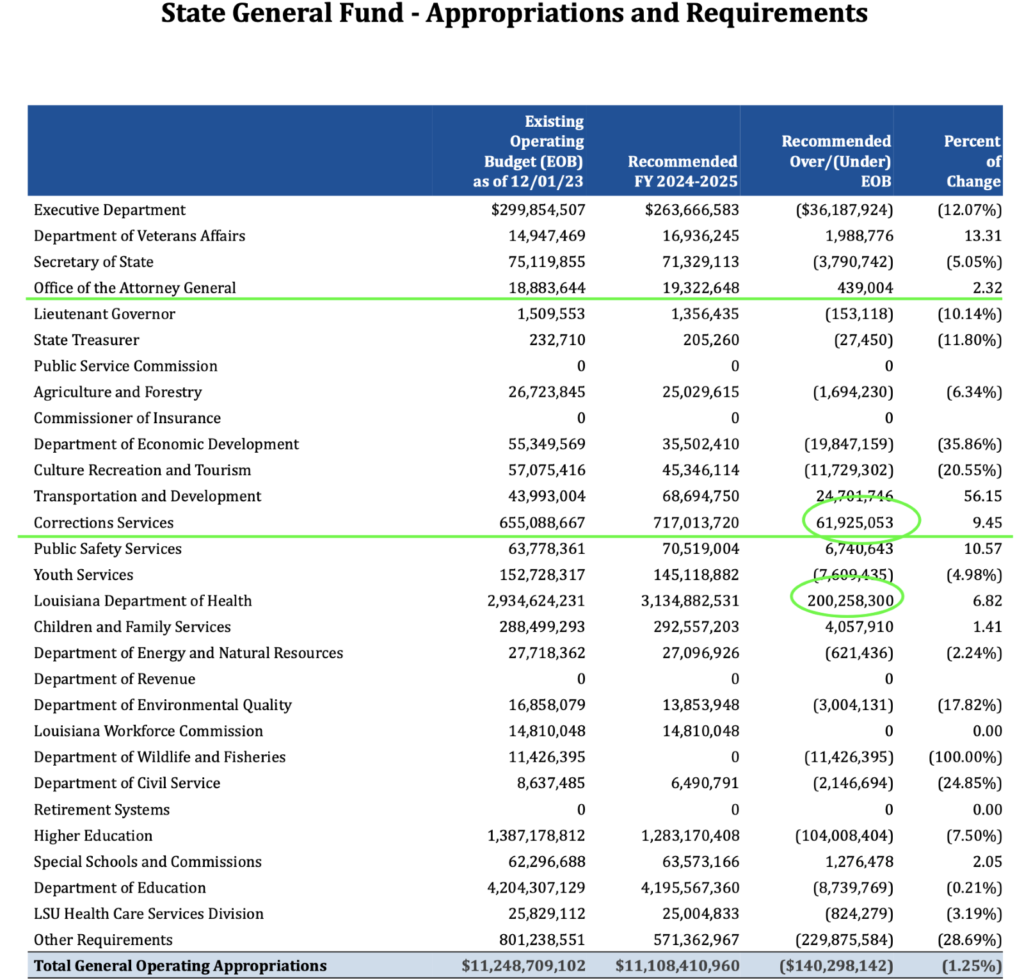
Our hope is to make the DOC Budget more transparent and accessible for our community including legislators, elected officials, media, reporters and investigators. We should all know where our tax dollars are and are not going. If our budgets are moral documents, let’s see where our morals lie.
****
THE INCARCERATION BUDGET: HIGH AND CLIMBING HIGHER
Budget documents are one of the best ways to cut through the chatter and get down to the numbers. What are we trying to do, and how much are we spending on it? From the time Gov. Jeff Landry ran for office to the time he celebrated his “special crime” legislation, one would guess a few things based on not just his words and deeds, but the people around him.
First, they believe that the way to prevent crime is to ensure someone is convicted, incarcerated, and not released for as long as possible so they can commit no more crimes (at least not until released). Second, they don’t believe in the concept of rehabilitation, change, second chances and helping people assimilate back into society. Finally, they are willing to write a blank check to achieve goal number one. With that said, it is increasingly difficult to understand the mission of the Department of Corrections if it reverts into a place of hopeless and brutal punishment that incites more crime than it prevents.
What follows is a look into the overall funding, a framing of the incarceration industry as a Louisiana employer, and the peculiar usage of local jails to handle a state obligation. Download the full budget here.
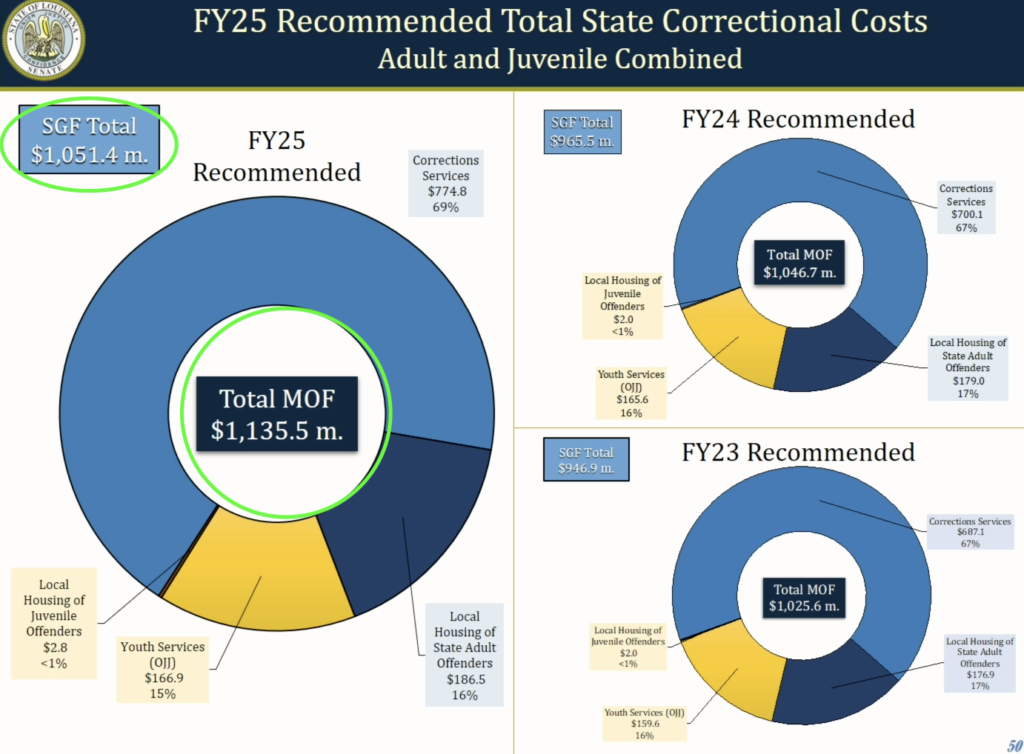
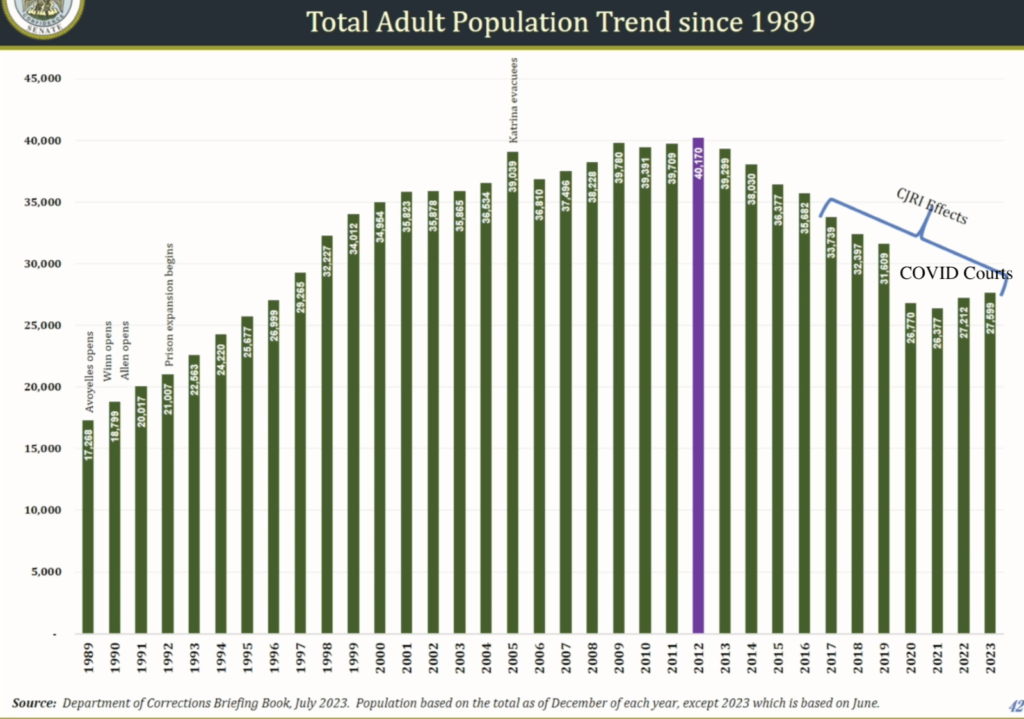
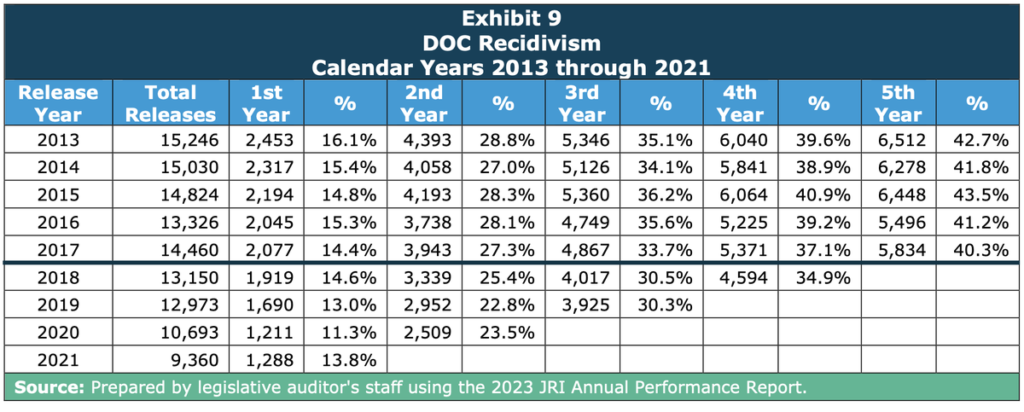
Despite the number of people incarcerated going down since the 2009 – 2012 peak, the cost of locking people up continues to climb past $1 billion dollars and beyond.
One look at the overall budget, and it is clear prisons are a massive part of the statewide budget and are at no risk of being cut.
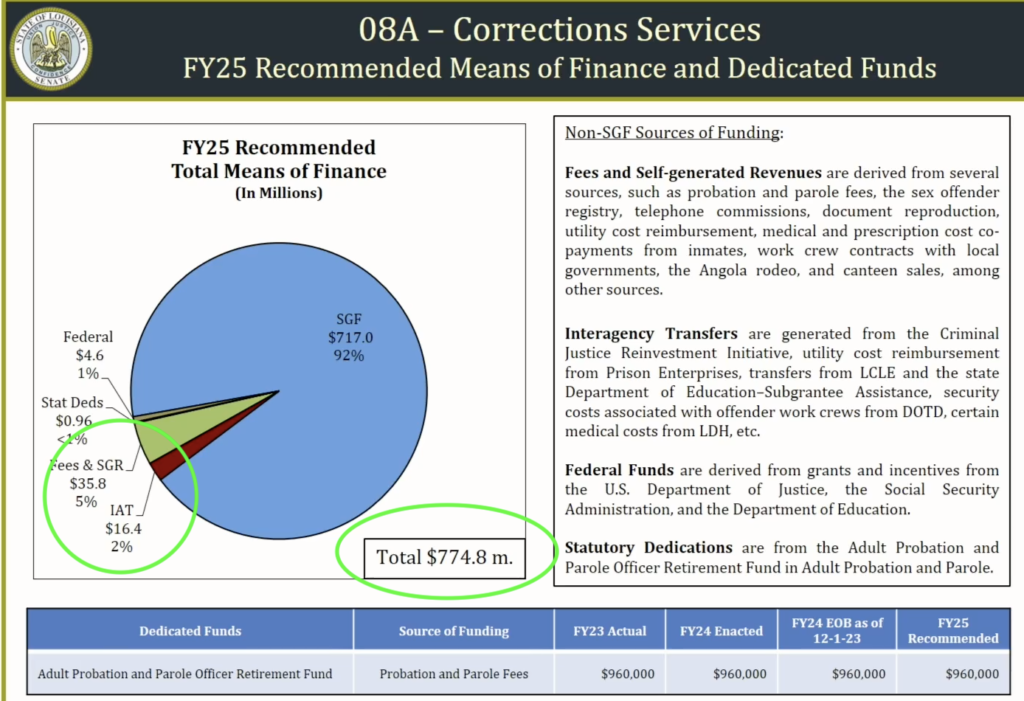
To cover up this major expense, politicians might seek to focus on “user fees,” such as probation fees, canteen profits, telephone kickbacks, or medical co-pays.
The users, however, are overwhelmingly penniless and it never adds up to any substantial percentage of the budget.
BUDGET DRIVERS: RETIREMENT AND MEDICAL COSTS
Why is incarceration so steep? The majority of funding goes to staffing expenses (more on that below), and to the thousands of retired staff who continue collecting a pension. Unfunded Accrued Liability (“UAL”) is not our expertise, but this is the amount of expected monies owed that do not have funds set aside. You can see that the Corrections budget has over $103 million (18%) going to UAL and retiree’s insurance.
Another major cost is medical care for patients in prison. According to the DOC, in their legislative presentation, total medical care spending is “somewhere around $100 million.” The monies are partly found in bills for people sent to the outside doctors, partly in the particular facility’s budget, and partly paid out to the local jails where people are detained.
The Legislature’s 2024 Special Crime Session passed several new laws that should make the medical costs skyrocket as people get older. Eliminating parole (including medical and geriatric) and major cuts to Good Time credits will increase sentences. Narrowing parole for people already inside (unanimous parole decision) will turn other people’s sentences into Death Sentences.
The Lewis v. Cain case on Angola’s unconstitutional health care is forcing that institution under federal receivership. Costs will go up as care becomes legitimate. And lawsuits should begin against every facility that houses people, as none of them provide anything close to a reasonable standard of care.
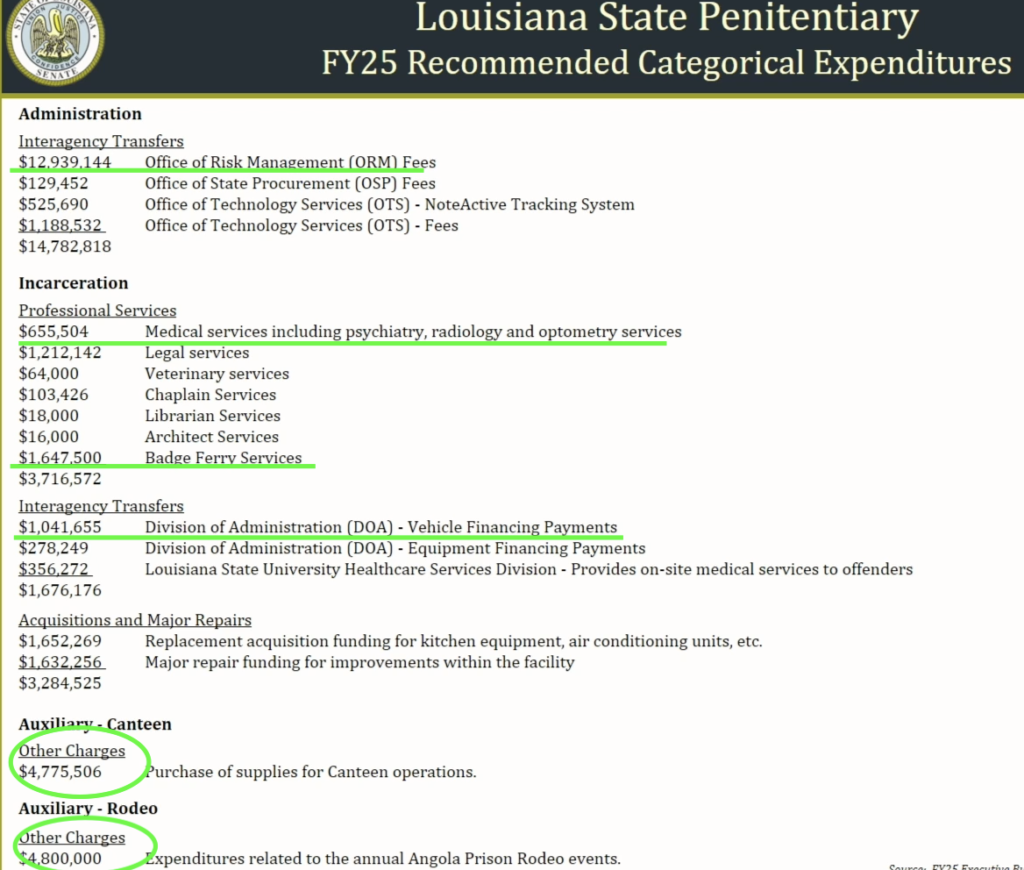
In the Corrections budgets, you will see them broken out by the overall statewide administration, and then each of the facilities in the system. The Louisiana State Penitentiary, AKA Angola, has the most incarcerated people who are the oldest and most likely to die in custody. Every facility budget has a few things that stand out:
Office of Risk Management fees (Angola: $12.9m)
Medical services ($1.1m)
Vehicle financing payments ($1m)
Angola also has $1.6m going to Badge Ferry, which likely refers to the prison ferry that crosses the Mississippi River for employees. It is unclear if that ferry still operates, and it is well known most of the staff live at the penitentiary itself. Angola’s budget is also peculiar in having costs for putting on the infamous rodeo, but it is unclear where the profits from these weekends fit into the budget. Meanwhile, every facility will put in costs for purchasing canteen supplies; however, if this is referring to the items incarcerated people are buying with their own funds, we know the prison runs an overall profit on that exchange.
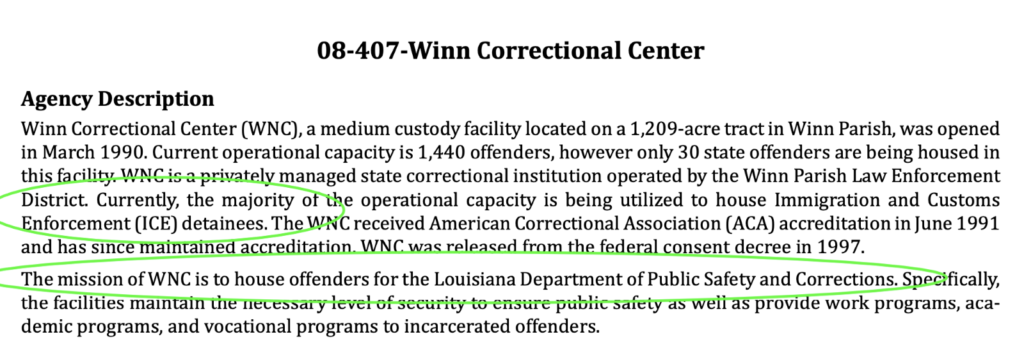
Looking at the overall summary, it is clear that another big piece is keeping the buildings functional, constitutionally compliant, and large enough to handle the influx of people. One shrinking part of the budget is in regard to Winn Correctional Center. In the Feb. 28 budget presentation at the Senate Finance Committee, it was noted that this prison is being leased out to the sheriff in Winn, “for about a million dollars.” It isn’t clear where that million is reflected. DOC Undersecretary Bickham explained to the House Appropriations Committee (March 6, 2024) that there is a Cooperative Endeavor Agreement in place, and the state can take control back from the Sheriff at any time, with roughly six months’ notice.
STATE BUDGET: SUBSIDIZING LOCAL JAILS, SHERIFFS, and DEPUTIES
According to the budget report, the mission of Winn Correctional Center is to ”house offenders for the Louisiana Department of Corrections.” However, it isn’t doing that. Instead, they are renting the beds out to Immigration and Customs Enforcement (ICE). During the Trump Administration’s massive border detention crackdown (which neither turned people back nor let them stay free pending their administrative hearing) Louisiana rented bed space to ICE for nearly 10,000 detainees. This is likely a large reason why the sheriffs had no qualms with the prison system contracting the way it did. The Feds pay a much higher rate per person. With that number coming down quite a bit, perhaps this contributes to why Gov. Landry deployed our National Guard to the Mexican border.
We are unsure why ICE or Winn Parish Sheriff, who uses LaSalle Corrections to administrate the prison, would want to obscure any details in a contract between two public entities, but it appears that somewhere around $65m is transferred between federal public funds to Winn, according to the Sheriff’s budget report. The entire parish population is only 13,755, and likely includes the number of incarcerated people. It is easy to see why a sheriff’s $14m payroll, pensions, plus local contracts contribute to political influence.
You may be wondering: Can the state lease out one of its facilities to a sheriff, who can then turn a profit with the federal government? And then pay for some incarcerated workers to help staff the facility?
It’s important to understand the relationship between state and local facilities. These parish jails were built in bulk during a time when the state subsidized construction costs and guaranteed the population to be detained. A great summary of this process is in “Prison Capital” (2023) by Lydia Pelot-Hobbes, who was a recent guest on the “From Chains to Change” podcast (listen here).
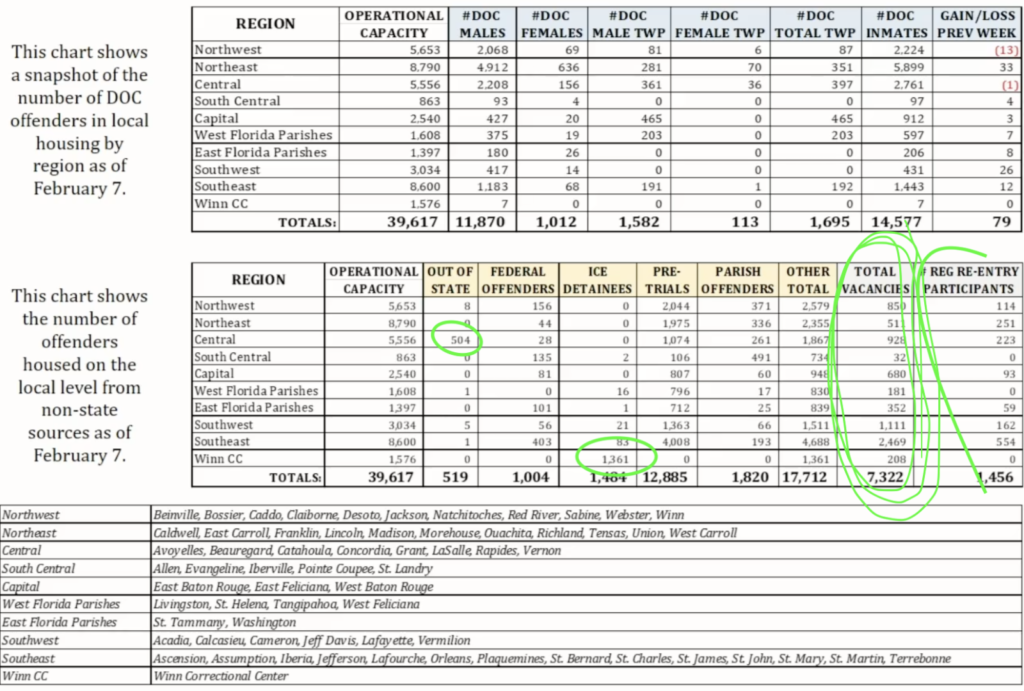
When the state facilities are bursting, the overflow goes to local jails run by sheriffs, with a per diem paid (less than half of what ICE pays the Winn Sheriff). Traditionally, the state/local balance was about 50/50, but taking Winn offline for state incarceration has led to the local jails holding more than the state prisons. While our prisons report only 781 total vacancies, and only 21 releases per day, the local housing has 7,322 vacancies. And naturally, the budget is confusing as to whether Winn is a state or local facility.
At times, this math does not add up. Rep. Kimberly Coates (D-73) of Tangiapahoa brought up a dilemma in her parish. The local jail is full of state prisoners, for which the sheriff collects the per diem from the state. Meanwhile, there is not enough room for locally arrested people. This forces the parish (not the Sheriff) to pay $800,000 to ship these people out to other jails.
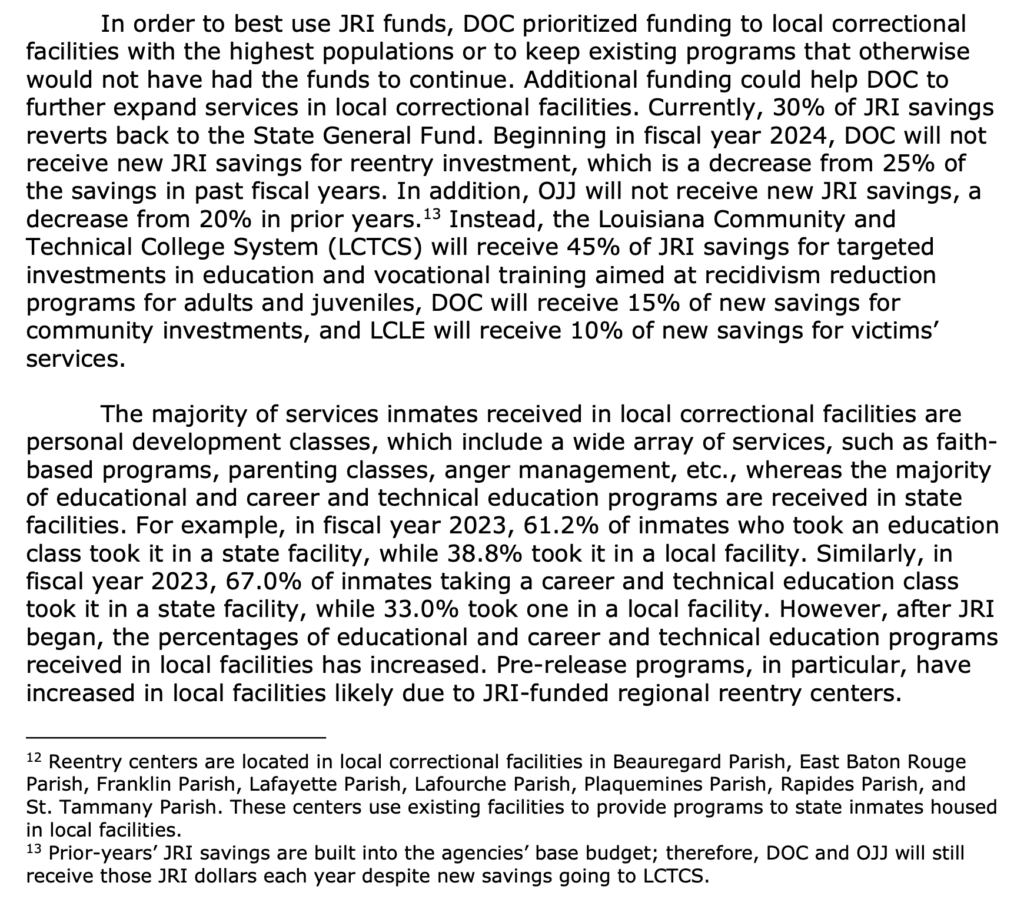
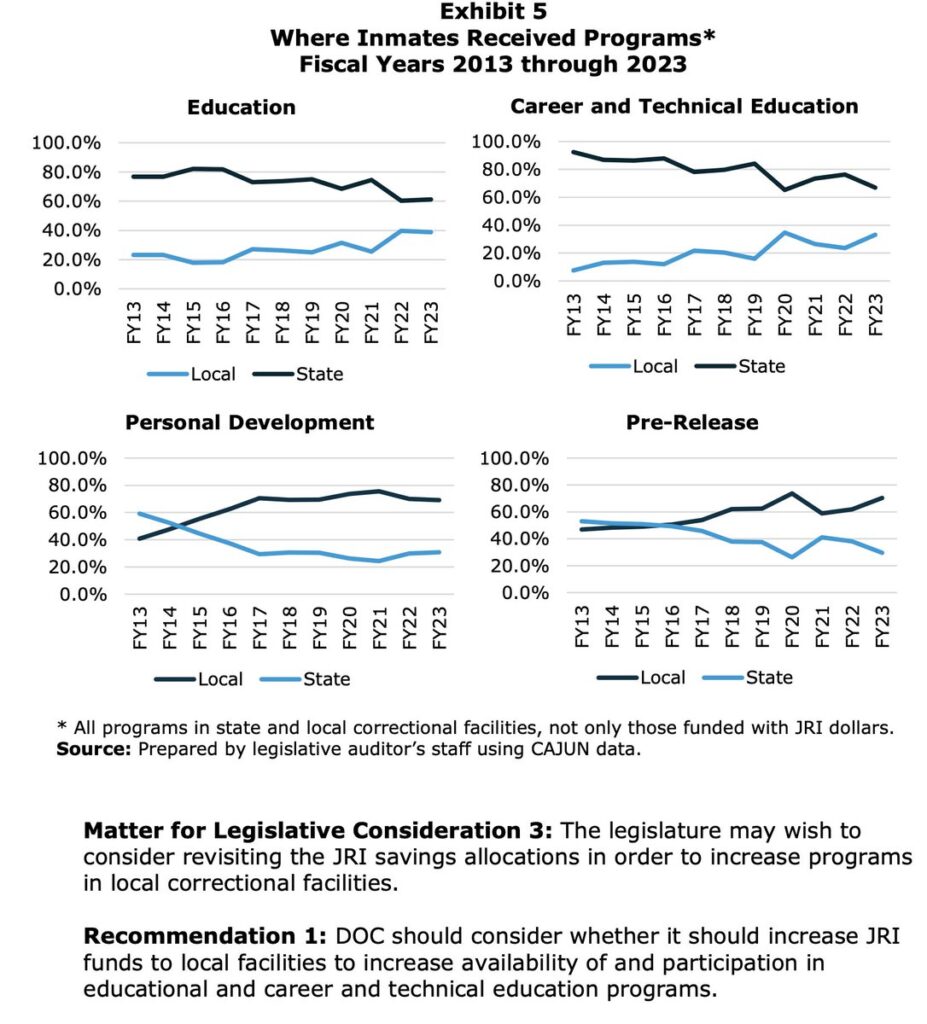
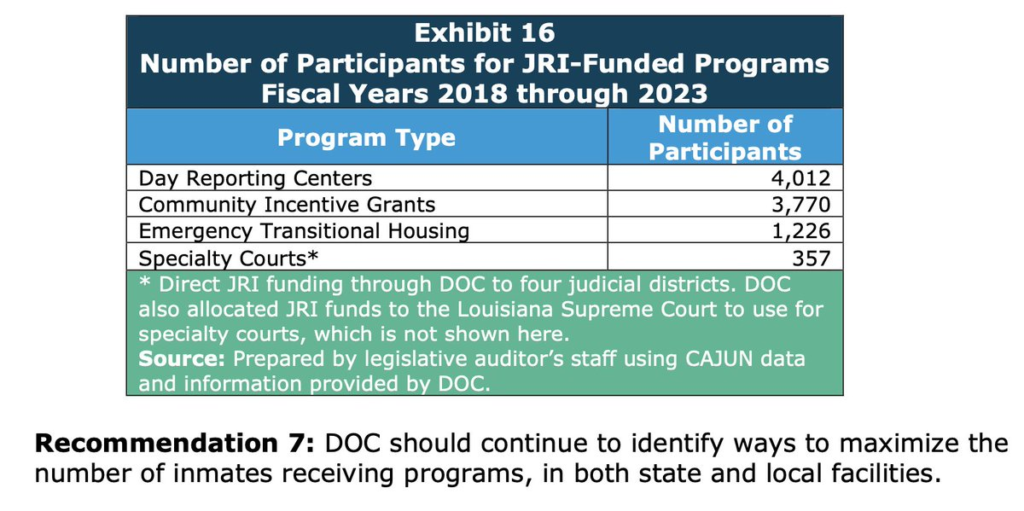
Also noteworthy in the above graphic are the 1,456 “Re-entry participants” at regional programs inside the local jails. This is a fraction of the 11,870 people serving state time, but part of the programming funded by the Justice Reinvestment Initiative (JRI). For those clamoring “JRI didn’t work,” we never once heard them criticize the sheriffs and their programming.
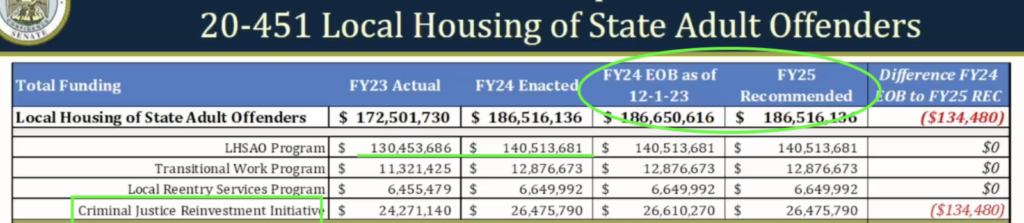
The state has an operational carceral capacity of 14,359 (not including Winn), and 13,505 people are housed. Local jails, on the other hand, can hold 39,617 people, and only 12,885 are being held pre-trial. It is clear who stands to gain by decreasing the use of bail, increasing probation and parole violations, and lengthening sentences. And we also are unlikely to see them give back the $26m in savings from JRI.
With the state prisons relatively stable in population, unless Winn’s lease is canceled, it is the local jails, run by sheriffs, whose funding was in jeopardy by increasing rehabilitation, decreasing recidivism, providing reentry support, scaling back discrimination, and downsizing prisons. The JRI funding to sheriffs was tailored to garner their support.
As anticipated, Louisiana’s Special “Crime Session” wrapped Thursday, February 29th with devastating speed. In just 10 days, almost the entire slate of proposed legislation passed. These bills will cost taxpayers millions while making us less safe and roll us back to failed policies of the past.
Here are 22 bills to be mindful of:
Act 1 / SB 1: Anyone over 18 (w/o felony conviction) can carry a CONCEALED FIREARM without a permit; can’t carry while under influence; can’t carry in church, parade, airport, place of worship, State Capitol, court, or wherever state/federal law prohibits (“gun free zones”). Any property owner or lessee can prohibit guns on property. (7/4/24)
Act 2 / SB 2: GUN LIABILITY. No Liability for firearm if caused by “justified use of force or self-defense.” Does not cover gross negligence, intentional misconduct, or if convicted of felony (7/4/24)
Act 3 / SB 9: SEX OFFENSE STATUTE OF LIMITATIONS begins with any newly discovered photo/video evidence.
Act 4 / HB 3: Opioid funds: Sheriffs DRUG TESTING all people arrested, within 24 hrs of booking; all positive tests are screened for substance abuse disorder and Drug Court eligibility; all found suitable for Drug Court shall be subject to Art. 904 (ineligible for Drug Court if charged w/ violent crime); test results inadmissible in any civil/criminal action (presumably probation/parole violations); all positive tests requires pretrial drug testing program; probation can be up to 8 years; completion of probation is eligible for expungement (but still counts as 1st offense for Habitual Offender tally) (7/1/24). Note: Mislabeled as “drug court expansion,” but any expansion requires additional funding by Legislature.
Act 5 / HB 6: DEATH PENALTY methods: nitrogen gas and electric chair; process secret; Inspector General will review and certify the vendor of drugs is licensed and not connected to governor or legislators (7/1/24)
Act 6 / HB 9: ELIMINATE PAROLE, (offense committed after 8/1/24) except under-18, Life or sentence over 25 yrs (25 yr eligibility), 1970s Lifers (currently eligible). (eliminates geriatric and medical; ends 20/45). Leaves only Good Time Parole release; effectively death penalty for anyone sentenced to over 50 years.
Act 7 / HB 10: “Serve at least 85%” Can only earn Good Time credits up 15% of the sentence, plus up to one-year for program completions; no Good Time while on parole; pretrial Good Time credits still in effect (Art. 880). Applies to offenses committed after 8/1/24.
Act 8: / HB 11: Increase maximum PROBATION from 3 to 5 yrs (unless in Drug Court’s 8 years); Probation can be extended for unpaid fines/fees; “compliance” requires paid fines/fees; no more Good Time credits; Judge can still early terminate at any time if in compliance; technical violations carry up to 90 days for 1st incident; misdemeanor possession of Marijuana still a technical violation; arrests (including misdemeanors) are subject to full revocation (do not need a conviction), court can order full revocation for Failure to Appear, violation of protective order, failing to complete drug program, failure to report for 120 days. (Offense committed after 8/1/24)
Act 9 / SB 7: DWI – interlock devices on car for at least 6 months
Act 10 / HB 4: D.A.s and judges lose discretion to waive procdural bars for out-of-time of repetitive POST-CONVICTION applications; no exceptions
Act 11 / SB 5:UNANIMOUS PAROLE BOARD; must have 3 years without major infraction to be eligible (was 1 year); A.G. is also notified, all notices must be 90 days prior (was 60 days); parole decisions are void if notification requirements not followed; 3 year wait for rehearing if 1st offense violent crime; 5-year wait for other violent crimes and sex offenses; release date can be revoked prior to release;
Act 12 / HB 23: All Challenges to CONSTITUTIONALITY of a statute must be served to the Attorney General, to which they have 30 days to reply.
Act 13 / SB 3: LOWER THE AGE – 17-year-olds committing a crime after April 19, 2024 are adults. Jails and prisons still must adhere to “sight and sound” separation from people over 18.
Act 14 / SB 4: JUVENILE mandatory minimum of 2 years on any second offense that is a violent crime (eligible for modification at 2 years, or 50% if sentenced under 36 months), must attain “low risk,” and either earned GED or in workforce training program, and recommendation of OJJ
Act 15 / HB 1: “TRANSPARENCY” of court records. All criminal court clerks provide public access (via statewide online portal) to minute entries on all cases filed since 2020. No traffic violations. Includes juveniles arrested on violent crimes after Jan. 1, 2024 (can be sealed by a court). Data: Arrest, charging, bail decisions, hearings, identity of judge and prosecutor; clerks are immune from liability. Will expose people whose charges are dropped, including kids in school, and every criminal allegation or conviction for those 17 and up.
Act 16/ HB 2: LIMIT LIABILITY of “peace officer” and their employers (includes Neighborhood Associations) unless criminal, fraudulent, or intentional misconduct. Gross negligence is now shielded, likely to impact traffic accidents with peace officers (and insurance claims). Police brutality claims can still proceed in federal court.
Act 17 / HB 5:“Illegal use of weapon” (i.e. firing a gun in the air) is now a violent crime regardless of anyone being hurt.
Act 18 / HB 7: Carjacking sentences raised: 20 – 30 years if serious bodily injury; 5-20 if not. (Most are charged under robbery statute anyways, carries up to 99 years).
Act 19 / HB 8: Possession w/ Intent, or distribution of FENTANYL: 25 – 99 years if “detectable amount” of fentanyl if the product or packaging has “reasonable appeal to a minor.” No minor need be present. No sale need happen.
Act 20 / HB 19: FUNDING $3m to send National Guard to Texas; $600k to create new Public Defender in Gov. Branch; $22 million to State Police
Act 21 / SB 10: NO GOOD TIME if 2nd (or more) violent crime; death of first responder = 1-day Good Time per month.
SB 8: Moves PUBLIC DEFENDER under Executive Branch. Gov. Appoints statewide public defender, subject to approval by Senate majority and PD Oversight Board (9 board members, must have been lawyers for 8 yrs, 4 appointed by the Gov, including Chair; Gov selects one of 3 nominees by LACDL; Supreme Court appoints a retired judge and a juv. Justice advocate; 1 each from Senate President and Speaker of House); State Public Defender approves budgets of district defenders; public hearings for contracts with attorneys or indigent defender organizations, etc.; deletes policy of selecting proportionate minority / women lawyers; State defender must be Louisiana licensed, with 20 yrs experience and 7 years in criminal defense; District Defender contracts can only be 5 yrs max; district defenders stay employed; Oversight board establishes district defender compensation plan; Selection of new district defenders via Committee: one attorney and 2 registered voters from that district (1 appointed by state defender, 1 by district chief judge, 1 by Oversight Board) and submit 3 nominees to the State Defender. All contracts honored through Jun 30, 2024.
Week One wrapped this Friday and we have thoughts…
This Governor and Legislature is reminiscent of Israeli Prime Minister Netanyahu and their legislature in the days after October 7. There is a complete disregard for history and circumstances that precipitated the situation, and comprehensive problem solving has been replaced with blind rage and a violent counterattack. This session is about crime “reaction,” and nothing about crime “prevention.”
Consider the bills, actions, and statements in totality:
New Orleans will be occupied by a second layer of state police whose arrests will be handled by the state Attorney General. A message to law enforcement that they will have immunity from prosecution or lawsuits regarding brutality and rights violations (HB 2, SB 6). A State of Emergency was declared to allocate additional funding to hire more police and alleviate any restrictions on hiring them too quickly or without proper training. Meanwhile, a deployment of the National Guard to Texas indicates how quickly the Governor is to expend our resources on ideological pursuits.
Police saturation is not based on any data correlation with safety and crime. Louisiana has more law enforcement per capita than anywhere in the world, including a police station inside the French Quarter (next to the Louisiana Supreme Court) and a second police station bordering the Quarter. Crime rates, which is the percentage likelihood that someone will fall victim of a crime, do not account for New Orleans commuters and visitors; thus, all of those “high” rates (based on number of residents) are false. Millions of visitors come and go without being scared, but that is not likely to be true if New Orleans begins to resemble the Palestinian West Bank.
Thursday night Rep. Jason Hughes gave an impassioned speech pushing back on the characterization of New Orleans as a “wild west” place to fear, and questioned the details around the State Police “Troop” to be stationed in New Orleans.
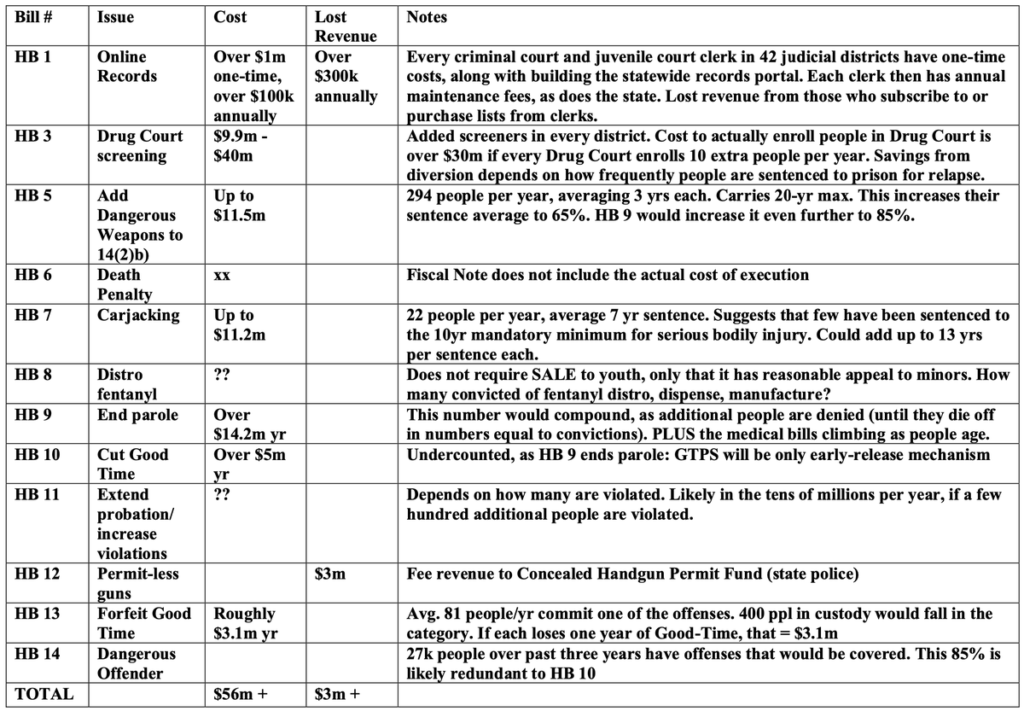
The expansion of Drug Court testing (HB 3) was a promising bill, however the hearing suggests this is simply a method of transferring millions of Opioid Litigation Settlement funds into the hands of sheriffs who will drug test everyone who gets booked into the jail. There is no talk of expanding Drug Court or expanding treatment, both of which are already at capacity, and there are no quality controls in place with sheriffs in Louisiana. Thus, it will be a handout, and testing will be relatively meaningless.
As shared on our X account, @FIPVOTENOLA in 24 tweets, here are key data points that counter the recurring “soft on crime” narrative and highlight the consequences of proposed legislation.
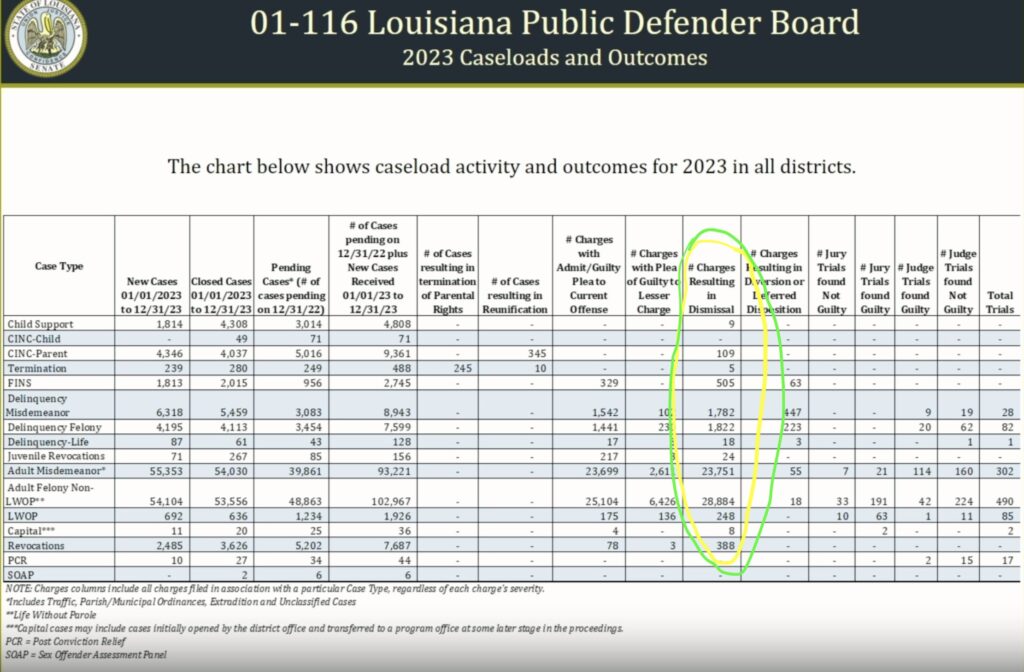
HB 1: Over 55,000 charges were dismissed, among people with public defenders in 2023. Under HB1, these arrests are publicized and freely scraped off the internet.
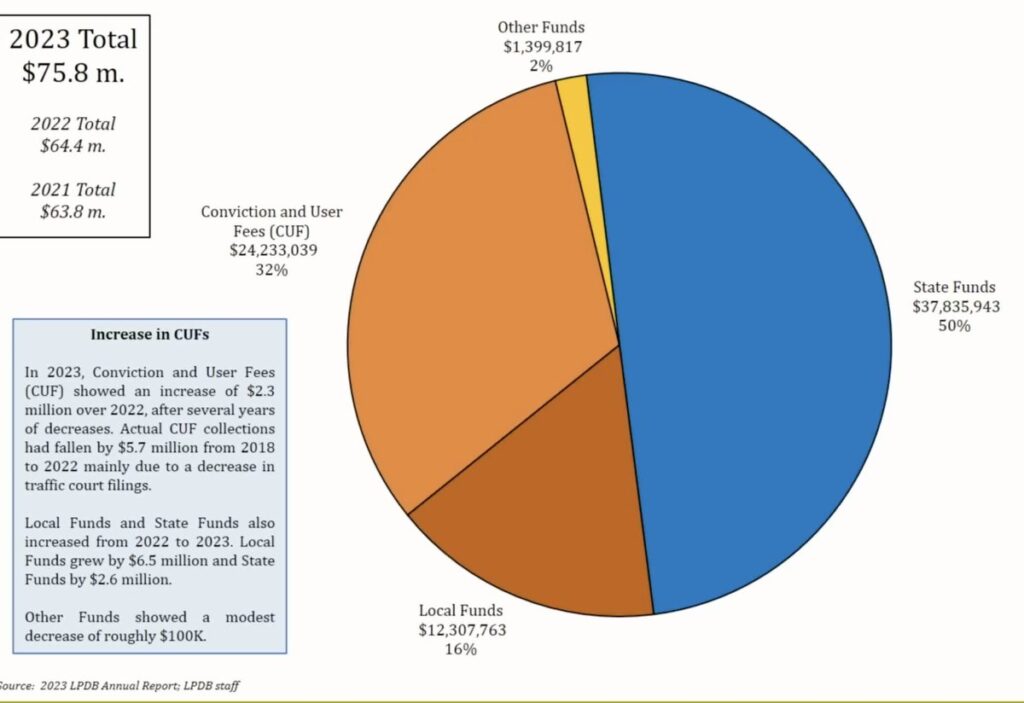
SB 8: Indigent defense currently gets 32% of its revenue from “Conviction and User” fees, creating a conflict of interest for lawyers getting paid when a client is found guilty, rather than innocent. Under SB 8, Gov. Landry will appoint the state Public Defender.
JRI: The 2017 Justice Reinvestment Initiative (JRI) impacted only non-violent offenses, and in the years since, people in prison have declined for all categories. Keep in mind that JRI programs did not begin until savings were converted into program and impact a few years later.
With reduction in people incarcerated, fewer people were sent into local jails (where over half of state prisoners serve). This resulted in significant lost revenue for sheriffs, which JRI stood to replace by funding local programs to help lower-level (and nonviolent) convictions
Despite added funding, jails do not offer nearly as many programs as state prison. JRI has had massive impact to increase that, but “savings” (JRI dollars) are expiring without reductions to incarceration. All progress is soon to be abandoned without a fiscal allocation.
None of the #CrimeSession bills provide any programming, nor fund prevention, rehabilitation, or reentry. However, the incarceration costs will soar at least $60 – $100m annually under the Governor’s package of bills. None of which acknowledges the Angola medical litigation.
Some legislators, rather than accept facts on recidivism going down (comparing apples to apples over time) would like to redefine the word “recidivism” while failing to provide their oranges to oranges data over time.
It is unclear which actual data visualization in reports by the Louisiana Legislative Auditor, the DOC, or Pelican Institute that people are not looking at, but the facts are facts.
Naturally, data sets can have imperfections (and we are all for better data), but that imperfection applies across the past 20 years. It can also be easy focus in on the less than 1% of cases that capture the public’s fury, as roughly 75% of crimes do not have a victim.
Keep in mind that the impact of reforms are typically a person being released a few months earlier than they would have. Someone serving 3 years on a nonviolent drug possession would be out on parole roughly 6 months earlier. Their success hinges on the supports, not the 6 months.
The clear #1 successful program is housing with an 89% success rate, even when over half of participants having a violent conviction. The Legislature can allocate funds here, and support Rep. Matt Willard’s bill to decrease discrimination for prospective tenants who are able to pay.
While programming has trended up under JRI, there is still hardly enough programs, practically zero substance abuse programming, and people serving the longer sentences will always be pushed back on waiting lists as others are closer to release.
With the majority of people held in local jails, JRI hasn’t had enough time to develop programming throughout the system. This begs for Equal Protection litigation for those held in jails, as fewer programs = less rehabilitation, longer terms, and worse results.
The primary programs under attack in the Governor’s push to “Stop Justice Reinvestment” will be the Reentry Programs, funded by JRI and run by sheriffs. It is unclear in this fast session if those programs will continue at all.
One reason for less recidivism is more supportive programs after release, even if only impacted a small portion of people. It should be no surprise that places such as New Orleans and Baton Rouge have lower recidivism rates because there is a broader and deeper network.
Despite seeing successes, the Crime Session does not invest in the things that decrease crime: Housing, jobs, mental health counseling, community health workers, opioid medication, substance use counseling, education, trauma care, restorative mediations, family reunifications…
Of the relatively few people able to learn a trade in prison, nearly a quarter were able to find a job in that industry. 80% of them did not return to prison.
The cost of incarceration is $37k per year, which is 9x the median wages of people who returned to prison, and nearly 3x the wages of people able to assimilate into the community. With robots, self-checkout, AI and jobs being exported, Louisiana is using prisons for excess labor.
Meanwhile, JRI youth programs show stellar success. However, the Louisiana legislature appears determined to halt any progress.
There are no glaring statistics about any specific age group. And with small numbers, a few successes or failures can seem like a major difference.
HB1: Despite juvenile crime going down, and 17 year olds being temporarily considered juveniles, the Crime Session will have impact kids who do not commit the most serious crimes, by publishing all arrests for violent crimes, and making petty offenses of 17 year olds “adult” crime.
It should concern everyone that the Crime Session is absent of actual data and lacks testimonies from the Legislative Auditor, DOC, judges, sheriffs, and other data analyst groups.
And even more concerning when the Violent Crime Task Force put out false narratives about people serving 15% of their time, on average; or people serving an average of 6 years on violent crimes [despite roughly 25% of people in Louisiana serving a sentence of Death in Prison].
Over 26% of Louisiana’s prison population (over half who are in sheriff’s jails) currently have over 10 years Time Served in prison. 10% of them have over 20 years in. Long sentences have increased, while short sentences decrease.
The Louisiana Legislature’s special “Crime Session” begins on Monday, February 19th, with committee hearings expected to happen on Tuesday and Wednesday. With the rules being suspended, a bill can pass out of committee in the morning and be heard on the Floor that afternoon. The next day it is likely in committee in the opposite chamber, with the process repeating.
Twenty-four bills were filed in five committees, with half of them in the House Administration of Criminal Justice. See them all in VOTE’s 2024 Bill Tracker here.
Below is a summary of the bills, organized by category, the largest being “Extending Sentences.”
Transparency
HB 1 requires court clerks to report all their docket entries to a public portal, including hearing dates, counsel of record, charges, bond set, sentences, continuances, and names of judges. This applies to all adult courts and juvenile cases in violent crimes and/or someone facing a second felony. Posting a juvenile’s pretrial information (while still holding the presumption of innocence) may violate a child’s right to privacy, and that will likely incite numerous lawsuits. This will be a very costly portal to create and maintain, all so people can easily look-up an arrest record of every Louisianan. HUD, and the FTC (who oversees background check databases under the Fair Credit Reporting Act) have on multiple occasions explained that arrests are not to be used as indicators of guilt, so it will be interesting to see how the state law “immunity” clause (for the Clerks of Court) plays out in federal court when someone sues a housing provider or employer for discrimination.
Law Enforcement
HB 2 and SB 6 limit law enforcement liability to actions that are criminal, fraudulent, or intentional misconduct. Considering nobody ever won a liability case against a police officer without proving one of those things, these bills are performative, with no real impact. Any officer accused of misconduct will still require a hearing to decide if it is “intentional.” SB 6 also bars any liability if the complainant is convicted of a crime. Thus, as long as there is a conviction, a police officer can violate someone’s rights in any number of ways. It is unclear how this intersects with criminal misconduct, or if a petty conviction will bury any and all abuses. Most people will file such a claim in federal court, where such a waiver will carry no weight.
Drug Court
HB 3: Mandatory drug testing and screening for specialty courts (by licensed professionals) is well intentioned. The actual impact on addiction recovery is far from clear. First, someone’s intoxication level within 24 hours of arrest is not a clear indication of their substance use, nor even if they were intoxicated while allegedly committing a crime. Drug Courts typically sentence people to an intensive outpatient regimen, and drug testing, over an 8-year probation term. Recovery and relapse are intertwined, thus the level of punishment (or support) someone receives if they slip up is the difference between Drug Court as a successful therapeutic model or simply as a gateway to prison. Having data on the preexisting Drug Court cases, including firsthand testimony, would help clarify the likely outcomes of expansion. Realistically, Louisiana can turn about a third of all judgeships into “drug court” if they truly want to handle the intersection between the desperation of drug use and crime. To tackle it correctly, however, we need an army of health care providers, treatment facilities, and medication assisted treatment. If the threat of prison alone kept us sober, we would be the straightest population on the planet.
Wrongful Convictions
HB 4 forces district attorneys and judges to object when a person files a post-conviction appeal that is after the filing deadline, if it had been heard before, or if over a year has passed since uncovering newly discovered evidence. This takes the discretion from judges and prosecutors who would only be allowing the case to be heard if they had serious doubts about the legitimacy of the conviction. It is a peculiar bill considering how often legislators say, “they trust their district attorney.”
Extending Sentences
HB 9 is the big one, as it eliminates parole eligibility on all crimes happening after 8/1/24, except for juvenile Lifers. The price tag on this will be enormous, including the medical costs, especially if it is determined that it overrides medical furloughs and release.
SB 5 impacts all the parole-eligible people currently in prison and requires a board to be a unanimous vote for release. One member of the board could single-handedly block every release. The bill also requires someone to go 3 years without a serious discipline infraction, rather than the current 2 years. The parole board only releases about 2% of the 15,000 people who get out every year, each of them typically showcasing impeccable behavior and an impressive institutional resume. For people with extreme sentences, it is typically the only way they can be released. The bill also makes someone wait an additional 4 years after denial to be reconsidered. The final paragraph of the bill, although slightly vague, suggests the Board will have the power to rescind any parole decision at any time in the future “for any reason deemed appropriate by the committee.” This may run afoul of the Supreme Court’s principles in Morrissey v. Brewer, and how Due Process (not the whims of a king) govern such a liberty interest.
HB 5 adds a 61st crime to the list of “violent crimes” (R.S. 14(2)(b), which are then ineligible for things such as Good Time or parole and become enhancers for Habitual Offender multipliers. The law defines “illegal use of weapons or dangerous instrumentalities” as an illegal or negligent discharge of a firearm (or use of an article or substance) where it is foreseeable that it may result in death or great bodily harm. Another example of how many ways someone can be charged for the same action.
HB 7 essentially doubles the sentences for carjacking, with mandatory minimums of 5 years where no serious injury and 20 years with serious injury. It raises the maximums to 20 and 30 years respectively.
HB 8 creates a 25-year mandatory minimum for a “detectable amount” of fentanyl whenever it is added to something that is “attractive to minors.” This vague phrase includes things that are in the shape of animals, vehicles, or candy. It is difficult to imagine this law holding up in court, if it is used, considering that basic adult vitamins, for example, look like candy. More to the point, however, this is another example of how we are punishing our community members who have an addiction problem rather than providing opioid antagonists and residential treatment. A 30-year-old parent who gets hooked on fentanyl won’t be eligible for release until they are 55 in this scenario.
HB 10 mandates that sentences after 8/1/24 will earn a maximum of 15% Good Time credits. This means that, if they do not get any write-ups, they will serve 85% before being released on Good Time Parole Supervision (GTPS). With the elimination of discretionary parole eligibility under HB 9, this will be the only path to release short of 100% of a sentence. People sentenced to 40 years or more will likely die in prison. This bill also ends Good Time credits for people on parole. If they are violated, they will serve the full-term in prison, with no credit for time on the street. This may result in people turning down GTPS release altogether.
HB 11 increases the maximum probation term from 3 years to 5 (except Drug Court, which can be 8). Based on data and research, this term was reduced because by year 4, people had generally either succeeded or failed. The extra years were simply unnecessary labor for probation officers, and subjected people to petty infractions and fees rather than being able to move on. The bill also increases the penalties for technical violations: up to 90 days in jail. It also reduces what is a “technical” violation, including how an “attempted misdemeanor” would be subject to a full revocation instead. Its unclear what would be good examples of such an act.
HB 13 pushes for anyone convicted of a violent crime while in prison to lose all their Good Time. This bill seems redundant, particularly if someone is earning just a small amount under HB 10. Good Time credits can already be deducted by a disciplinary action without needing the trouble of a trial and conviction for assaulting someone.
HB 14 “Dangerous Offender” bill is redundant to HB 10, which would require everyone to serve at least 85% before GTPS release. Under this bill, a judge can deem someone a “dangerous offender” if they have one prior conviction for violence, sex, or drug distribution. This would require them to serve 85% of their time.
Children
SB 3 reverses the “Raise the Age” law which puts 17-year-old kids in the juvenile system. The law took five years to phase in, but Louisiana did nothing to expand the juvenile system to absorb those court cases and kids in custody. With extra space in adult jails and prisons, Louisiana prefers to return to the old ways. This change complicates things for wardens who must keep the 17-year-olds separate from the actual adults and coincides with Louisiana building more juvenile prisons. Thus, there will be even more space for 14-16 year olds across the state in a system with 300% turnover in their staff and a newly appointed head of the Office of Juvenile Justice who was notoriously involved in sexual abuse scandal with the kids.
SB 4 will make it more difficult for kids to get a second chance through the courts. Any child seeking a sentence modification must serve at least 3 years in prison (or 2/3 the sentence if shorter than 3 years). This will prevent judges from recognizing positive rehabilitative changes amongst children who are deep in their developmental stage.
Death Penalty
HB 5 creates absolute secrecy over who executes the people on Death Row and where they get the lethal substances. It also adds nitrogen hypoxia as an approved method of killing someone. Realistically, it should be the Governor who executes a person, as they alone have the power to not kill someone.
Indigent Defense
SB 8 moves public defenders from the independent “Board” into an executive state office. The Governor would appoint a head of the office who has 20 years’ experience as a barred attorney, with 7 years in criminal defense. This would be more experience required than the Attorney General and Louisiana judges, and it isn’t clear how the 7 years in defense would be calculated. The extreme requirement is likely intentional. The Chief Defender would hire an executive staff, and then contract with local head public defenders who (apparently) are nominated by a selection committee of one lawyer and two registered voters. It remains to be seen (if passed) who would be providing the constitutionally guaranteed right to effective defense counsel, and how flush (or starved) their budgets. It is likely that lawsuits are filed based on conflicts of interest and falling short of the 6th Amendment rights. For a chief executive who appoints the heads of the State Police and the Department of Corrections, a former Attorney General who successfully advocated for the State Police and A.G. to have criminal divisions in New Orleans (for starters): this has a massive appearance of impropriety.
Guns
HB 12 and SB 1 make it so any 18-year-old can hide a gun under their jacket, even if they have a documented mental illness or substance use issue. The only people prevented would be those with a felony record. It will certainly cause distress for gas station employees, Lyft drivers, and others who may rightfully question the intention of someone packing heat. How police officers, security guards, and business owners react will range from strict “No guns allowed” signs to shooting anyone considered armed and dangerous. It is difficult to imagine there being less shootings in Louisiana under such a law.
SB 2 takes away liability for conceal carry owners unless there is gross negligence, intentional misconduct, or a criminal act. This would put the onus on courts and juries to define gross negligence if an unlocked gun is stolen and used criminally.
Other
HB 15 is a reasonable amendment to the law. The 6-year time limit to charge someone for 3rd Degree Rape does not begin until after the crime is discovered by the victim.
SB 7 increases the usage of ignition interlock devices for DWI punishments. The sentence for .08 (the standard for “drunk driving”) from 90 days to 180. Realistically, DWI laws are among the few criminal laws that take a reasonable approach to balancing freedom, the right to work, and accountability for a dangerous situation. If only all parts of the criminal code were addressed as such.
Governor Landry has increased two parts of the state budget: prisons and the state police. He also recently issued a state of emergency that allows sheriffs to hire more people and receive more pay. The public concern about the incoming administration is well placed, as he continues to fight all regulations on clean air, clean water, and land pollution. It also appears public education and health care, already abysmal in Louisiana, are further on the chopping block. In a state so committed to force women to have babies, one might wonder what vision they have for such children.
Dear Members of the Violent Crime Task Force (VCTF),
Thank you for posting the Draft Report under HR 168. After thoroughly reviewing the report and examining the data in the public folder, please find the comments from Voice of the Experienced (VOTE) below, addressing specific sections of the Draft Report:
Addressing Violent Crime
The purpose of the HR 168 task force is “to study and evaluate recent legislative reforms to the Louisiana criminal justice system and the effects of such reforms on public safety and crime in Louisiana,” and make legislative recommendations for “criminal justice reform that reduces crime and recidivism in Louisiana while improving public safety and strengthening our communities.” However, the task force falls short by focusing on only a few reforms, neglecting hundreds of others, and potentially misinterpreting data. This narrow focus, combined with the conflation of data sets, leads to questionable and dangerous conclusions about the relationship between sentencing reforms and new crime.
Importantly, the VCTF crunches two data sets together, incarceration and crime, and implies a causality that has not been proven. The task force erroneously correlates the rise in crime with an increase in parole, implying causality without evidence. First, you would need to show that there are more people on parole (there are not) and second you would need to show that these people on parole are at the heart of a spike (you have not). In fact, members of the VCTF have claimed that there are not enough parole violations.
There are two types of reasons someone on parole can be returned to jail or prison, for a “New Crime” or for a “Technical Violation.” The first one will get their parole revoked along with an additional new sentence. The second, a technical violation, is when there is no new crime, but they violated the terms of their parole- often related to living conditions, jobs, travel, or a failed drug screen. Technical violations do not drive up crime rates. Sometimes such people will have parole revoked and sometimes they will get “sanctions” of several days in jail.
The VCTF also fails to distinguish between “all crime” and “violent crime.” It is well established that people who have four or more felony convictions are nearly always those people who struggle with mental health and/or addiction. Often, such people will have no victim in their cases other than themselves, and potentially low-level property offenses. It appears that the VCTF’s goal is to lock away the problem and not seek to address it. It would be negligent and backwards if Louisiana’s best solution to mental health and addiction issues is incarceration in the form of psych prisons and addiction prisons.
The VCTF possesses more data than a “hunch,” as to the relationship between sentencing reforms and new crime. There have been no changes in the law that prevent a prosecutor from charging someone with a violent crime, regardless of whether they were 12 years old or convicted five times before.
The task force suggests punitive measures without addressing root causes, such as mental health, addiction, poverty and lack of tools for conflict resolution. Instead of proposing solutions, it leans towards incarcerating individuals without considering alternative interventions. The need for programs that mediate disputes, provide outlets for children’s anger, and offer support to struggling families is crucial.
To tackle violent crime effectively, the legislature should focus on addressing the underlying factors that contribute to criminal behavior. This involves creating decent job opportunities, affordable living conditions, and accessible mental health resources. The desperation of poverty creates a confined list of poor choices. When someone’s parent(s) are incarcerated, or struggling with poverty, mental health, or addiction: those children get a daily education in a harsh world. There is a reason that most of the violence is perpetrated by young people whose minds are not fully developed, and who have a limited view of the possibilities. They act impulsively and are often put in dilemmas far beyond their years to navigate.
If the legislature is serious about preventing violent crime, it is critical Louisiana political leadership call upon people with firsthand experience in violence and its consequences. Impacted people are not just credible messengers to reach young people acting out of hopelessness and anger, Louisiana needs their insights as to how we can address the critical factors that can save lives. Humans are not robots to program or dogs to whip into submission. We are complex emotional creatures, and we will all sink or swim together.
Addressing specific parts of the Draft Report:
Has violent crime gone up, or has the Legislature simply labeled more crimes as “violent?”
First, it should be noted that crime is down from last year, across Louisiana and across the nation. For example, New Orleans has seen such dramatic decreases in violent crime between 2022 and 2023:
Homicides decreased by 27%
Carjackings dropped by 43%
Armed robberies were down by 35%
Nonfatal shootings decreased by 23%
All of these improvements occurred while the New Orleans Police Department has been experiencing an unprecedented staffing shortage. This suggests there is less connection between law enforcement and violence as some would believe. And although some equate the crime spike coincided with the COVID-19 epidemic to “less policing” or “delayed trials,” the more thoughtful connection is regarding employment, housing stability, recreational activities, school closures, and more.
Statistically speaking, violent crime data will inherently change if we redefine “violent crime.” Many citizens would likely be surprised to learn that Louisiana classifies 60 offenses as “violent crime.” These offenses include high profile and extreme scenarios like murder, rape, and robbery, but also lesser offenses such as 2nd degree battery, violating a protective order, and possession of a firearm (in certain circumstances). Re-classifying crimes into the “violent” category of R.S. 14.2 does not make crime go up or down but does create apples-to-oranges comparisons over time. If there were 40 crimes, for example, in 2004, then a twenty-year comparison would be adding 20 new offenses to the data set.
According to the 2022 JRI Report:
The largest increase in Types of Crimes is “Possession of Firearm by Felon” – from 1,028 (2016) to 2,009 (2021). Because this is categorized as a “violent crime” under Louisiana R.S. 14.2(57), it creates a significant uptick in “violent crime” whether a person was harmed by the firearm or not. As a staunch 2nd Amendment rights state, it is unclear what impact that culture has on gun ownership.
By contrast, the next largest (and one of few) increases by crime type was Possession of Schedule II Drug, from 926 to 1,427, respectively. Roughly half the increase of the possession of a firearm.
1700 people were sentenced to probation for “violent crimes.” This indicates prosecutors and judges agreed that the offense, although classified as “violent,” was not so egregious as to warrant imprisonment (although surely many served multiple months in pretrial detention before their probation sentence).
Several Draft Report claims do not seem supported by the data
The report reads:
“Length of time served by an inmate is actually less than 15% of their actual sentences.”
According to the DPSC Table 1.f “Time Served,” and Table 1.e “Sentence Length,” we get a snapshot of incarcerated people, but not the percentage of their overall sentence served upon release. If the VCTF can point to a specific data point revealing this 15% number, please do.
Among those incarcerated:
60.4% served 0-5 years
14.1% are 6-10 years
25% served over 10 years
This leads us to another peculiar statement in the Report:
“Moreover, the data shows that less than 5% of Louisiana’s prison population is serving more than thirty years.”
How is this remotely true, when the data clearly shows 11.3%? [See Table 1e]
6.6% are serving 0-2 years
7% serving 3-4 years
29.7% 5-10 years
19.8% 11-20 years
25.3% 21-30 years
7.7% 31-50
3.6% 51+
The statement is especially misleading when an additional 25% are sentenced between 21-30 years. Thus, well over a third are sentenced to longer than a generation.
Continuing the odd choice of data:
“[T]he average time served by a violent offender is less than six years.”
This should be changed to, “among those released on a violent crime, they served an average of 64.3 months on a sentence averaging 122.9 months (about 10 years).” The sentence may need an * as the data in the 2022 JRI Report (p. 46, Table 15) may be omitting Life Sentences and discretionary parole altogether. This is nowhere near the 15% figure noted above.
Additionally, only 17% of people released from prison are for violent offenses.
The average time served before discretionary parole on violent offenses is 261.3 months, or nearly 22 years. This is only a few dozen people. Perhaps the VCTF can calculate the time served prior to death within the data.
III. Recidivism data matters- and Report claims need support
A. “55% recidivism for Habitual Offender class after 5 years.”
This statement deserves context.
As the table below [compiled from various data tables DPSC provides] indicates, all recidivism has gone down over the past decade, with some sub-populations dropping more than others. While 4th offenses is at 55%, 3rd offenses are only at 24%. It is also unclear by the DPSC data how many people fit this most extreme data point. And as noted above, people in this class are typically saddled with an addiction or mental health situation that requires treatment to overcome.
People who have served over 7 years in prison have less than 3% recidivism, with those who spent over a decade at less than 1%. Considering the average release time on a violent offense is over 5 years, there is certainly a significant overlap here. This erodes the notion that “violent recidivism” is a driver of incarceration growth or spikes in crime.
People released after violent offenses have lower recidivism (37%) than those released on nonviolent offenses (40%), on a consistent basis over the years.
The recidivism rooted in education completion has had the most drastic impact (from 44% down to 29%), likely attributable to both the quality of education available and the expansion of opportunities over the years (such as licensing reform and Ban the Box policies), including policy reforms attributable to a bipartisan Louisiana Legislature.
The parole board has 22% recidivism amongst a tiny sample, while the massive number of people completing Probation or Parole (20,188) have just 12% recidivism.
The gap between getting out of jail vs. prison is growing, with people having more success leaving the latter. This likely stems from the programming, education, and recreational activities in prison.
Population Subset
2012 Releases
5th yr Returns
2017 Releases
5th Year Returns
Total Releases (baseline)
14,487
43.6%
14,460
40.3%
GoodTime Parole (auto)
11,808
45.1%
12,620
41.5%
NonViolent Offenses
11,943
44.4%
11.833
40.9%
Education completion
1,345
44.7%
974
29%
Released Local Jail
8,441
46.2%
9,566
43.3%
Released State prison
3,080
43.4%
2,197
35.3%
Completed P&P
19,017
15%
20,188
12.9%
Work Release
2742
37.7%
2,849
36.4%
Parole Board
825
38.5%
288
22.2%
Violent offenses
2,551
40%
2,627
37.6%
Under 1 yr served
51.6%
1-3 yrs
32.4%
3-7 yrs
11.7%
7-10 yrs
2.7%
Over 10 yrs
Under 1%
Jefferson P.
31.7%
Orleans P.
33.7%
EBR
36%
Caddo
45.7%
Livingston
46.2%
1st Offense
4.7%
2nd Offense
16.1%
3rd Offense
24%
4th Offense
?
55.2%
Livingston (20.8%) and Ouachita (22.8%) Parishes have nearly double the Statewide 1st year recidivism (13.8%), which is 5% in Orleans and 8.8% in Jefferson, suggesting that access to resources plays a major role in stability. Among the DPSC listed parishes: Bossier, Lafourche, Ouachita, Rapides, Terrebonne, Caddo, and Livingston all have over 41% recidivism after 5 years.
According to the Draft Report:
B. “LDAA shared that 55% of 1,948 people who benefitted from early release under JRI werearrested”
Louisiana District Attorneys Association (LDAA) data set was not provided, or not posted to the Task Force folders.
Arrests are not convictions, nor are they P&P violations (although they could be), as people carry the presumption of innocence. It is troubling that government lawyers would provide such data when they could easily provide conviction or revocation data instead, as DPSC has done.
2017 release data (above) shows 14,460 people; meaning that 12,512 people were released without the benefit of JRI. Thus, 86% of the people released did not get the benefits of JRI reforms. And those who got the “benefits” mostly were released a matter of weeks or months earlier than otherwise. There is ZERO spike in 2017 recidivism data, and this is part of a consistent trend over the previous decade.
Similarly, where is the LDAA data that indicates:
C. “1/3 of those [1,948 JRI impacted] released had been arrested for violent crimes and sexoffenses.”
Is the point of this to mean they were originally in prison for violent or sex crimes, and JRI reforms allowed them to be released weeks or months sooner? Or is VCTF/LDAA stating that over 600 of this specific cohort has been re-arrested for one of the 60 violent crimes or a sex offense? It is unclear, but again: arrests are a poor form of data when believing in the legal system that relies on either a guilty plea or a trial conviction. This data is not in the folder.
“JRI reforms, which made it much more difficult to revoke an offender’s probation of parole sentence for violations of their supervision, led to an approximately 50% reduction in probation revocations between 2016 and 2020.”
What specifically made it “more difficult?”
Fewer revocations may also mean fewer violations of supervision. Would the Task Force be satisfied if revocations were trending upward, thereby implying supervision does not work?
According to the 2022 JRI Report: Probation revocations for New Criminal Activity have steadily declined from 1,133 (2016) to 836 (2021). Other revocations have similarly declined (GTPS, Parole, Technical Violations). (p.12 Fig. 4)
The average sentence length for new felony admissions (for those on supervision) is 64.5 months (about 5 and a half years). This implies that many must be sentences under 5 years, including many nonviolent crimes.
The shortest stint are technical probation violations (no new crime committed)- averaging 49.3 months in 2021. Thus, a technical probation violation and a new felony admission are (on average) only 15 months apart. GTPS revocations are 85.4 (2016) and 58.5 months (20, respectively, in 2021. (Fig. 12)
Habitual Offender sentences decreased, but the length stayed relatively stable. In 2016, 466 sentences averaged 124.8 months. A decline in usage at first saw a spike in sentencing, then 2021 dropped to 89 sentences averaging 119.4 months.
Juvenile Crime
Regarding juvenile violent crime, it is impossible to assess any changes without breaking out crimes committed by age group. From 2016 to 2023, the number of juveniles adjudicated of a violent offense increased from 1,408 to 2,199. Were those seven hundred 17-year-olds?
Did 17-year-olds commit MORE crimes after being moved into the juvenile system? The same? Fewer? Of course, all the numbers went up. First, Louisiana moved the most criminally active of all age groups under 18 into the juvenile system. Second, Louisiana made no changes in the number of judges, lawyers, and carceral facilities despite years of phasing in the “Raise the Age” legislation.
Conclusion
Based on the data provided, the past decade has seen a reduction in both crime and punishment. We should not legislate based on salacious stories and extreme examples. We must work to create more opportunities for people to become better people and then accept them back into our community when that happens. It is the only way to reverse cycles of trauma, poverty, and violence.