New Orleans jail construction may continue, 5th Circuit Panel rules

“So unhinged and so indefensible, the majority’s assertion hardly merits a response.”
— 5th Circuit Court of Appeals Justice Jerry Smith

On Monday, August 26th, the 5th Circuit Panel issued a 2-1 ruling that blocks Orleans Parish Sheriff Susan Hutson’s appeal to halt the controversial “Phase III” jail expansion—a project billed as a “mental health” facility but widely opposed by advocates, the community, and the Sheriff herself. The majority invoked the “Law of the Case” doctrine, enforcing agreements made by a court-appointed receiver and former Sheriff Marlin Gusman. Despite significant changes in leadership and circumstances, New Orleans is now compelled to continue building the jail under federal orders. This case raises critical questions about the limits of court authority in mandating jail construction.

What is the 5th Circuit Court of Appeals?

The 5th Circuit Court of Appeals is a key federal appellate court based in New Orleans with jurisdiction over cases from three states: Louisiana, Texas, and Mississippi. As one of thirteen federal appellate courts in the U.S., its primary function is to review decisions made by federal district courts within its region. The court doesn’t hold trials but rather evaluates whether legal errors were made in the initial proceedings that would warrant overturning or modifying a decision. The court’s decisions are binding on lower federal courts in its jurisdiction and can have far-reaching effects. New York University law professor Melissa Murray dubbed it “a meth lab of conservative grievance.”

The Basis for Appeal

Sheriff Hutson and her legal team argued that Phase III construction should be stopped, pointing to the evolving needs of the community, the project’s escalating costs, and the fact that the original agreement was made under different leadership. They sought to overturn or modify a lower federal court’s order from Judge Lance Africk that compelled the city to move forward with the expansion, despite these significant concerns.

VOTE’s Take

Justice Jerry Smith, in his dissent from the majority ruling, highlighted the majority’s dismissive stance toward the serious consequences of enforcing this outdated agreement. Specifically, Justice Smith’s dissent refers to: 

“[T]he majority’s flippant assertion that the denial of Hutson’s motion does not impose ‘any serious, perhaps irreparable consequences.’  

“Yes, you read that right – according to the majority, it is no big deal if a federal court forces the political subdivision of a coordinate sovereign to build a prison, in conformance with that court’s specifications, under express threats of ‘severe sanctions’ and ‘contempt of court.’” 

The two-judge majority here are Justice Dana Douglas, who wrote the opinion, and Justice Jacques Wiener, who is 90 years old and has been on the bench for 36 years. The disappointment is Douglas, who is 49 years old and doesn’t yet have two years on the federal bench. She worked several years as a magistrate before this, and likely has zero experience in jail or prison litigation.  

Next Steps & Implications

We expect Sheriff Hutson’s attorneys to file for an en banc ruling, meaning it would be reviewed by a quorum of the full 5th Circuit’s twenty-six judges. This case, now a published opinion which can be binding across Texas, Louisiana and Mississippi (and persuasive in other parts of the nation) has some pretty large implications: 

  • It contradicts previous 5th Circuit decisions, like the one concerning Angola’s Death Row—a facility built for AC but never equipped, where temperatures could reach 120 degrees in summer. In that case, the court mandated reducing the heat to a constitutional level but allowed the state to choose how to achieve it. As a result, instead of installing AC, the prison used ice and fans to “comply.”
  • In the Orleans jail scenario, the district court ruled that they were NOT forcing the city to spend $110 million on a jail expansion. Instead, they were ordering the City to be bound by an agreement made by a court-appointed receiver and deposed Sheriff Gusman (who had the jail taken from him by the court-appointed receiver). Thus, even if the “ordering this deal be completed” is not considered “ordering jail construction,” does it not matter under law that (a) one of the parties, who proposed the deal, was court-appointed, (b) neither party was still in position, and (c) the projected cost tripled? 
  • The district court and the Douglas/Wiener majority used the “Law of the Case” doctrine to enforce a prior ruling, i.e. build the jail. This brings into question what are the true parameters on this doctrine which, without going deep on it here, is being used to bind prior strategic decisions of the deposed defendant? Decisions that have not yet been turned into actions?  
  • Finally, at the heart of the issue are some factual assumptions that need rigorous review. If any of the following three assumptions are wrong, then it is a massive waste of funds that could otherwise be spent providing years of mental health treatment in the community. 

    1) The mental health conditions at the jail, for pretrial detainees, fall below a constitutional standard of care. 
  • It isn’t clear to anyone, what IS the constitutional standard of care for detaining people with serious mental illness. 
    • This standard has not been outlined any more than ‘treatment’ 
    • It isn’t clear what the goal of this care is for people awaiting trial, or in some cases, not yet charged. If the goal revolves around making people mentally competent to stand trial on serious charges, and face a mandatory sentence of dying in prison, in a prison that does not offer treatment or adhere to a constitutional standard of care, it should bring the twisted logic of pretrial ‘mental health treatment’ under a microscope. 

      2) The jail expansion to create enough mental health cells to ‘treat’ less than 10% of detained people will resolve the unconstitutional level of care
      • There have been no clear explanations other than “we will have space to provide treatment” that they currently can’t (i.e. talk therapy)
      • Putting people in cages, providing no outside recreation, no exercise equipment, feeding low quality food, forcing them to drink water that is never boiled (despite frequent Boil Water Advisories in New Orleans), no contact visits, and even meeting with therapists through Hannibal Lecter glass… equals constitutional level of mental health care?

        3) The jail expansion and treatment will be effectively staffed to resolve the unconstitutional level of care. 
    • The jail has consistently been understaffed, and this would add dozens more required positions, as well as full-time mental health professionals. What changes to improve the staffing dilemmas? 
    • Juvenile facilities, jails, prisons, and police ALL have staffing challenges, as it is clear they have expanded beyond the point of interested people- some have 300% turnover rate. 
    • If that mental health staffing exists, where are they now, and why can’t these few dozen people be brought into a multi-purpose room to provide this treatment today? 
    • Is the City Council prepared to provide an additional $20 million each year to run this jail expansion? It does not seem the residents of New Orleans feel that way, as the jail is already one of the largest portions of the budget. 

As noted in the dissent, the intervention approved (or forced, depending on your perspective) by the court should be “narrowly tailored” to achieve the goal of creating constitutional level of mental health care. The magistrate’s rationale, that he is enforcing the proposal of the court-appointed receiver, failed to connect the intervention with the constitutional issue. Furthermore, the 2019 debate is five years old and facts change. So the legal question remains, how tightly must a court connect the issue with the intervention? Put another way, to what degree can a progressive activist judge order a prison or jail to do something, such as install a recreational yard, against the wishes of prison or jail officials? 

The dissent gets into the jurisdictional questions quite a bit, whereas the majority’s circular logic goes as far as saying Sheriff Hutson’s issue (stopping jail construction) is premature, as the jail is only 12.82% complete, and then also saying her arguments are out-of-time. Granted, someone needs to make off with the money before it is “bank robbery,” but if you catch them 12% into the robbery, it is still a crime. 

In summary, this ruling feels like the many post-conviction rulings where the court fiddles around the issues without ever getting to the heart of the matter. Where they have their pre-determined result (“denied”) and do their best to ignore the genuine evidence, especially any new (and more accurate) evidence. Every overturned conviction went down the same dark rabbit hole of Alice in Wonderland logic. In hindsight, however, it was always clear the court system got it wrong. In this case, the right side of history is obvious, it just remains to be seen if and how we get there. 

Read the full opinion here: Anderson v. Hutson, No. 23-30633, (08/26/2024) 

VOTE Responds to LA Violent Crime Task Force Report

Dear Members of the Violent Crime Task Force (VCTF), 

Thank you for posting the Draft Report under HR 168. After thoroughly reviewing the report and examining the data in the public folder, please find the comments from Voice of the Experienced (VOTE) below, addressing specific sections of the Draft Report: 

Addressing Violent Crime 

The purpose of the HR 168 task force is “to study and evaluate recent legislative reforms to the Louisiana criminal justice system and the effects of such reforms on public safety and crime in Louisiana,” and make legislative recommendations for “criminal justice reform that reduces crime and recidivism in Louisiana while improving public safety and strengthening our communities.” However, the task force falls short by focusing on only a few reforms, neglecting hundreds of others, and potentially misinterpreting data. This narrow focus, combined with the conflation of data sets, leads to questionable and dangerous conclusions about the relationship between sentencing reforms and new crime. 

Importantly, the VCTF crunches two data sets together, incarceration and crime, and implies a causality that has not been proven. The task force erroneously correlates the rise in crime with an increase in parole, implying causality without evidence. First, you would need to show that there are more people on parole (there are not) and second you would need to show that these people on parole are at the heart of a spike (you have not). In fact, members of the VCTF have claimed that there are not enough parole violations. 

There are two types of reasons someone on parole can be returned to jail or prison, for a “New Crime” or for a “Technical Violation.” The first one will get their parole revoked along with an additional new sentence. The second, a technical violation, is when there is no new crime, but they violated the terms of their parole- often related to living conditions, jobs, travel, or a failed drug screen. Technical violations do not drive up crime rates. Sometimes such people will have parole revoked and sometimes they will get “sanctions” of several days in jail. 

The VCTF also fails to distinguish between “all crime” and “violent crime.” It is well established that people who have four or more felony convictions are nearly always those people who struggle with mental health and/or addiction. Often, such people will have no victim in their cases other than themselves, and potentially low-level property offenses. It appears that the VCTF’s goal is to lock away the problem and not seek to address it. It would be negligent and backwards if Louisiana’s best solution to mental health and addiction issues is incarceration in the form of psych prisons and addiction prisons. 

The VCTF possesses more data than a “hunch,” as to the relationship between sentencing reforms and new crime. There have been no changes in the law that prevent a prosecutor from charging someone with a violent crime, regardless of whether they were 12 years old or convicted five times before. 

The task force suggests punitive measures without addressing root causes, such as mental health, addiction, poverty and lack of tools for conflict resolution. Instead of proposing solutions, it leans towards incarcerating individuals without considering alternative interventions. The need for programs that mediate disputes, provide outlets for children’s anger, and offer support to struggling families is crucial. 

To tackle violent crime effectively, the legislature should focus on addressing the underlying factors that contribute to criminal behavior. This involves creating decent job opportunities, affordable living conditions, and accessible mental health resources. The desperation of poverty creates a confined list of poor choices. When someone’s parent(s) are incarcerated, or struggling with poverty, mental health, or addiction: those children get a daily education in a harsh world. There is a reason that most of the violence is perpetrated by young people whose minds are not fully developed, and who have a limited view of the possibilities. They act impulsively and are often put in dilemmas far beyond their years to navigate. 

If the legislature is serious about preventing violent crime, it is critical Louisiana political leadership call upon people with firsthand experience in violence and its consequences. Impacted people are not just credible messengers to reach young people acting out of hopelessness and anger, Louisiana needs their insights as to how we can address the critical factors that can save lives. Humans are not robots to program or dogs to whip into submission. We are complex emotional creatures, and we will all sink or swim together. 

Addressing specific parts of the Draft Report: 

  1. Has violent crime gone up, or has the Legislature simply labeled more crimes as “violent?” 

First, it should be noted that crime is down from last year, across Louisiana and across the nation. For example, New Orleans has seen such dramatic decreases in violent crime between 2022 and 2023:     

  • Homicides decreased by 27% 
  • Carjackings dropped by 43% 
  • Armed robberies were down by 35% 
  • Nonfatal shootings decreased by 23% 

All of these improvements occurred while the New Orleans Police Department has been experiencing an unprecedented staffing shortage. This suggests there is less connection between law enforcement and violence as some would believe. And although some equate the crime spike coincided with the COVID-19 epidemic to “less policing” or “delayed trials,” the more thoughtful connection is regarding employment, housing stability, recreational activities, school closures, and more. 

Statistically speaking, violent crime data will inherently change if we redefine “violent crime.” Many citizens would likely be surprised to learn that Louisiana classifies 60 offenses as “violent crime.”  These offenses include high profile and extreme scenarios like murder, rape, and robbery, but also lesser offenses such as 2nd degree battery, violating a protective order, and possession of a firearm (in certain circumstances). Re-classifying crimes into the “violent” category of R.S. 14.2 does not make crime go up or down but does create apples-to-oranges comparisons over time. If there were 40 crimes, for example, in 2004, then a twenty-year comparison would be adding 20 new offenses to the data set. 

According to the 2022 JRI Report: 

  • The largest increase in Types of Crimes is “Possession of Firearm by Felon” – from 1,028 (2016) to 2,009 (2021).  Because this is categorized as a “violent crime” under Louisiana R.S. 14.2(57), it creates a significant uptick in “violent crime” whether a person was harmed by the firearm or not. As a staunch 2nd Amendment rights state, it is unclear what impact that culture has on gun ownership. 
  • By contrast, the next largest (and one of few) increases by crime type was Possession of Schedule II Drug, from 926 to 1,427, respectively. Roughly half the increase of the possession of a firearm. 
  • 1700 people were sentenced to probation for “violent crimes.” This indicates prosecutors and judges agreed that the offense, although classified as “violent,” was not so egregious as to warrant imprisonment (although surely many served multiple months in pretrial detention before their probation sentence). 
  1. Several Draft Report claims do not seem supported by the data 

The report reads: 

  1. “Length of time served by an inmate is actually less than 15% of their actual sentences.”  

According to the DPSC Table 1.f “Time Served,” and Table 1.e “Sentence Length,” we get a snapshot of incarcerated people, but not the percentage of their overall sentence served upon release. If the VCTF can point to a specific data point revealing this 15% number, please do. 

Among those incarcerated: 

  • 60.4% served 0-5 years  
  • 14.1% are 6-10 years 
  • 25% served over 10 years 

This leads us to another peculiar statement in the Report: 

  1. “Moreover, the data shows that less than 5% of Louisiana’s prison population is serving more than thirty years.”  

How is this remotely true, when the data clearly shows 11.3%?  [See Table 1e]  

  • 6.6% are serving 0-2 years 
  • 7% serving 3-4 years 
  • 29.7% 5-10 years 
  • 19.8% 11-20 years 
  • 25.3% 21-30 years 
  • 7.7% 31-50 
  • 3.6% 51+ 

The statement is especially misleading when an additional 25% are sentenced between 21-30 years. Thus, well over a third are sentenced to longer than a generation.  

Continuing the odd choice of data: 

  1. “[T]he average time served by a violent offender is less than six years.” 

This should be changed to, “among those released on a violent crime, they served an average of 64.3 months on a sentence averaging 122.9 months (about 10 years).” The sentence may need an * as the data in the 2022 JRI Report (p. 46, Table 15) may be omitting Life Sentences and discretionary parole altogether. This is nowhere near the 15% figure noted above. 

Additionally, only 17% of people released from prison are for violent offenses.  

The average time served before discretionary parole on violent offenses is 261.3 months, or nearly 22 years. This is only a few dozen people. Perhaps the VCTF can calculate the time served prior to death within the data. 

III. Recidivism data matters- and Report claims need support 

A. “55% recidivism for Habitual Offender class after 5 years.” 

This statement deserves context. 

As the table below [compiled from various data tables DPSC provides] indicates, all recidivism has gone down over the past decade, with some sub-populations dropping more than others. While 4th offenses is at 55%, 3rd offenses are only at 24%. It is also unclear by the DPSC data how many people fit this most extreme data point. And as noted above, people in this class are typically saddled with an addiction or mental health situation that requires treatment to overcome. 

People who have served over 7 years in prison have less than 3% recidivism, with those who spent over a decade at less than 1%.  Considering the average release time on a violent offense is over 5 years, there is certainly a significant overlap here. This erodes the notion that “violent recidivism” is a driver of incarceration growth or spikes in crime. 

People released after violent offenses have lower recidivism (37%) than those released on nonviolent offenses (40%), on a consistent basis over the years.  

The recidivism rooted in education completion has had the most drastic impact (from 44% down to 29%), likely attributable to both the quality of education available and the expansion of opportunities over the years (such as licensing reform and Ban the Box policies), including policy reforms attributable to a bipartisan Louisiana Legislature. 

The parole board has 22% recidivism amongst a tiny sample, while the massive number of people completing Probation or Parole (20,188) have just 12% recidivism. 

The gap between getting out of jail vs. prison is growing, with people having more success leaving the latter. This likely stems from the programming, education, and recreational activities in prison. 

Population Subset  2012 Releases 5th yr Returns 2017 Releases 5th Year Returns 
Total Releases (baseline) 14,487 43.6% 14,460 40.3% 
GoodTime Parole (auto) 11,808 45.1% 12,620 41.5% 
NonViolent Offenses 11,943 44.4% 11.833 40.9% 
Education completion 1,345 44.7% 974 29% 
Released Local Jail 8,441 46.2% 9,566 43.3% 
Released State prison 3,080 43.4% 2,197 35.3% 
Completed P&P 19,017 15% 20,188 12.9% 
Work Release 2742 37.7% 2,849 36.4% 
Parole Board 825 38.5% 288 22.2% 
Violent offenses 2,551 40% 2,627 37.6% 
Under 1 yr served    51.6% 
1-3 yrs    32.4% 
3-7 yrs    11.7% 
7-10 yrs    2.7% 
Over 10 yrs    Under 1% 
Jefferson P.    31.7% 
Orleans P.    33.7% 
EBR    36% 
Caddo    45.7% 
Livingston    46.2% 
1st Offense    4.7% 
2nd Offense    16.1% 
3rd Offense    24% 
4th Offense   55.2% 

Livingston (20.8%) and Ouachita (22.8%) Parishes have nearly double the Statewide 1st year recidivism (13.8%), which is 5% in Orleans and 8.8% in Jefferson, suggesting that access to resources plays a major role in stability. Among the DPSC listed parishes: Bossier, Lafourche, Ouachita, Rapides, Terrebonne, Caddo, and Livingston all have over 41% recidivism after 5 years. 

According to the Draft Report:  

B. “LDAA shared that 55% of 1,948 people who benefitted from early release under JRI were arrested”  

Louisiana District Attorneys Association (LDAA) data set was not provided, or not posted to the Task Force folders. 

Arrests are not convictions, nor are they P&P violations (although they could be), as people carry the presumption of innocence. It is troubling that government lawyers would provide such data when they could easily provide conviction or revocation data instead, as DPSC has done. 

2017 release data (above) shows 14,460 people; meaning that 12,512 people were released without the benefit of JRI. Thus, 86% of the people released did not get the benefits of JRI reforms. And those who got the “benefits” mostly were released a matter of weeks or months earlier than otherwise. There is ZERO spike in 2017 recidivism data, and this is part of a consistent trend over the previous decade. 

Similarly, where is the LDAA data that indicates:  

C. “1/3 of those [1,948 JRI impacted] released had been arrested for violent crimes and sex offenses.”  

Is the point of this to mean they were originally in prison for violent or sex crimes, and JRI reforms allowed them to be released weeks or months sooner? Or is VCTF/LDAA stating that over 600 of this specific cohort has been re-arrested for one of the 60 violent crimes or a sex offense? It is unclear, but again: arrests are a poor form of data when believing in the legal system that relies on either a guilty plea or a trial conviction. This data is not in the folder. 

  1. “JRI reforms, which made it much more difficult to revoke an offender’s probation of parole sentence for violations of their supervision, led to an approximately 50% reduction in probation revocations between 2016 and 2020.” 

What specifically made it “more difficult?”  

Fewer revocations may also mean fewer violations of supervision. Would the Task Force be satisfied if revocations were trending upward, thereby implying supervision does not work? 

According to the 2022 JRI Report: Probation revocations for New Criminal Activity have steadily declined from 1,133 (2016) to 836 (2021). Other revocations have similarly declined (GTPS, Parole, Technical Violations). (p.12 Fig. 4) 

The average sentence length for new felony admissions (for those on supervision) is 64.5 months (about 5 and a half years). This implies that many must be sentences under 5 years, including many nonviolent crimes. 

The shortest stint are technical probation violations (no new crime committed)- averaging 49.3 months in 2021. Thus, a technical probation violation and a new felony admission are (on average) only 15 months apart. GTPS revocations are 85.4 (2016) and 58.5 months (20, respectively, in 2021. (Fig. 12) 

Habitual Offender sentences decreased, but the length stayed relatively stable. In 2016, 466 sentences averaged 124.8 months. A decline in usage at first saw a spike in sentencing, then 2021 dropped to 89 sentences averaging 119.4 months. 

Juvenile Crime 

Regarding juvenile violent crime, it is impossible to assess any changes without breaking out crimes committed by age group. From 2016 to 2023, the number of juveniles adjudicated of a violent offense increased from 1,408 to 2,199. Were those seven hundred 17-year-olds? 

Did 17-year-olds commit MORE crimes after being moved into the juvenile system? The same? Fewer? Of course, all the numbers went up. First, Louisiana moved the most criminally active of all age groups under 18 into the juvenile system. Second, Louisiana made no changes in the number of judges, lawyers, and carceral facilities despite years of phasing in the “Raise the Age” legislation. 

Conclusion 

Based on the data provided, the past decade has seen a reduction in both crime and punishment. We should not legislate based on salacious stories and extreme examples. We must work to create more opportunities for people to become better people and then accept them back into our community when that happens. It is the only way to reverse cycles of trauma, poverty, and violence. 

Sincerely,  

Bruce Reilly 

Deputy Director 

Voice of the Experienced 

Advocating for True Representation and Mental Health Justice: VOTE Opposes the Disastrous “Phase III” Expansion of OJC

Who represents the civil rights of the people incarcerated in New Orleans’ jail? They don’t know. Do you? 

Voice of the Experienced surveyed people incarcerated at OJC about the consent decree and their experiences with mental health care in the jail.

“Who are these people? OJC is understaffed and run terribly. Why would you need another jail?” 

– Community Member incarcerated 5 years at OJC, in response to our inquiry on the civil rights lawyers representing them

“No one residing at OJC has been informed of the civil rights case before 7/11/2023, when these surveys were issued. The mental health staff to resident ratio is way too large. The staff is not equipped to deal with the amount or level of mental health issues of residents. Medication services are sporadic and not on a reliable schedule.”

Community Member incarcerated 16 months at OJC, diagnosed with anxiety, depression, and PTSD. Expecting to leave OJC “within a year or two.” 

AUGUST 1, 2023—In the ongoing saga of the proposed $110 million dollar Orleans Justice Center (OJC) expansion, a critical question remains unanswered: who truly represents the people incarcerated in our jail?  

We, Voice of the Experienced (VOTE), raise strong concerns about the representation of the community most impacted – the people currently incarcerated and who could be incarcerated at OJC – by the MacArthur Justice Center (MacArthur). The 2012 federal court Consent Decree was intended to bring meaningful change to the abhorrent jail conditions in New Orleans and meet standards mandated by the United States and Louisiana constitutions. But instead, it has devolved into a labyrinth of murky intentions and questionable judgment that we believe would make mental healthcare at the jail worse

More than a decade into the litigation, at least 100,000 people have been in that jail, held for periods ranging from a few days, to a few weeks, to a few months. We are totally surprised that MacArthur supports a $110 million panopticon jail expansion to house a few dozen people with serious mental illnesses (SMI).  It is understandable for others to put weight in their opinions, as MacArthur is tasked with representing the incarcerated people inside the jail. We have heard Judge Africk, Magistrate North, and City Council give credence to what the jail’s incarcerated people want (which is rarely the case for people in jails and prisons). We hope such deference continues after reading this letter.  

Our concerns have reached the point that we feel the necessity to raise them in a public forum. The fate of our jail and its population should not be directed through private court deliberations limited to pleadings by a few lawyers, but in public dialogue. This is for the people of New Orleans. 

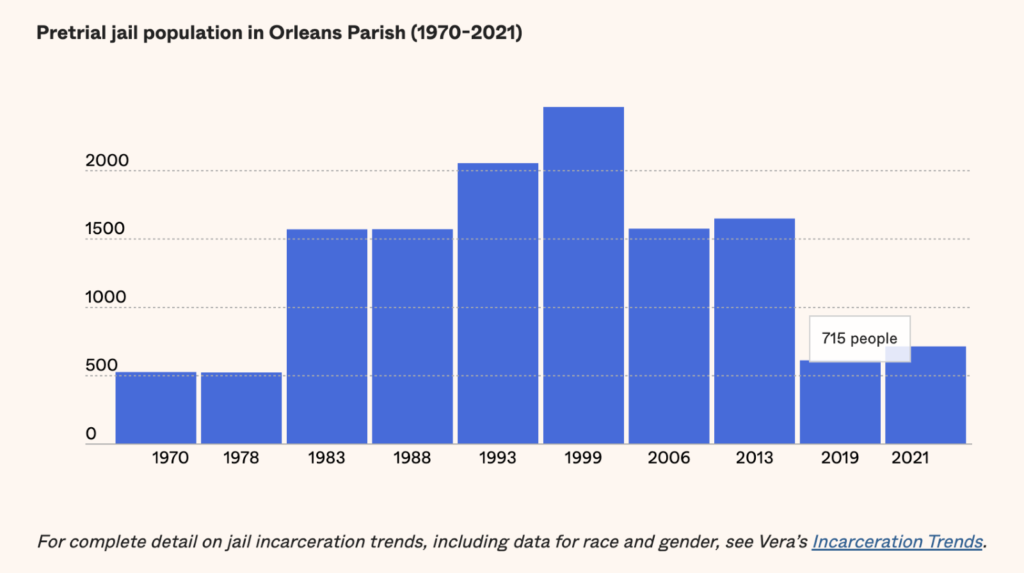
Historical trends in Orleans Parish pretrial jail population. Source: Vera Institute of Justice
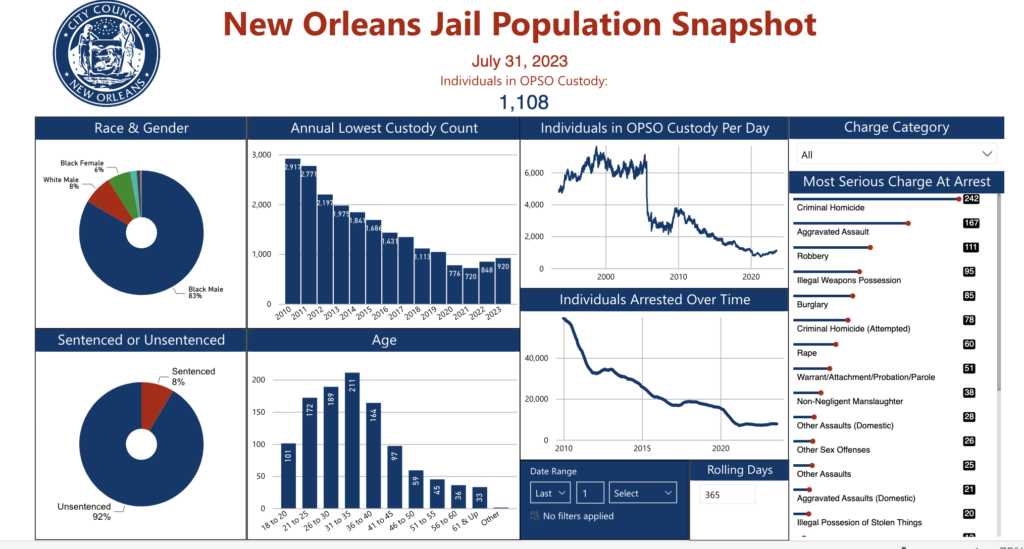
Screenshot captured 08-01-2023, 11:44 am. Source: Criminal Justice Committee Jail Dashboard

A Brief History of the Orleans Parish Prison / Orleans Justice Center Consent Decree

“I’m unsure of what that means.”

– Community Member at OJC, when asked about the “Consent Decree.”

The Consent Decree is an agreement, overseen by a federal judge, of a 2012 class-action lawsuit brought forth by a group of 10 incarcerated whistleblower plaintiffs in Orleans Parish who had the courage to speak out on the dangerous conditions and lack of mental healthcare treatment in the jail. The Southern Poverty Law Center (SPLC) originally represented these individuals.  Within a year and a half, when the original lead attorney switched organizations, MacArthur replaced SPLC’s representation of them. 

At the time this litigation was initiated, the jail regularly detained roughly 3,600 people. Conditions in the jail were so egregious that the federal government moved to join the plaintiffs to sue Sheriff Gusman, following an independent investigation conducted by the Department of Justice. By the end of the year, these three parties entered into a federal court Consent Decree, agreeing to work together to make the jail conditions in New Orleans constitutionally compliant (which is still a very low standard of existence). 

Importantly, the Consent Decree acknowledges that the “Plaintiff” class now represented by MacArthur consists of “all individuals who are now or will be imprisoned” in the Orleans Parish Jail.  This court document starkly contrasts with MacArthur’s regular claim that they solely represent the individuals currently in the jail.  

Continue reading Advocating for True Representation and Mental Health Justice: VOTE Opposes the Disastrous “Phase III” Expansion of OJC

Lewis v. Cain: A Portrait of Death at Angola Penitentiary

The people of Louisiana received a critical ruling (3/31/2021) regarding the unconstitutionality of medical care in Angola, the state’s largest prison, where over 6,000 men are held. Among these incarcerated people are many of the oldest and most debilitated, several thousand are sentenced to, realistically, die in custody. They include people previously sentenced as children to the (now unconstitutional) mandatory ‘Juvenile Life Without Parole,’ as well as several thousand who have been sentenced under non-unanimous jury convictions. The latter group, if they had been on direct appeal, would have had their convictions vacated, as a non-unanimous jury conviction has been ruled unconstitutional. They await the U.S. Supreme Court’s ruling on whether an unconstitutional verdict will stand.

The federal court for the Middle District of Louisiana ruled in Lewis v. Cain that Angola’s health care system violates the Eighth Amendment prohibition against cruel and unusual punishment, as well as the Americans with Disabilities Act (ADA) and the Rehabilitation Act (RA). This class action, represented by Promise of Justice Initiative (PJI), looked into a “discovery period” of care from 2015 to 2016. Judge Shelly Dick, supported in process by Magistrate Richard Bourgeois, could not turn away from so many uncontroverted facts presented by the class of patients.

Louisiana’s state penitentiary violated patient’s rights in the following manner, by failing to provide adequate1:

  • Clinical care, particularly:
    • privacy in examinations;
    • lack of routine medical equipment in exam rooms;
    • lack of adequate medical records management;
    • lack of clinical hygiene and spacing;
    • episodic treatment of complaints;
  • Medical care with qualified providers at sick call;
  • Specialty care in a timely manner;
    • failure to schedule and track specialty appointments;
    • failure to comply with testing and diagnostic requirements;
    • failure to execute appropriate follow-up care as ordered by specialist;
    • failure to coordinate care;
  • Emergency care evaluation by qualified providers and
    • failing to timely treat and/or transport to hospital;
  • Adequate, qualified staff in infirmary/inpatient care;
  • Medical leadership and organization in the following particulars:
    • lack of meaningful mortality review;
    • use of correctional personnel to manage medical decisions;
    • lack of peer review;
    • lack of medical staff involvement in budgeting;
    • lack of medical supervision by Dr. Lavespere; and
    • failure to maintain proper credentialing records;
  • Failing to comply with the ADA and RA in:
    • Not providing disabled inmates access to programs and services;
    • Lacking adequately trained, staffed, and safe orderly assistance where physical modifications have not been made;
    • Lacking proper oversight of health care orderlies;
    • Not following LSP’s own ADA Directives in maintaining a qualified ADA Coordinator and advisory committee;
    • Not integrating disabled inmates within the spirit of the ADA;
    • Not training medical staff regarding ADA compliance;
    • Failing to evaluate, address, and track ADA accommodation requests;
    • Not accommodating disabled inmates in applying discipline;
  • Maintaining blanket exclusionary policies for disabled inmates regarding access to various services, activities, and programs

The Angola medical care situation is especially egregious considering that, for the most part, these same allegations came up three decades ago. Prison officials lost in court, and were given specific oversight on developing a constitutionally compliant health care system. They did not. In reading the recent 124-page ruling, it is difficult to see what, if anything, the prison officials improved upon.

Overview of the System

According to the Court, “LSP lacks the infrastructure necessary to provide a constitutionally adequate health care system for patients with serious medical needs. This includes a lack of adequate organizational structure, credentialing and peer review process, health care policies and procedures, clinic space, and a quality control program.” The Court further finds that “overwhelming deficiencies in the medical leadership and administration of health care at LSP contributes to these constitutional violations.”2

It is unclear if the Board of Medical Examiners takes any responsibility for authorizing people on suspended licenses to have absolute control over such a large population of vulnerable patients.

In summary, patients who are suffering some symptoms (whether brutally painful, visibly frightening, or obvious concerns “about a lump”) currently put in a request to be seen by a doctor. They likely need to put this request in several times before being called to sick call, where they are seen by a prison guard who has been trained as an EMT. This sort of training may be good for choking on food, putting pressure on a wound, or a field splint on broken bones, but they have absolutely no training for diagnostic assessments.

A patient, when seen, is in an “exam room” with no diagnostic equipment, and there is no patient chart to track symptoms, chronic conditions, past surgeries, or any medical history. A patient may have had previous orders for testing, but they are often not taken out to a facility where that test can happen. When it does happen, the results are often not forwarded to the right place, and orders from a specialist are not followed by the prison doctors.

Patients often have to re-file a request and, without a chart, are sometimes ordered to undergo the same test from months before. And the cycle continues. Basically, the prison often delays diagnostics as long as possible, does not follow next steps that have been medically ordered, and delays or interrupts treatment on a regular basis.

People are dying because of this cycle, and doing so under a medical team that lacks proper credentials. Angola’s doctors also refuse to do reviews after a patient dies (“mortality review”) and has a complete absence of peer review. This ensures that they do not learn any lessons from a single death, and make zero changes after losing a patient. This is intentional, and quite clear when reading the decision and the uncontested evidence. 

For people who have a diagnosed chronic disease, or a physical disability, it does not get much better. These are people who often require a continuum of care, and the primary supporters are fellow incarcerated men trained as “orderlies.” There is a clear lack of oversight of the program, allowing for a great deal of neglect or abuse, on top of the reality that the orderlies are overwhelmed with far too many patients to support.

Disabled people, be they in a wheelchair, deaf, blind, or otherwise less-able: routinely face a “blanket denial” of work and programs, including access to making crafts for sale at the infamous Angola Rodeo. Rather than following the ADA’s basic premise that a public entity will help make things accessible for disabled people (an “accommodation,” like a wheelchair ramp, or subtitles), Angola forces people to file a grievance asking that they be allowed to participate.

Few things can illustrate the scope of the problem better than the prison’s own ADA Coordinator not having any special training, nor records, nor specific duties, and the prison’s own ADA Advisory Committee having zero members. To have things in name only is why oversight boards and commissions need to look under the hood, and to see what is happening in practice.

Staffing and Leadership – Willful Indiffernce, Wanton Disregard, and Knowledge

The Medical Department is managed by an assistant warden; the Deputy Warden, a layperson with no medical training, is the health authority.3

Angola has five doctors and one nurse practitioner. Each doctor was disciplined by the Louisiana State Board of Medical Examiners prior to getting a job at the prison, and all had a restricted license (some have since completed the Board’s requirements and probationary period).4 Although the lawsuit does not say, it is known that doctors have been disciplined for abuse of their patients and abuse of prescription medications. Experts at the trial could not determine if providers were practicing within their credentials because Angola, despite national standards, does not keep credentials on file.5

Correctional officers administer medications, and most of the emergency medical technicians (EMTs) on staff are former correctional officers who increased their pay grade with a low-level training and change in uniform. EMTs handle sick call, where they screen requests to see the doctor.

Orderlies are incarcerated people who have received some training (which ironically they are overwhelmingly barred from using on the Outside). The orderlies provide both assisted living supports and as nursing assistants in the infirmary. They are supervised by security staff, not by nurses, and Angola does not follow their own internal policies regarding the use of orderlies.6

ADA coordinators receive no formal training, nor any additional duties.7

The Court finds the leadership and organizational deficiencies show “deliberate indifference.” This means, essentially, someone chooses not to care. The lack of meaningful mortality review, what a proper medical care provider does to prevent future deaths, ensures that the administration finds no problems in their system. This willful ignorance is in the context where “the death rate nearly doubled from 361 deaths in 2001 to nearly 600 deaths in 2008.”8

There is no annual review of physicians, and no major event reviews. The only thing bordering on review has happened three times since 2010, when the medical director reviews 15 records.

The Court found that the prison administration and medical providers had knowledge of the unconstitutional practices, particularly as this is essentially the same investigation and litigation from 1989 – 1992. At that time, the DOJ investigated and issued a letter of findings which could have been re-dated two decades later. A 1994 trial resulted in a 1998 settlement calling for specific improvements that simply did not happen.9

Deliberate indifference and wanton disregard for human life is not only a matter of failing to correct flaws in health care delivery. Former medical director Dr. Singh recommended to DOC Director James LeBlanc that they not “dig too deep: in investigating a death because “liability is still ours.” Dr. Vassallo testified on how frequently death summaries “misrepresented the facts of the patient’s death.”10

Facilities

To provide care for over 6000 people, Angola has two infirmaries in the “hospital.” Infirmary 1 (“Ward 1”) is for outpatient urgent care, with 20 beds. Infirmary 2 (“Ward 2”) is chronic care for people who require long-term housing (20 beds). Additionally, there are two more dormitories, Ash 2 and Walker 2 (43 beds each) that also serve in this capacity, in addition to the Hospice Ward where people can receive end-of-care medications.11

Ward 2 is managed by a nurse practitioner who oversees over 1000 patients, and only about 100 of the patients are living in what would be considered the informal medical wings of the prison. The rest are spread across general population. According standards in Correctional Health Care, every patient should be within sight and sound of a nurse.12

For context, there are over 5,000 registered hospitals in America, and they are classified into three basic sizes: Small (fewer than 100 beds), Medium (100-499), and Large (over 500 beds).

Within the hospital ward are individual rooms with locking doors and no call system, where Patient K.P., a quadripalegic with a tracheotomy, has been locked facing away from the door with no means to summon assistance.13

Patient #39 was immunosuppressed with a history of congestive heart failure and diabetes. This 65-year old was seen by EMTs seven times in a month. He entered the infirmary with a fever of 103.6 and altered state. The next day, a nurse reported he was masturbating and put him in a locked room with the “hatch up,” and no doctor visited him for three days. On the fourth day he was sent back to general population. Two days later he was laying on the floor vomiting. Angola’s medical director, Dr. Randy Lavespere, along with Dr. McMurdo, ordered EMTs to “not transport” Patient #39 to the hospital. The next day he died.14

Dr. Lavespere, formerly incarcerated himself due to abuses in his practice and hired by the DOC on a restricted license, was promoted to be the DOC’s statewide medical director in 2020.

            Patient #18 complained repeatedly for months before being admitted to the infirmary with pneumonia, 55-pound weight loss, and life-threatening vitals. He tested positive for HIV. He was monitored only once daily, and medications, started four days later, were irregularly administered. Within a week his fever spiked and he was transferred to the hospital. A month later he died.15

Clinical Care

Angola’s EMTs hold sick call in the dorms, without patient records, standard medical equipment, or supplies.16 The five physicians do not clinically supervise the EMTs, despite both prison policy and the medical Standard of Care.17Exam rooms were not designed as such, and resemble more like a store room or break room. There is nowhere to wash hands, no privacy, and no paper to cover the exam table. There is not even a blood pressure cuff nor other typical equipment.18 These EMTs are allowed to triage patients and evaluate health requests without having spent a single day in medical or nursing school.

Physicians routinely fail to identify patient diseases, fail to obtain adequate medical history, do not perform meaningful physical examinations, fail to read and monitor testing, and fail to monitor and manage medications.19

            Patient #11, having Crohn’s disease, received a colonoscopy six months after the referral. He saw the referred gastroenterologist three months after that. The delay in treatment resulted in five surgeries and two hospitalizations. He was treated by surgeons for two years prior to being managed by a specialist, and prison doctors gave him the wrong dose of a medication that likely resulted in more episodes of fistula.20

            Patient #13, having vascular disease and at risk of stroke, was not given the required Statin drugs except for a short 4-month span. He had a preventable heart attack, was hospitalized, and a specialist ordered an echocardiogram test (which took nearly two months to complete). The results never made it in the patient file, and another ECG was ordered during the time Patient #13 had to more hospitalizations for heart failure. Several months later, when he had an episode which indicated a stroke, it took three months to receive a CT scan, revealing a stroke.21

The record indicates what Angola patients know: people presenting with stroke symptoms (slurred speech, for one), have been charged with “intoxication” instead of getting treatment.

Specialty Care

Despite the many failures in the penitentiary health care, it is impossible to avoid the bulk of diagnoses when people are held at Angola for decades. Putting aside whether incarcerated people are more or less likely to contract a specific disease or encounter a specific injury, Angola has an aging population that is no less human than everyone else. Hearts, lungs, kidneys, brains and other vital organs run into difficulty- including things that are preventable or treatable.

            Patient #5 complained for two years of weight loss and abdominal pain, to the point where he couldn’t walk, was vomiting and had diarrhea. When he was seen for a bowel obstruction, nobody evaluated the x-ray. Finally, after multiple times he “required hospitalization” over several weeks’ time, he was hospitalized and diagnosed with advanced colon cancer. He died during surgery.22

            Patient #17 was at Angola for six years and had chemotherapy for leukemia. A suspicious lung nodule was identified on a CT scan, and two specialists (oncology and pulmonology) recommended follow-up testing. The prison, with full control over Patient 17’s options, did not follow-up. Over the next six months, he could no longer walk and was given a wheelchair. Finally, he was diagnosed with metastasized cancer and died within three months. He was 46 years old.23

Patient #13 was hospitalized for a heart attack, and a vascular specialist recommended a CT angiogram. The test was not done for 10 months. A month later, he had another heart attack, and a month after that he saw a cardiologist, who ordered an echocardiogram. The test occurred a few weeks later, but it was not put in the chart. Over the next three appointments with the cardiologist, they were not able to review the findings.24

Patient #7 received an x-ray revealing a potential malignancy on his lung, at age 58. Three months later he received a CT scan and was referred to a pulmonologist, which took four months: nearly eight months after the initial x-ray. The specialist recommended a biopsy, and Patient #7 did not see the prison doctor for another month, and according to the court records, it seems “the doctor wasn’t sure what the pulmonologist recommended.” A year after the initial x-ray, the pulmonologist saw this patient again, and noted “the biopsy did not occur, what gives?” They recommended a biopsy (again) and “strongly suggest immediate IR [interventional radiology], FNA [fine needle aspiration] of left upper lobe nodule. A month later, still with no biopsy, he had surgery to remove a portion of his lung infested with cancer. After being sent back to Angola, he was scheduled to begin chemotherapy a month later. Two months went by without chemo. Patient #7 put in repeated requests complaining of swelling in his tongue and mouth, and vomiting. An EMT treated the medical complaints with coal tablets and cough syrup. Patient #7 never got chemo. He died.25

Patient #6 was evaluated by a cardiologist for hypertension and significant cardiac arrhythmia, who ordered an echocardiogram and an event recorder test. Only one test was performed, and he was not treated with the proper anticoagulation. Two years later he was hospitalized and anticoagulated. Back at Angola, he was not given the recommended treatment for 10 days, despite developing critical symptoms within four days. He was sent to the infirmary rather than the hospital, and given no diagnostic testing. After four days in the infirmary, he finally received anticoagulation. He died.26

Patient #10 got lab results revealing potentially life-threatening obstructive jaundice. His CT scan revealed a mass in his pancreas, yet was kept in the infirmary (developing a fever) rather than being sent out for a biopsy. After his ultimate diagnosis of pancreatic cancer, he was returned to the Angola infirmary where no coordination occurred with his oncologist. They did not review or monitor his care, and was placed back in general population. Eventually, Patient #10 developed hypotension and an altered mental status and refused care. Finally, he was brought to the hospital, and died in the emergency room.27

Patient O.B. fed himself for three years through a tube and could barely speak due to facial injuries. Despite recommendations from dental providers for reconstructive surgery, Angola’s doctor would not approve because it was considered a “cosmetic surgery.” As of this trial, he still had not received surgery.

Several other patients in the record were documented as having sought treatment for over a year, having waited months to get a test despite multiple requests reporting obvious symptoms, and then receiving a follow-up appointment a month beyond the test being completed.28

Procedures – Sick Call, Referrals, Malingering, and Orders

EMTs enter the dorms to review Health Service Requests, and rarely consult a doctor. From their reviews, less than half of people attending sick call are referred to a provider. Over half of HSRs are, essentially, denied.29 EMTs are supervised by security, not by doctors.30

Having no medical records on hand, requests often receive the same response or same treatment (e.g. aspirin) that did not work.

Sick Call costs $3 while medical emergencies cost $6. This will be debited from one’s account whether or not they received treatment or, in the case of a workplace injury, after being transported to the infirmary. Most incarcerated people at Angola who work receive roughly $1 per day. Additionally, medication costs people $2 to start a new prescription. With access to health care costing between two days and a week’s pay, this is the equivalent of free Americans, such as prison guards, paying anywhere between $250 – $1000 for a co-pay.

“Malingering” is punitive violation that patients can be booked for if it is determined, by security staff, that someone is only seeking sick call so they can get out of work. In Louisiana, people are still sentenced to “hard labor” at the penitentiary, itself originally built as a plantation. Attorneys in Lewis v. Cain failed to produce enough evidence to prove the policy is in some manner unconstitutional, the state’s medical expert agreed the policy should be discontinued.31It isn’t clear if the discipline records throughout the institution were examined, but incarcerated people have a different view than the Court.

Overall, the Court found that having a medical system controlled by security, rather than qualified health care providers, is unconstitutional.32

            Patient #20 complained of abdominal pain to the EMTs for over four months. He was never referred to care, and finally the burning pain, weight loss, and vomiting blood resulted in him being admitted to the nursing unit. He died the next day.33

            Patient S.H. repeatedly complained for two years of consistent and worsening symptoms, including weight loss and testicular swelling. Eventually he was given testing, revealing renal cancer. S.H. has since died.

            Patient Joseph Lewis (top-named plaintiff of Lewis v. Cain) complained to EMTs for 33 months of symptoms consistent with laryngeal cancer. Finally, he received that testing and diagnosis. His case shows repeated “no transport” orders, creating diagnostic and treatment delays. Mr. Lewis has since died.34

            Patient #39 was 65 years old, with a history of diabetes, severe coronary artery disease and heart failure. He saw EMTs seven time in a month, with symptoms that included a fever, “breathing but unresponsive,” and “lying on the floor of his cell vomiting and won’t move.” Angola gave “no transport” order three times. After the third, he died.35

            Patient #34 complained of flank pain and received an order for an x-ray. A second doctor saw him the next day and noted no explanation for the pain. Three days later, Dr. Lavespere gave a “no transport” order. The next day he died.36The prison does not conduct post-mortem analysis.

Emergency Care

Angola lacks an actual emergency room, despite being a place where over 7000 people are living and working, and instead transports people from the remote location to an ER. The area known as an Acute Treatment Unit (ATU), or “outpatient” facility, sees as many as 76 patients per day despite lacking appropriate equipment. The EMTs, rather than focusing on “emergency” interventions, provide ongoing treatment instead.

People are dying while under this extended care of EMTs, rather than being immediately transferred to a proper medical facility. Patient #1 died in the ATU while being managed by EMTs, as did Patient #15 who was put in and out of the ATU while suffering acute coronary syndrome. Patient #20 also died, while it seemed he suffered internal bleeding. Patient #38, with a history of strokes, died while suffering a stroke.37

Not receiving emergency treatment in time results in preventable effects, and a clear pattern for people suffering strokes not getting treatment within the medically standard 4.5 hour treatment window. Whereas it is a one-hour drive to the actual ER in Baton Rouge, prison security must make a prompt decision to seek proper medical care. Several examples were presented in the litigation that indicate this is a systemic problem.38

Making matters worse, patients who present with “altered mental status” are routinely treated as though they are on narcotics. Even without any clinical indication of illegal drug use, these patients are treated with Narcan (for opioid overdose), given urinalysis for illegal drug use, “often by catheterization,” and stomach-pumping. Through this practice, Patient #37 died, rather than receiving treatment for his seizures.39

Although the plaintiffs presented examples of prison staff seeking to obtain “Do Not Resuscitate” (DNR) orders from patients, the Court did not find it a constitutional violation.

Chronic Care

The Court declined to find the system of chronic care to be unconstitutional, nor to change any prior rulings regarding Hepatitis C care.

Americans with Disabilities Act (ADA)

Throughout the ruling, it is clear that Angola has made very little attempts to be compliant with the ADA, and it is not clear that the staff or leadership have a solid understanding of what the ADA requires of public entities. Some obvious modifications were created since the 1991 standards took effect three decades ago, yet there are 190 architectural barriers that went unrefuted by the Defendants in this trial.40

Medical dorms were designed for unimpaired people, while people in medical wards have been wholesale denied the chance to participate in any classes (including those required to be eligible for release), nor church services, nor other events. This is “unjustified segregation,” in the eyes of the Court, in medical dorms where neither doctors nor nurses make rounds.41

The Court found that the orderly program (using incarcerated people to assist other incarcerated people) “creates an unnecessary risk of harm to disabled and vulnerable inmates.”42 This program is constantly hiring and training new orderlies who are both overwhelmed and underqualified, at times with improper motivations, and the warden admitted “sometimes it is just going to be what it is.”43

Whereas the ADA Coordinator has no added training, and no documentation for reasonable accommodations, there is a wholesale lack of ADA compliance. Exacerbating this is where disciplinary measures do not account for disabilities, such as gassing a blind, mentally ill, man who refused to shave, or using isolated housing where the physically disabled have no manner of calling for help.44

Conclusion

As a matter of law, the Court found that the DOCs medical care in their largest facility is a gross violation of the Eighth Amendment and the ADA. It is clear by the ruling that the current staffing structure cannot simply improve their practices and procedures where it is security staff making unqualified health care decisions that lead to a pattern of preventable deaths.

Read the full decision here.


  1. See: Lewis v. Cain, 3:15-cv-00318-SDD-RLB (3/32/21), “Conclusion,” at 122-124. ↩︎
  2. Id. at 8. ↩︎
  3. Id. at 38. ↩︎
  4. Id. at 5. ↩︎
  5. Id. 14 40-41. ↩︎
  6. Id. at 22-23. ↩︎
  7. Id. at 56-57. ↩︎
  8. Id. at 37-38. ↩︎
  9. Id. at 41-43, including notice from outside providers, specialists, and consultants calling for changes. It has become a pattern where a specialists’ treatment regimen or recommendations are not followed. ↩︎
  10. Id. at 45. ↩︎
  11. Id. at 21, regarding two infirmaries; additional information according to VOTE staff and recently incarcerated. ↩︎
  12. Id. at 21-22. ↩︎
  13. Id. at 22. ↩︎
  14. Id. at 23-24, 27-28. ↩︎
  15. Id. at 24, 26. ↩︎
  16. Id. at 9. ↩︎
  17. Ibid. ↩︎
  18. Ibid. ↩︎
  19. Id. at 9-10. ↩︎
  20. Id. at 10-11. ↩︎
  21. Id. at 11-12. ↩︎
  22. Id. at 13. ↩︎
  23. Id. at 13-14. ↩︎
  24. Id. at 14. ↩︎
  25. Id. at 15-17. ↩︎
  26. Id. at 17-18. ↩︎
  27. Id. at 18-19. ↩︎
  28. Id. at 20-21. ↩︎
  29. Id. at 25. ↩︎
  30. Id. at 30. ↩︎
  31. Id. at 29. ↩︎
  32. Id. at 30. ↩︎
  33. Id. at 26. ↩︎
  34. Id. at 27. ↩︎
  35. Id. at 27-28. ↩︎
  36. Id. at 28. ↩︎
  37. Id. at 32. ↩︎
  38. Id. at 33-36, describing patients suffering strokes, brain injuries, and pneumonia. ↩︎
  39. Id. at 35-36. ↩︎
  40. Id. at 49. ↩︎
  41. Id. at 55-56. ↩︎
  42. Id. at 55. ↩︎
  43. Id. at 54. ↩︎
  44. Id. at 73. ↩︎

Proudly powered by WordPress