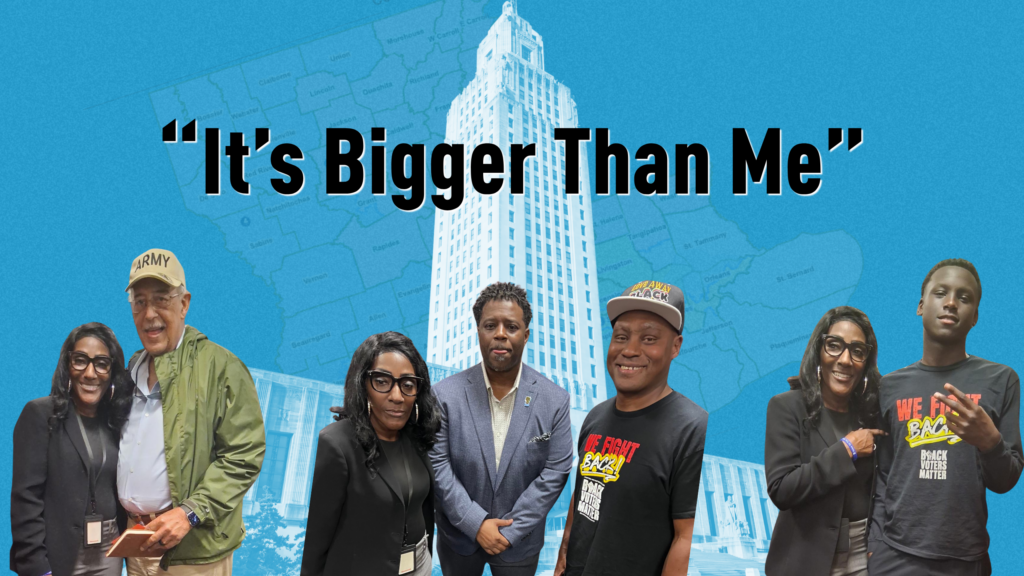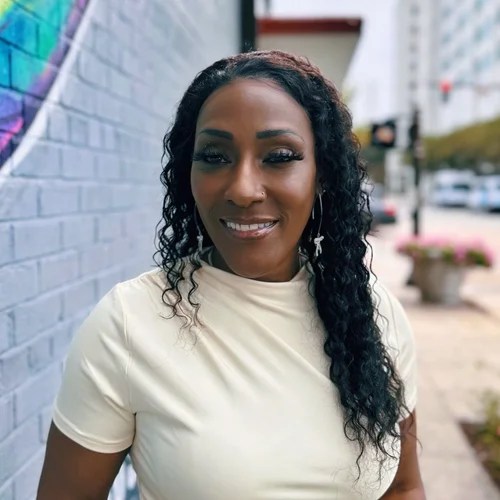
Featuring Amelia Herrera, Organizer, Voice of the Experienced (VOTE), and Dr. Matthew Green, Associate Professor of Education, UL Lafayette
Amelia Herrera: I’m Amelia Herrera, an organizer with VOTE — Voice of the Experienced — in Baton Rouge. I’m also an advocate and a mother. I’ve been doing criminal justice reform work and following the criminal legal system in Louisiana for about seven years now.
Dr. Matthew Green: My name is Dr. Matthew Green. I’m a VOTE member and an associate professor of education. I’m also the interim department head of the curriculum and instruction department at UL Lafayette. I’ve been working with VOTE for about five years. Part of my research and teaching is around the school-to-prison pipeline — how school suspensions and education systems push students out of educational opportunity and into the criminal legal system.
How are you both coming into this conversation today?
Dr. Green: I’m tired but energized. Anytime I come to work with a community like VOTE, it re-energizes me. Even though times are tough, I’m feeling inspired.
Amelia: I can say the same. I’m inspired and energized — especially around this subject. Though many of us know it exists, it’s not a well-discussed topic. So I’m glad we’re lifting it up.
Why did you each want to be part of this conversation?
Amelia: I grew up in New Orleans, graduated high school, and went off to Xavier before eventually moving to California. When I came back home and had kids of my own, I took a look at our school system and was alarmed. There was a stark difference from what I was accustomed to raising my kids elsewhere. I kept thinking — why isn’t anyone paying attention to this?
Dr. Green: For me, it was moving to Louisiana and seeing the carceral nature of how this state approaches almost everything. People often think schools and prisons are the antithesis of each other — but Louisiana is the only state I’ve ever lived in, taught in, or done work in where there’s a person at schools with the job title of disciplinarian. Everywhere else, discipline is one part of a role. In Louisiana, there’s a person devoted specifically to punishment. That stark contrast from how other places approach schools is really how I came to this work.
How would you define the school-to-prison pipeline?
Amelia: I’d identify it as a systemic process — a way of pushing marginalized communities, specifically Black and brown youth, into the incarceration system. It’s a pipeline. All the pieces are systematically put together so that incarceration becomes the most accessible path — sometimes the only visible way out — for many in our communities. Intentional, systemic, and closed-box syndrome.
Dr. Green: I explain it as the policies and processes that push students out of educational opportunity and into the criminal legal system — things that favor incarceration over education. And I use that phrase deliberately: favor incarceration over education. If you look at the funding in Louisiana, there’s far more money per capita going to our carceral systems than to our education systems. When you give more money to something, you’re showing that you favor it over something else.
What do you want people to know about this topic that they might not know?
Dr. Green: The thing I want people to understand is that it affects everybody. It affects your child’s school. It affects kids and adults across the full age spectrum. When we talk about the school-to-prison pipeline, we’re not just talking about teenagers. We’re talking about kindergartners who are arrested at school, punished, denied educational opportunity. We’re talking about adults who were pushed into the criminal legal system years ago. And we often associate this issue with schools in dangerous neighborhoods or certain parts of town — but the way it operates, it affects every kid in every community, because every student is under the same umbrella. The same systems that either provide educational opportunity or push people out of it work across Louisiana and across the nation. It is not one school, one community, one isolated instance.
Amelia: What I want people to know is: what are the identifiers? What should we look for? Coming from a Black mother — it starts as young as third grade. A lot of people in our community don’t know that. Everyone looks at the middle school and high school years as the primary danger zone, but the pipeline goes all the way back. The marks teachers put on your child’s record in pre-K, kindergarten, first and second grade — those are determining their future. You can be involved. You can ask for your child’s records. You can show up and ask questions. Just because someone is a teacher or administrator doesn’t mean they have your child’s best interest at heart. I want people to identify this big, ugly system that is locking our kids up.
Dr. Green: I want to add — it sounds simple, but: kids don’t suspend themselves. That requires a teacher, an administrator, a decision by an educator. One of VOTE’s most important principles is that those closest to the problem are closest to the solution. Once teachers start identifying that they are in control of many of these outcomes, we can begin working with parents, students, and communities toward real solutions.
Amelia: And we also have to look at what teachers are bringing into the space — predisposing biases, assumptions about how a child looks or how they show up. For a Black child, the default response is often to punish rather than support or encourage. Teachers aren’t always culturally cognizant of what each student from a different neighborhood or household is carrying when they walk through that door. And they’re going to demonize these kids without even knowing what they’re dealing with.
Dr. Green: And teachers aren’t always coming from the communities that their students come from. They don’t always understand the history and context of that community.
What are some common myths about the school-to-prison pipeline?
Dr. Green: The myth I always focus on is that the punishment fits the infraction. There’s a well-known study out of Tulane — done about six years ago — that looked at school suspensions across Louisiana and examined the disproportionality. It found what is found nationwide: three groups are suspended more than any other. Not that they commit more infractions — they are suspended more. Those groups are Black and brown students, students in special education, and students in poverty. What was most striking: a Black student and a white student can get into the exact same fight with each other, and on average across Louisiana, the Black student is suspended one day longer. Most suspensions in this state are for nonviolent offenses. Not contraband, not weapons, not fighting — but subjective things: disrespecting a teacher, questioning authority, insubordination. Things that require a teacher’s judgment. And even when the infraction is clear-cut, we see disproportionate suspensions along racial lines.
Amelia: I always bring it back to community. Take two kids — James and Tommy. James is a Black child from a two-parent home. Tommy comes from an abusive household. They’re in the same classroom with the same teacher. Tommy is carrying trauma that James isn’t carrying. If James doesn’t act out and Tommy does, why isn’t there support for Tommy? Because no one knows — or cares — what Tommy is going home to. So teachers start marking him as disobedient, unable to grasp the material. The records pile up. The child gets discouraged and stops wanting to go to school. Then you have truancy. And there are officers in the schools now. That is a direct pathway to the incarceration system.
Dr. Green: That’s a perfect description of how small infractions become systematized — repeated over time, put on records, escalating punishments, until kids don’t want to go to school. Or they get kicked out. Why would you go to school if it’s a hostile place toward you?
Amelia: I met a parent whose son was on the spectrum. She didn’t have the tools or resources to support him properly, so she hoped the teachers would catch it. The teacher didn’t — she ridiculed him in front of the class. So he wrote a note to the teacher, something he’d seen on television. The teacher took it to the school resource officer. Instead of recognizing a child crying out for help, it was treated as a criminal matter. That child now has to report to the juvenile detention center. He has a full record. Because of one outcry that no one knew how to answer.
Dr. Green: This is why I always teach that all behavior is communication. The behavior of kids who sit still and silent, the behavior of rambunctious youth — it’s all communicating met and unmet needs. The school-to-prison pipeline is what happens when the response to those unmet needs is punishment: demerits, paperwork trails, infractions, suspensions. All negative consequences rather than care.
What does summer mean for youth in Louisiana, in the context of all this?
Dr. Green: Before we get to summer, I want to name something. VOTE member Ronald Marshall championed a bill a couple of years ago about mental health screenings for anyone entering incarceration. For many people, that is the first mental health screening they have ever had. When we talk about under-resourced schools, when we talk about Amelia’s story of that child — if going to prison is the first time someone receives a screening for trauma or mental health needs, it is way too late to change the course of that person’s life.
Amelia: What summer looks like to me — I’m going from this conversation to a budget hearing where they’re giving more money to the Baton Rouge Police Department. Our communities are already being over-policed. Juveniles roughly ages 8 to 16 have nothing to do. No parks to go to. No mentorship programs. Where are the Boys and Girls Clubs? So these neighborhoods are over-policed, officers already arriving with assumptions about who these kids are. Meanwhile, the pull of the street is real — especially for a child whose parent is too busy surviving to be home, who has no clean park, no structured activity, nothing to do but sit on the porch. A police officer sees that and calls it a threat. Not knowing that if you gave that child a basketball, a safe park, a resource — the outcome could be completely different. It’s intentional. I see it as intentional. There are police cars parked throughout certain neighborhoods, and when I cross to the other side of town, they’re nowhere to be found.
Dr. Green: From an educator’s perspective, if people could compare what summer looks like for different children across Louisiana, it would be staggering. Some children have summers full of enriching experiences: academic programs, summer camps, structured and unstructured play, great parks, tons of opportunity. Others have the complete opposite. And that is a strategic, purposeful decision. Louisiana loves to talk about community — but where we draw the lines of community matters. Because if we’re truly a community, we should be taking care of every child in this state. Which parks get funded. Which sports leagues. Which neighborhoods. The decision to defund programs, remove parks, eliminate spaces where people can gather — and then at the same time complain about young people being on their phones — you took away all the other spaces. And when you layer surveillance systems and police monitoring only in certain neighborhoods on top of that, you’re going to arrest more people in the places police are. This is a layered system that starts with decisions that don’t seem to be about schools or prisons at all — and yet they determine children’s lives and opportunities.
What solutions do you see? What are you working toward?
Amelia: I’m going to go back to community. There’s an intersectionality here that we can’t ignore. In EBR Parish, roughly 38% of Black and brown children in impoverished communities — about 72% of them are being pushed down the pipeline. That’s alarming. So what happens on the back end? Fully incarcerated people coming home — they are mentors. They can go in and talk to at-risk youth and say, this is not what you want. The parent is too busy surviving. The teacher has already given up. Someone has to care. Pull on your community. Pull on the ones who’ve seen it, done it, been there. Because the people governing are not prioritizing this — they’re closing schools and building prisons. We have to demand that money come back to the community. Educate impacted communities to know: you don’t have to accept this. You can go to your child’s school and ask questions. You can advocate for your child. Who said you had to listen to what that resource officer said? That is your child.
Dr. Green: From a school perspective — the easiest, most concrete solution is: stop suspending students. There are alternatives. Even one suspension increases the likelihood of a child interacting with the criminal legal system by 50%. Avoiding that first suspension is critical. But the bigger battle, and for me the most viable long-term solution, is changing the mindset that children deserve to be punished. It is pervasive. One of the first classes I taught in Louisiana, students asked me: “Dr. Green, if you don’t punish a kid, how will they learn?” That was eye-opening. There is a deep-seated notion that punishment is right, deserved, and produces positive outcomes. That same mindset drives the adult incarceration system too. But in schools, with children, it is toxic — it hampers educational opportunity and life opportunity. When you break it down and ask someone: do you really think a five-year-old deserves to be kicked out of school? It sounds ridiculous. But that is what is happening. To kindergartners, to third graders. The things we do to high school students — who we too often see as adults rather than children — we also do to the youngest kids in our schools.
Any final takeaways?
Amelia: I want to say — we need bridges between community members and experts like Dr. Green. This issue is so prevalent, but it isn’t discussed. If you don’t know what to say or how to go about it, go to the experts. Let them show you the way. Something needs to be done, and something can be done.
Dr. Green: To anyone listening — the first step is holding up a mirror, for yourself and in your conversations with others: What are you willing to accept, and what are you not? The reason we have a school-to-prison pipeline is because as a society, we have accepted far too many children being suspended, punished, pushed out. We accept it because we think they deserve it. That is a harsh and damning critique of our society. And my last thought: if we are willing to do it to children, we are definitely willing to do it to adults — and worse.