
RE: Trade Regulation Rule on Unfair or Deceptive Rental Housing Fees Practices (Document Number 2026-04907)
Dear Chairman Ferguson,
We, the undersigned members of Formerly Incarcerated Convicted People and Families Movement (FICPFM) write to support and encourage your pursuit of fair rule making in the rental housing market. FICPFM is a national movement of seventy organizations across twenty six states. We are people directly impacted by mass incarceration and the lifetime of discriminatory policies impacting our lowered economic caste and infringed rights of citizenship. We work to educate the public and policymakers regarding systemic harms, and offer alternative proposals that reduce the primary drivers of crime, reduce recidivism, and elevate overall
community outcomes.
Our grassroots organizations have led multiple local and statewide rental housing campaigns for over a decade, including shifting the direction of Housing and Urban Development (HUD) towards inclusionary policies. We have experienced the digitization and dehumanization of the rental application process during a time when housing is increasingly concentrated in the hands of absentee corporate landlords. Their profit motives do not always align with community sustainability, while those rents flow away from the neighborhoods from where they came.
We have seen the rise of online platforms enabling short-term rentals. This reduces housing stock and drives up rents. Visitors replace neighbors and streets become less safe.
Finally, we have witnessed the rise of unfair, hidden, and deceptive practices in the rental application process. This system has become a racket, causing far more harm than the notorious flight, hotel and concert ticket pricing. The over-reliance of automated online platforms to rent housing is creating barriers for people who struggle with literacy, mental health, and other physical disabilities. Most significantly, blanket barriers for people with conviction histories remain.
Consumer choice is hidden behind a paywall.
The computer algorithms that make decisions in rental housing are programmed with rules and restrictions. Property managers and realtors direct people to apply through portals, as they themselves typically lack the discretionary power to rent a property. The application, inevitably, has a fee, typically a non-refundable $50 – $200. None of the restrictions are actually listed prior to spending money. Other than lotteries, we can think of no other product a person can purchase (in this case, a rental application) which can result in total failure.
Criminal records are an unseen omnipotent barrier. Over 100 million Americans have a criminal history, and millions more are impacted as household members. It is extremely rare for a rental advertising to mention convictions at all, and definitely never with the specificity that provides consumer guidance as to their eligibility. A student, for example, knows the criteria a college requires to be a strong applicant for limited seats. They also frequently receive fee waivers if requested. Housing merchants do not provide fee waivers, nor do they post their criteria.
There are a broad range of circumstances for the millions of people with felony convictions who seek housing. Some received probation for a petty offense and, in the course of a month, that conviction may have been used for their eviction prior to them going back into the rental market to find a new place to live. The recent nature of their conviction will often be held against them (and their entire family) by a computer program that never meets the prospective renter. The eviction will be held against them even where the conviction had absolutely nothing to do with their home or neighbors.
Others may have served a long sentence, whether for a violent crime or not, and may have been incarcerated since they were teenagers. Their lack of credit history will be held against them, as will the seriousness of the offense regardless of how long ago. Despite the natural growth and maturity of all humankind, a convicted person’s character becomes “frozen” by the computer systems and society for decades on end.
Renters with criminal histories are unable to put their own circumstances into eligibility criteria and decide if this is a waste of their time and money, or not. Taking applicants’ money, and then revealing their ineligibility, is a classic bait and switch. Many people have theorized that some apartment listings exist only to collect application fees. If so, this would be a fraudulent advertisement from a deceptive merchant in commerce.
Reducing housing access increases crime in America.
It is self-evident that people without a place to sleep are in volatile situations. It is difficult to take a shower, store clothes, affordably eat, and charge a phone; which makes it even harder to get and keep a job. The secret restrictions hidden behind application paywalls only impact people who actually have the money to rent an apartment. Typically, they have steady employment. Sometimes they have a spouse and/or children. These are the people some rental businesses are
forcing into desperation rather than allowing access to all people who can afford it.
Denying access discourages participation in society and encourages a “work-around” by whatever means necessary. Hotels and motels do not have background checks and computers deciding eligibility, yet a denied $1500 apartment would be replaced by an accepted $4500 motel for a month. Life is more expensive, and desperation for food and shelter should not be anyone’s motive for crime in any civilized nation. Instability impacts children as well, who are forced to live out of a suitcase, car, or a maze of shelters as their parent confronts faceless computers making decisions based on events occurring before the child was born.
Additionally, states and municipalities are creating more statutes that criminalize “public camping,” a phrase made popular by the U.S. Supreme Court’s infamous ruling in City of Grants Pass v. Johnson (2024), regarding the criminalization of having no home to sleep in. These efforts also criminalize people living out of their cars. Americans are increasingly being squeezed out of any place to live, and yet the prison gates are always open.
Over three million people currently live in the community while sentenced to probation. This is considered an “alternative to incarceration,” deemed appropriate by prosecutors and judges who felt a person’s accountability was best served in the community. Terms of their probation typically require their gainful employment and stable housing, and every judge across America either encourages or admonishes a person to “get it together.” But nobody tells the rental market.
Over a million people live in the community, after being released on parole. These people were reviewed by a government parole board, often with extremely strict criteria, and deemed safe to be given a chance prior to the eventual end of their full sentence. Typically, they need permission from their parole officer to move into a property; thus, there needs to be conversation between the property manager and the officer who must approve the apartment. Thus, a person (generally very low income) must pay an application fee, get approved by the property, then contact their officer to investigate the property and speak with the manager, then pay the rent, then move in. It should puzzle nobody when a property manager revokes the offer to rent the property because this is seen as “too much.”
Many jurisdictions now have courts that specialize in Veterans, Mental Health, Drugs, and Homelessness. They are generally creations of the state legislatures, and intended to create non-criminalization supportive services, yet sentencing someone to “probation” can impact their housing pursuits in the same manner as any other court. Housing providers who undermine public policy are contributing to criminal desperation rather than crime reduction.
Rental Property is commerce.
We have seen the lobbyists of rental marketeers subvert actual market forces through the hand of the governments. Very few marketeers are the “Mom ‘n Pop” landlords of old, where a second home is a rental property for a working family. Most own dozens, hundreds, even thousands of units. They put out false narratives about the danger of renting to someone with a criminal record, and seek to incite fear amongst neighbors yet still remain the only people opposing inclusive policy reforms.
The corporate landlord is often based across state lines, using nationwide providers of computer services for their application processing. They mention, yet fail to cite, these so-called legal liability cases where a landlord lets a person with a criminal record into an apartment building, who then commits a crime against a neighbor in the building, and the court holds the property owner liable. Their admissions policies should reflect that they are subject to commercial regulation, and should be sanctioned for unfairness or deception. They are not individuals seeking a preferable roommate.
Conclusion
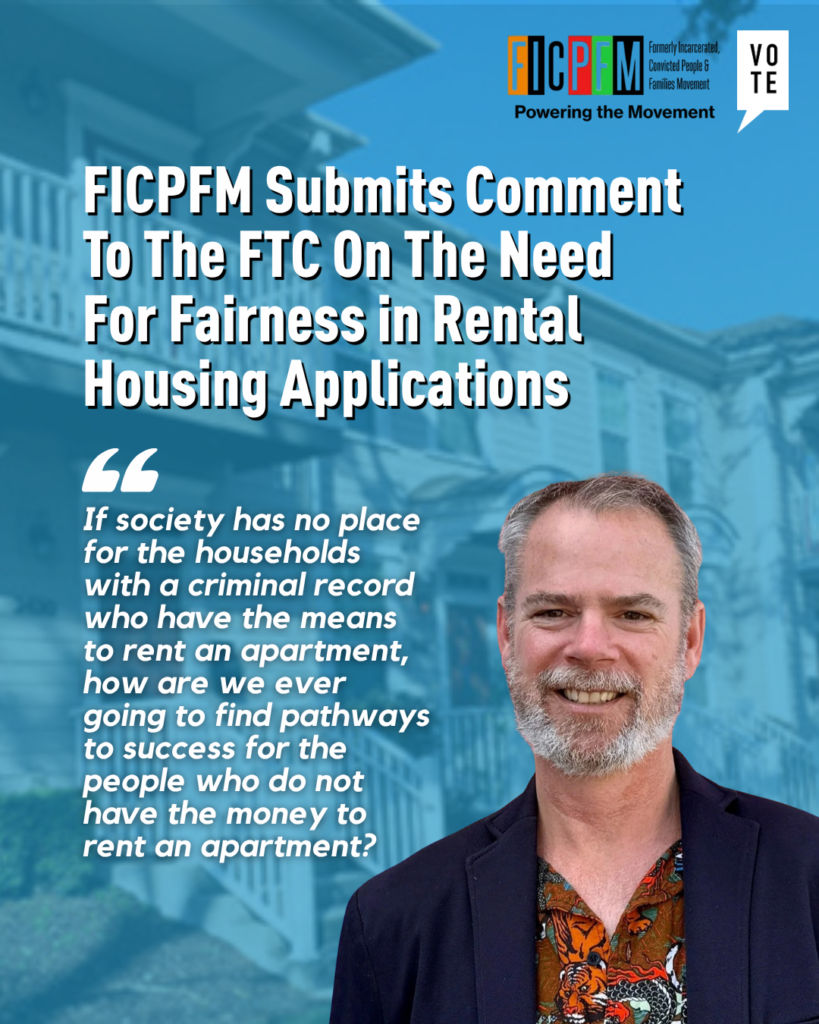
If society has no place for the households with a criminal record who have the means to rent an apartment, how are we ever going to find pathways to success for the people who do not have the money to rent an apartment?
If we cannot fairly regulate commercial activity through good public policy, we leave our citizens to either file litigation (which is only successful to the extent courts reinforce inclusive housing policy and constitutional fairness). Many people, particularly those with little means, do not have genuine access to the court system. This leaves citizens to exercise their 1st Amendment rights of assembly and peaceful protest, and/or to become a market force such as boycotts, picket lines, shaming and otherwise impacting the commerce of discriminatory, unfair, deceptive, and fraudulent actors.
We encourage you to take a deep dive into the issue of hiding the criteria behind a paywall, using application fees as a money-making scheme, and the computer programs that use background checks to deny people housing with no rational relationship between criminal activity and being good tenants.
If the Commission wishes to better understand our issues, or in any way collaborate on furthering fairness in the rental market, please reach out to Bruce Reilly, our lead on the Housing4All campaign.
Sincerely,
David Ayala, Executive Director
Formerly Incarcerated Convicted People & Families Movement (FICPFM)
David@FICPFM.org
Bruce Reilly
FICPFM #Housing4All
Voice of the Experienced (Louisiana)
Bruce@VoiceoftheExperienced.org